- Main
- News
- Young scientists from KazNU and their partners joined the global initiative City Nature Challenge to achieve the Sustainable Development Goals
Young scientists from KazNU and their partners joined the global initiative City Nature Challenge to achieve the Sustainable Development Goals
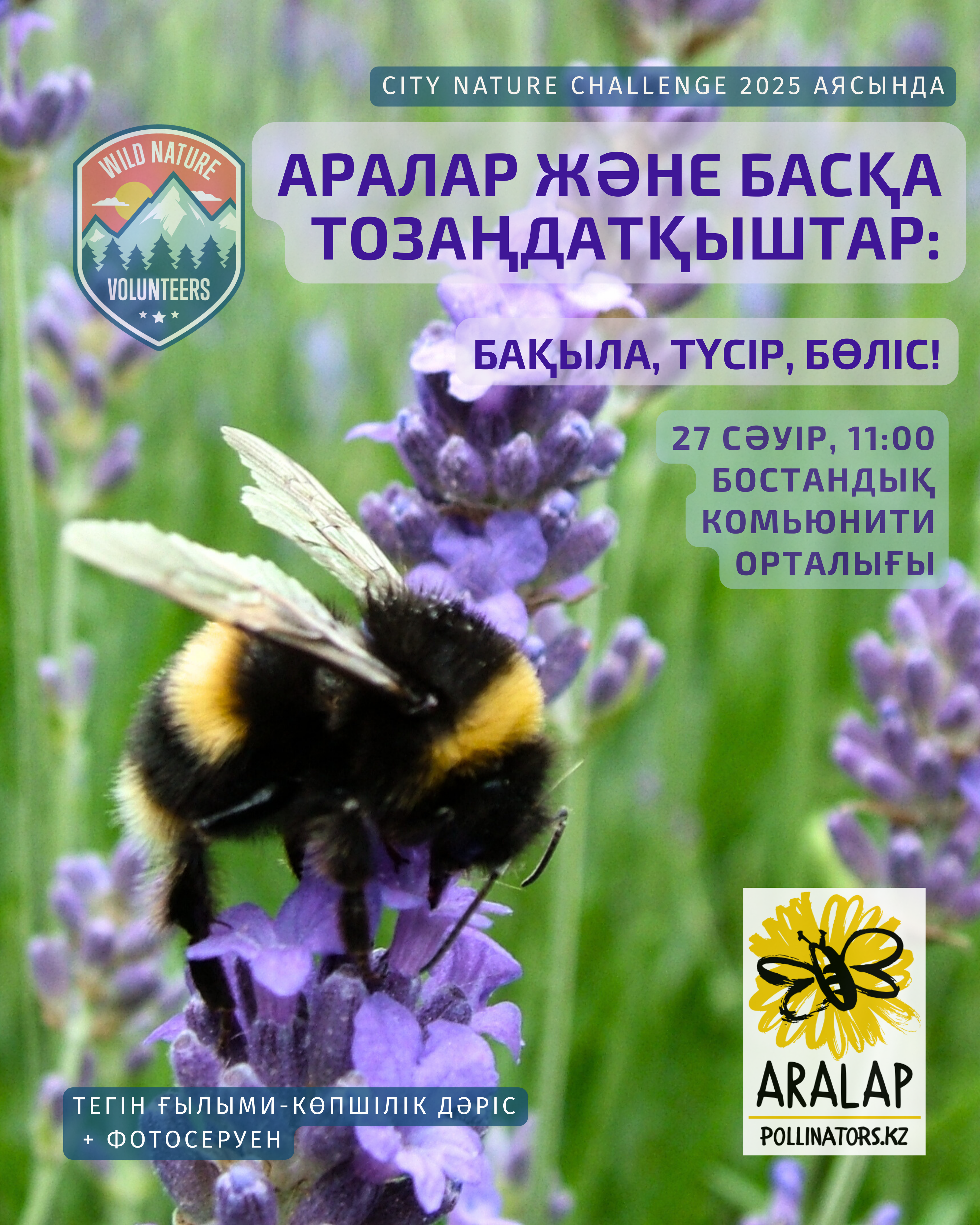
Kazakhstan on the world biodiversity map
Young scientists from al- Farabi Kazakh National University , along with colleagues from research institutes across the country, joined City Nature Challenge is a large-scale international initiative to document urban biodiversity that annually unites hundreds of cities around the world in a shared mission to study and conserve nature.
City Nature Challenge 2025, held from April 25 to 28, marked its 10th anniversary. This year, approximately 103,000 people from 669 cities in 62 countries across six continents participated in the global bioblitz , recording more than 3.3 million wildlife observations. Kazakhstani scientists and volunteers contributed to this impressive statistic by applying a cutting-edge international citizen science approach ( Citizen). Science ) to the study of domestic biodiversity.
From Rivalry to Cooperation: The History of City Nature Challenge
City Initiative Nature The Challenge was founded in 2016 by citizen science teams from the California Academy of Sciences and the Natural History Museum of Los Angeles County. What began as a friendly competition between San Francisco and Los Angeles quickly grew into an international movement, motivating people around the world to document wildlife in their cities.
Since 2020, due to the COVID -19 pandemic, organizers have shifted the focus from competition to collaboration, aiming to highlight the unifying power of nature and the importance of collective efforts to study biodiversity. Cities are now working together, sharing observations and experiences, creating a global database of urban nature.
Each year, participants try to answer three key questions:
· How many observations Can fix ?
· How many species Can discover ?
· How many people can be involved in the process?
iNaturalist Platform : Technology at the Service of Biodiversity
The key instrument of City Nature Challenge and other citizen science projects is iNaturalist , a revolutionary digital platform that combines a social network of naturalists with a powerful species identification system and a scientific repository of biological data.
What is iNaturalist ?
iNaturalist is an American nonprofit online platform founded in 2008 as a graduate project by graduate students at the University of California, Berkeley's School of Information. Today, it is a joint initiative of the California Academy of Sciences and the National Geographic Society, uniting millions of participants worldwide.
Main platform features:
Automatic species identification: The platform uses artificial intelligence trained on millions of crowdsourced identifications. Simply upload a photo of an organism, and the system will analyze the image pixels, suggesting possible species with impressive accuracy.
Community of Experts: Observations are reviewed and validated by a community of users, including professional scientists, expert naturalists, and nature enthusiasts. When more than two-thirds of the identifiers agree with the species identification, the observation is designated "research-grade" ( Research). Grade ).
Integration with scientific databases: Research-grade observations are automatically submitted to the Global Biodiversity Information Facility ( GBIF ), the largest international repository of species distribution data used by scientists worldwide.
Projects and Collaborations : Users can create thematic projects by combining observations based on geography, taxonomic groups, or research objectives.
Mobile apps: iOS and Android apps allow you to make observations even without an internet connection, automatically recording GPS coordinates and time.
Scale and Impact
As of August 2025, iNaturalist users had generated approximately 300 million observations of plants, animals, fungi, and other organisms worldwide, with 400,000 users active in the past month. The platform's data has served as the basis for over 4,000 scientific publications and is widely used by scientists, conservation organizations, and land managers to study biodiversity, monitor rare species, track invasive organisms, and understand the impact of climate change on ecosystems.
The platform has helped discover and rediscover dozens of species previously thought extinct, describe new species, and document the expansion of organisms' ranges in response to climate change.
Kazakhstan in the global biodiversity network
Kazakhstani scientists are actively using iNaturalist to document local flora and fauna. According to the "Biodiversity of Kazakhstan 2025" meeting held on February 20, 2025, at the Almaty Botanical Garden, the platform recorded 37,018 verified observations of 3,179 species in Kazakhstan in 2024—a 1.7-fold increase compared to the previous year.
A particularly significant achievement was the registration of more than 2,500 sightings of 139 species listed in the Red Data Book of Kazakhstan, which represents a significant contribution to scientific research and conservation efforts.
The event brought together biologists, zoologists, botanists, ecologists, and amateur naturalists who conduct wildlife photography. The organizers were the Institute of Botany and Phytointroduction , the Institute of Zoology, and the international expert group " Open " Conservation Biology Laboratory ", ASBK, National Committee of the UNESCO "Man and the Biosphere" program, Karaganda Regional Ecological Museum and other organizations.
The City Nature Challenge's contribution to achieving the UN Sustainable Development Goals
Participation of young scientists from KazNU and their colleagues from research institutes in City Nature The Challenge demonstrates how international scientific collaboration and citizen science directly contribute to the achievement of multiple Sustainable Development Goals:
SDG 1 (No Poverty): Studying urban biodiversity and ecosystem services helps us understand the role of nature in supporting the resilience of urban communities. Green spaces and biodiversity directly impact the quality of life, public health, and economic productivity of cities, creating the conditions for overcoming poverty.
SDG 2 (Zero Hunger): Documenting pollinators and other beneficial organisms in urban ecosystems helps understand their role in food security. Urban agriculture and greening depend on healthy populations of pollinators and other organisms.
SDG 4 (Quality Education): City Nature The Challenge is a powerful educational tool that engages schoolchildren, students, and the general public in real-world scientific activities. Participants develop observation skills, critical thinking, and technology use, and gain knowledge about the biodiversity of their region.
SDG 7 (Affordable and Clean Energy): Understanding the role of urban ecosystems in regulating climate and cleaning air and water helps inform decisions on sustainable urban planning that reduces dependence on fossil fuels and the need for energy-intensive air conditioning and cleaning technologies.
SDG 8 (Decent Work and Economic Growth): Developing citizen science creates new opportunities for young scientists and promotes ecotourism and green jobs. Biodiversity data is used for sustainable urban development and the creation of environmental jobs.
SDG 9 (Industry, Innovation and Infrastructure): City Nature The Challenge showcases the application of cutting-edge technologies—artificial intelligence for species identification, mobile apps for data collection, and cloud platforms for storing and analyzing information. These are examples of innovative scientific infrastructure for the 21st century.
SDG 10 (Reduced Inequalities): iNaturalist Platform and the City Project Nature The Challenge is open to everyone, regardless of education, profession, social status, or location. Residents of remote areas can contribute to science on par with professional researchers from major research centers. Free mobile technology makes science truly accessible.
SDG 11 (Sustainable Cities and Communities): Data collected within the City Nature Challenge helps urban planners and administrators make informed decisions about creating and preserving green spaces, parks, and wildlife corridors. Understanding the species that inhabit a city contributes to creating a more sustainable and comfortable urban environment.
SDG 13 (Climate Action): City Long-Term Data Nature Challenge is creating a framework for monitoring the impact of climate change on urban biodiversity. Scientists are tracking changes in phenology (flowering time, migration, and reproduction), species distribution, and the composition of urban ecosystems, which is critical for developing adaptation strategies.
SDG 15 (Life on Land): Although City Nature The Challenge focuses on urban areas; the data collected is important for understanding how urbanization impacts biodiversity, which species are able to adapt to urban conditions, and what measures are needed to conserve nature in anthropogenic landscapes. The data is used to monitor rare and endangered species.
SDG 17 (Partnership for Sustainable Development): City Nature The Challenge is the embodiment of a global partnership. The project unites scientific institutions (the California Academy of Sciences, the Natural History Museum of Los Angeles), technology platforms ( iNaturalist ), local communities, educational institutions, conservation organizations, and millions of citizens around the world to achieve a common goal: studying and preserving the planet's biodiversity.
Kazakhstani Citizen Science: A Look to the Future
Participation of young scientists from KazNU and colleagues from research institutes in City Nature Challenge 2025 has become an important step in the development of citizen science in Kazakhstan. By leveraging international experience and modern digital technologies, Kazakhstani researchers are creating the conditions for widespread citizen engagement in scientific endeavors.
Integration with global initiatives not only increases the visibility of Kazakhstan's biodiversity on the global stage but also facilitates the exchange of experiences, methodologies, and best practices among scientists from different countries. Data collected by Kazakhstani participants becomes part of the global biodiversity knowledge base and is used by researchers worldwide.
Young scientists from KazNU demonstrate that modern science must be open, inclusive, and technologically advanced. Citizen science transforms every person with a smartphone into a potential researcher, democratizes scientific knowledge, and makes achieving the Sustainable Development Goals a shared responsibility for society.
More information about the initiative of young scientists from KazNU and its partners can be found at the following links:
https :// www . instagram . com / aralap . kz /
https :// www . inaturalist . org / projects / aralap - project - pollinators - kz
http :// pollinators . kz /? utm _ source = ig & utm _ medium = social & utm _ content = link _ in _ bio & fbclid = PAZXh 0 bgNhZW 0 CMTEAc 3 J 0 YwZhcHBfaWQMMjU 2 MjgxMDQwNTU 4 AAGnjuHoMyCmX -0 KqaUlZh 4 gCfYdbc 6 VUejQoWLONDCaEVjWhAqu 23 B 1 S 7 TFcIo _ aem _4 uL 3 H 3 r 0 YSzfw 6 a 4 V 8 dAaQ
Join the City Nature Challenge 2026!
The next global bioblitz will take place in April 2026. Stay tuned . for updates on :
- Website: https://www.citynaturechallenge.org
- iNaturalist : https://www.inaturalist.org
- Instagram: #CityNatureChallenge2025
Download the iNaturalist app and start documenting biodiversity today!
Faculty of Biology and Biotechnology of al-Farabi Kazakh National University
Department of Botany and Agroecology
#SDG #SustainableDevelopment #THEImpact #KazNU #SDG_KazNU #SustainableKazNU #CityNatureChallenge #CityNatureChallenge2025 #iNaturalist #CitizenScience #BiodiversityKazakhstan #ЗелёныеГорода #Aralap #PollinatorsKZ #CitizenScience #SDG1 #NoPoverty #SDG2 #ZeroHunger #SDG4 #QualityEducation #SDG7 #CleanEnergy #SDG8 #DecentWork #SDG9 #IndustryInnovation #SDG10 #ReducedInequalities #SDG11 #SustainableCities #SDG13 #ClimateAction #SDG15 #LifeOnLand #SDG17 #PartnershipsForGoals #ГражданскаяНаука #ОпылителиКазахстана #БиоразнообразиеКазахстана