- Main
- News
- The Significance of Research Activities of KazNU’s Faculty of Biology and Biotechnology for Achieving SDG 1 (No Poverty)
The Significance of Research Activities of KazNU’s Faculty of Biology and Biotechnology for Achieving SDG 1 (No Poverty)
29 december, 2025
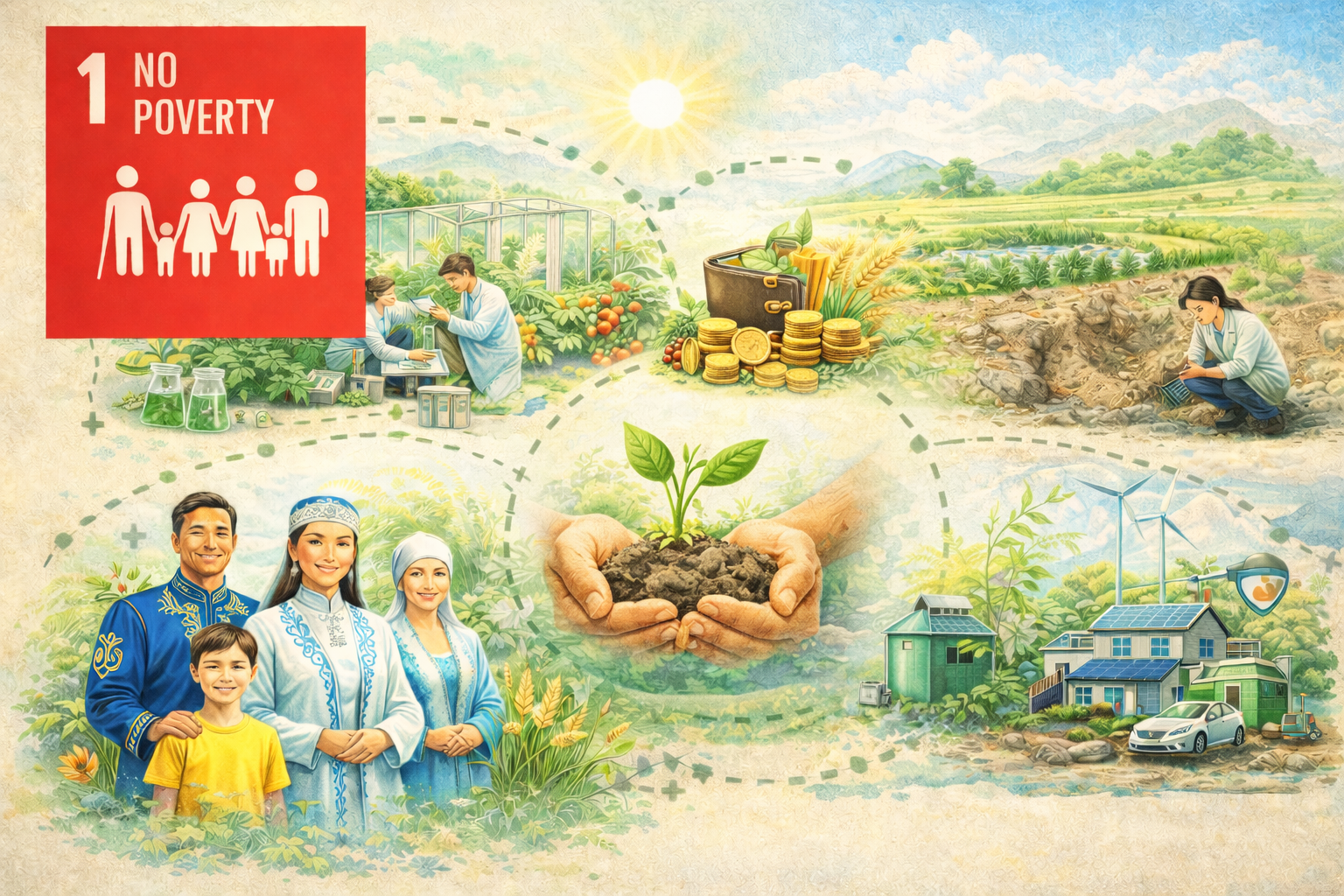
The Faculty of Biology and Biotechnology at Al- Farabi KazNU actively contributes to achieving Sustainable Development Goal 1 (SDG 1)—end poverty—through grant-funded research projects funded by the Ministry of Science and Higher Education of the Republic of Kazakhstan. The faculty's research is aimed at developing innovative biotechnologies that enhance agricultural productivity, improve food security, and create new opportunities for sustainable economic development.
Increasing agricultural productivity
A key area of work is the development of biopreparations for increasing agricultural yields . The project "Development of a Technology for Obtaining Biopreparations Based on Microalgae and Cyanobacteria Strains to Increase Crop Yields" led by F.K. Sarsekeyeva aims to create environmentally friendly alternatives to chemical fertilizers, thereby reducing farmers' production costs and increasing agricultural profitability.
A continuation of this direction was the new project "Application of cyanobacterial strains for the production of organic fertilizers and plant biostimulants in agriculture" (2025-2027) under the leadership of the same F.K. Sarsekeyeva , which emphasizes the continuity and development of promising research.
The project "Development of Agrobiological Foundations for Cultivating Perennial Rice to Increase Cropland Productivity in the Almaty and Kyzylorda Regions," led by Professor M.S. Kurmanbaeva , is of particular importance for regional food security. The introduction of perennial rice can significantly increase rural incomes by reducing annual sowing costs and increasing yields.
Plant protection and biosecurity
The project "Development of biotechnology for protecting agricultural crops from phytopathogens based on the use of microbial antagonists and their metabolites" (2025-2027) under the direction of E.V. Brazhnikova is aimed at creating biological plant protection products that will allow farmers to reduce crop losses and decrease dependence on expensive chemical pesticides.
An earlier project , "Isolation, genomic analysis, and study of the nematophagous activity of predatory fungi in Southern Kazakhstan to identify and select promising strains for the creation of bionematicides, " led by Professor K.K. Boguspaev , also contributes to the development of biological methods of plant protection.
Restoration of degraded lands
The project "Obtaining and Studying Algocyanobacterial Biofilms for the Restoration of Saline and Polluted Soils" led by M.O. Bauyenova aims to reclaim unproductive lands, thereby expanding agricultural opportunities and improving the well-being of the local population.
Similar goals are pursued by the project " Phytostrategy : restoration of hydrocarbon-contaminated soils in the Atyrau region using plants and bioinoculants " under the direction of R. Berzhanova , which promotes the return of lands contaminated with oil products into circulation.
The project "Development of a New Composite Compost Technology Using Cattle Manure and Low-Grade Coal for Sustainable Soil Fertility" led by Professor A.A. Zhubanova is creating an accessible technology for increasing soil fertility for farms.
Creation of alternative sources of income
The project "Biotechnology for the production of synbiotic functional chocolate with therapeutic and prophylactic effects" led by A.S. Kistaubaeva opens up opportunities for the development of high-value-added products, which could become a source of income for small and medium businesses.
The study, "Biotechnology for the production of biologically active peptides from mare's milk whey proteins," led by Associate Professor M.Kh. Narmuratova , contributes to the development of the processing industry and increased income for producers of traditional Kazakh products.
Energy security of rural areas
The project "Creation of environmentally and economically viable biofossil fuels based on the efficient co-combustion of coal residues and microalgae biomass" led by N.Sh. Akimbekov aims to create affordable energy sources for rural communities, thereby reducing household energy costs.
Thus, the research activities of the Faculty of Biology and Biotechnology at KazNU make a significant contribution to achieving SDG 1 through the development of biotechnological solutions that increase agricultural productivity, restore degraded lands, create new sources of income, and improve living conditions, especially in rural areas of Kazakhstan.
Faculty of Biology and Biotechnology of al-Farabi Kazakh National University