- Main
- News
- KazNU's Faculty of Biology and Biotechnology contribution to SDG 13 (Climate Action) implementation through R&D
KazNU's Faculty of Biology and Biotechnology contribution to SDG 13 (Climate Action) implementation through R&D
26 december, 2025
The Faculty of Biology and Biotechnology of the Al- Farabi Kazakh National University is implementing an integrated scientific research approach to combat climate change , contributing to the achievement of Sustainable Development Goal 13 (SDG 13 - Climate Action ) through the implementation of fundamental and applied R&D , financed through grant and program-targeted funding (AP, BR).
The Faculty's research activities cover key mechanisms for climate change mitigation and adaptation , including:
- atmospheric carbon sequestration ;
- development of low-carbon and biotechnological solutions ;
- restoration of degraded ecosystems ;
- adaptation of agriculture to climatic stresses;
- monitoring climate change and its environmental consequences .
1. Carbon sequestration and reduction of greenhouse gas concentrations
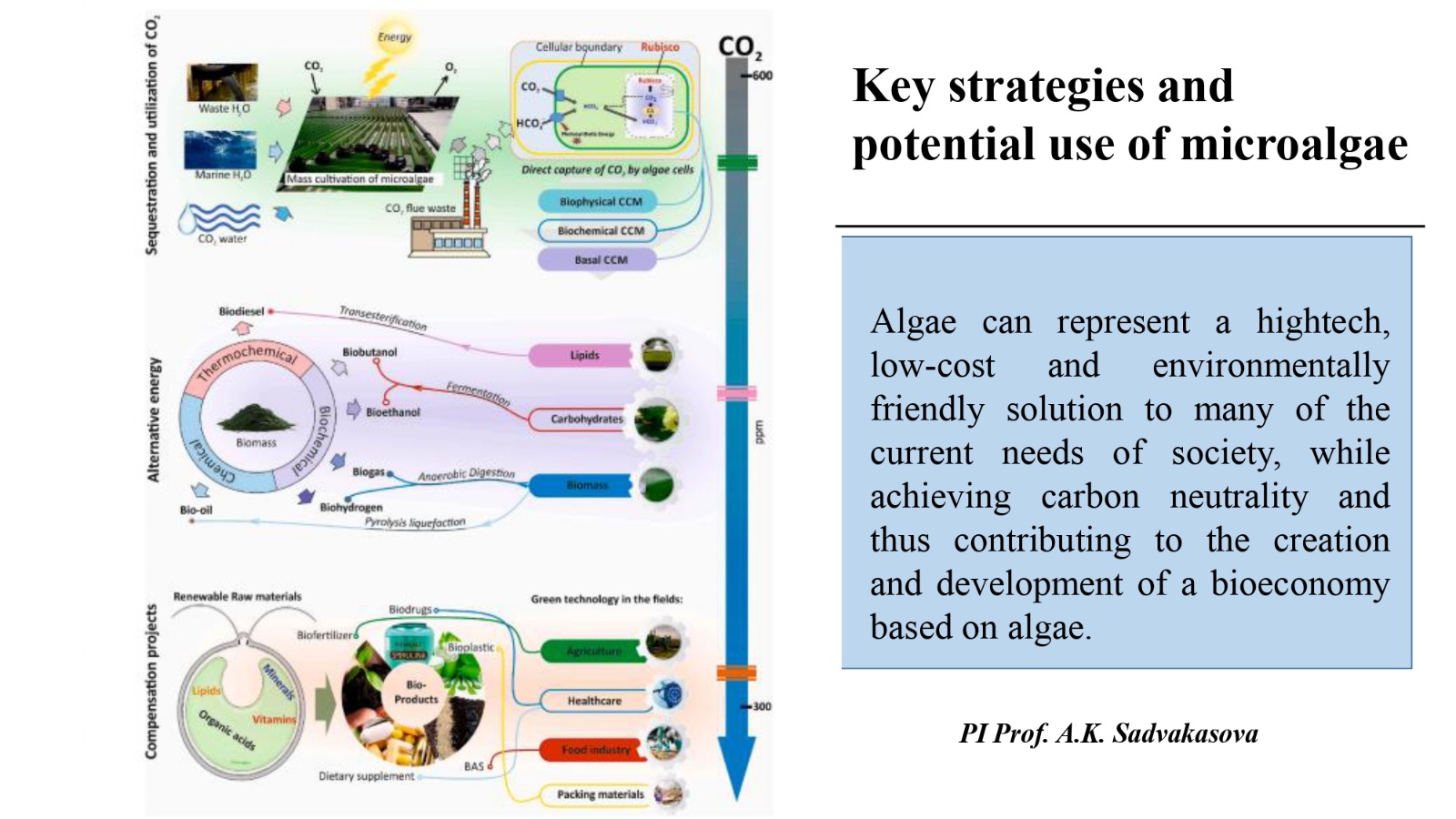
AP25794587 — "Development of a Biotechnology for Atmospheric Carbon Sequestration by Microalgae for Green Innovations." Supervisor: M. Kozhmakhmetov .
The project aims to develop biotechnological solutions for the biological sequestration of atmospheric CO₂ using microalgae. Photosynthetic microorganisms are viewed as an effective tool for reducing greenhouse gas concentrations and laying the foundations for a "green" economy, which directly aligns with SDG 13.2 .
BR24992833 — "Development of chemical and biochemical solutions for carbon footprint reduction and ecosystem restoration." Supervisor: A. Zhubanova .
The program-targeted project develops integrated approaches to reducing the carbon footprint , combining technological solutions and the restoration of ecosystems capable of long-term carbon accumulation .
2. Biochar and carbon farming
AP14973042 — “Development of a technology for creating biochar from biomass of bioenergy plants”
Supervisor : PhD Mamirova A.A.
The project is aimed at developing a technology for producing biochar , which ensures long -term carbon fixation in soils and simultaneously increases their fertility, which is a recognized tool for climate mitigation.
AP23491702 - "Development of decontamination technology "Biochar for the Sustainable Conversion of Biomass Waste into Value-Added Products"
The project complements the carbon farming approach by developing technologies for the sustainable use of biomass and stable carbon sequestration in agroecosystems . Scientific Director: PhD Mamirova A.A.
3. Adaptation of agriculture to climate change
AP23487566 - "Development of agrobiological principles for cultivating perennial rice to increase the productivity of arable land in the conditions of Almaty and Kyzylorda "Regions"
Supervisor : Professor M.S.
Kurmanbaeva . The project aims to develop climate-adapted agricultural technologies that reduce the carbon footprint of agriculture by reducing mechanical tillage and increasing the sustainability of agricultural systems . The new study is a continuation of project AP09259457, " Introduction of perennial wheat into agricultural cropping to preserve biodiversity and soil fertility in southern and southeastern Kazakhstan."
AP26196039 — "Cadmium Toxicity in Rice Plants and the Use of Physicochemical Methods to Enhance Resistance" (2025–2027 )
Supervisor : Professor S.D.
Atabaeva . The project studies the mechanisms of plant resistance to stress factors relevant in the context of climate change, including soil degradation and changes in water regime.
4. Restoration of degraded ecosystems and climate resilience
AP23489379 — “ Phytostrategy : restoration of hydrocarbon-contaminated soils in the Atyrau region using plants and bioinoculants ”
Supervisor : Berzhanova R.
The project is aimed at restoring the ecosystem functions of soils , including their ability to accumulate organic carbon .
AP22788030 — “Obtaining and studying algocyanobacterial biofilms for the restoration of saline and contaminated soils”
Supervisor : Bauyenova M.O.
Biotechnological methods for increasing the productivity of degraded lands and their climate resilience are being developed.
AP23488308 — “Study of the biotechnological potential of microalgae and cyanobacteria in the biodegradation of pesticides and increasing soil fertility.”
The project contributes to the restoration of soil biological activity and the increase of organic carbon reserves.
5. Monitoring climate change and vulnerable ecosystems
AP23486019 — “Comprehensive ecotoxicological assessment of high-mountain-glacial watersheds of the main rivers of the Northern Tien Shan.”
Supervisor : M.A. Suvorova.
The project studies the impact of climate change on mountain and glacial ecosystems , which play a key role in regulating water and carbon balance.
6. Alternative biomass sources and low-carbon biotechnologies
AP23485416 — “Creation of a biobank of a collection of microalgae and cyanobacteria and the study of their biotechnological potential”
Supervisor : Zayadan B.K.
The project forms the basis for the development of photosynthetic technologies for CO2 fixation and the production of sustainable biomass.
AP14870201 — “Search and study of new secondary metabolites of cyanobacteria for agricultural biotechnology”
Supervisor : PhD, Associate Professor N.R. Akmukhanova
7. Reduce chemical use and carbon footprint
AP13068051 — “Development of biopreparations based on microalgae and cyanobacteria to increase crop yields”
Supervisor : PhD Sarsekeyeva F.K.
AP26101745 — “Application of cyanobacterial strains for the production of organic fertilizers and plant biostimulants” (2025–2027 )
Supervisor : Associate Professor F.K. Sarsekeyeva.
AP14972916 — “Creation of an active consortium of microalgae and PGP bacteria as an alternative to chemical fertilizers”
Supervisor : Bauenova M.O.
AP19679444 — “Development of a prolonged-release biopreparation based on a polymer matrix with effective microorganisms”
Supervisor : Associate Professor L.V. Ignatova
8. Assessment of environmental risks in the context of climate change
AP14869740 - "Biotesting of water and bottom sediments of the Ili River and Kapchagay reservoirs"
Supervisor : Professor T.M. Shalakhmetova
AP19674623 — “Innovative multispatial approach to biomonitoring of saline ecosystems of Lake Alakol ”
Supervisor : Inelova Z.Z.
AP26100125 - "Study of genotoxicity and mutagenicity of microplastics in vivo » (2025–2027 )
Scientific Supervisor: Acting Associate Professor Lovinskaya A.V.
AP26101681 — “Study of the toxicogenetic effect of pesticides on biological objects” (2025–2027 )
Supervisor : Professor T.M. Shalakhmetova.
9. Integrated approach to climate solutions
The research activities of the Faculty of Biology and Biotechnology of KazNU in the field of combating climate change are characterized by a systems approach that combines:
- Mitigation : AP25794587, BR24992833, AP14973042 provide emission reduction and carbon sequestration
- Adaptation : AP23487566, AP26196039 improve agricultural sustainability
- Restoration : AP23489379, AP22788030, AP23488308 rehabilitate degraded ecosystems
- Monitoring : AP23486019, AP14869740, AP19674623 assess climate change
Innovations : AP13068051, AP26101745, AP14972916, AP19679444 develop low-carbon technologies
10. Contribution to national climate goals
The projects being implemented directly support Kazakhstan's national commitments under the Paris Agreement and contribute to achieving carbon neutrality by 2060. The technologies developed can be implemented in the country's agriculture, industry, and environmental protection sectors.
Conclusion
Thus, the research activities of the Faculty of Biology and Biotechnology of KazNU represent an integrated system of climate R&D , covering carbon sequestration, ecosystem restoration, low-carbon agriculture, climate change monitoring and biotechnological alternatives to chemical technologies.
The projects being implemented make a demonstrable contribution to the achievement of SDG 13 and also synergistically support SDG 7 and SDG 12 , facilitating Kazakhstan’s transition to a sustainable, low-carbon, circular economy.
Faculty of Biology and Biotechnology of al-Farabi Kazakh National University