- Main
- AL-FARABI NEWS LETTERS
- Al-Farabi Kazakh National University Scientists Launch Project to Convert CO₂ into Valuable Chemicals and Fuels
Al-Farabi Kazakh National University Scientists Launch Project to Convert CO₂ into Valuable Chemicals and Fuels
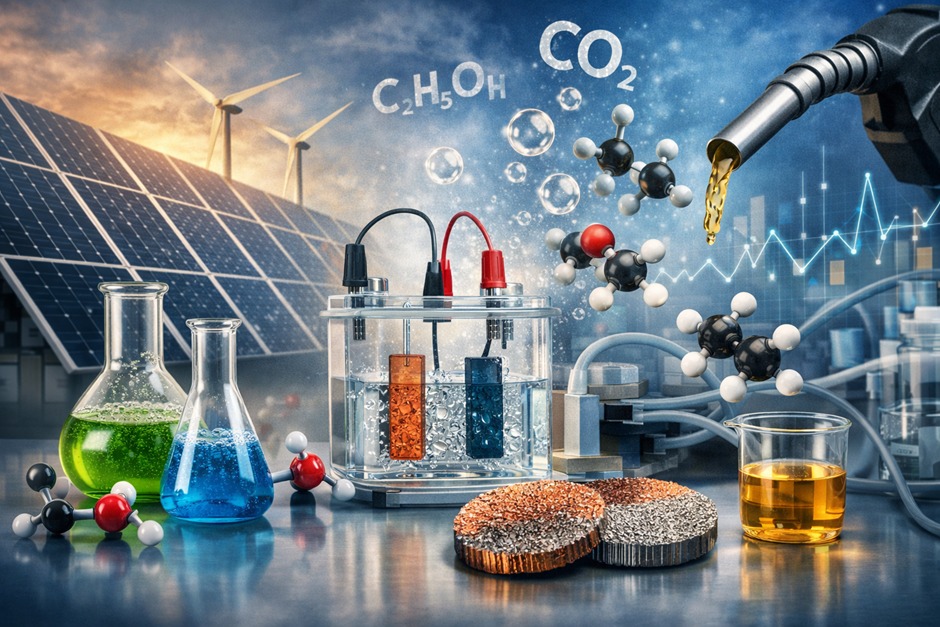
In the context of modern environmental challenges, reducing carbon dioxide emissions has become a strategic priority for global science and industry. The increasing consumption of fossil fuels contributes to the accumulation of CO₂ in the atmosphere, intensifying climate risks and driving the search for innovative technological solutions. In this regard, research on electrochemical CO₂ conversion into valuable chemical products is highly relevant. This study is conducted by scientists of the Al-Farabi Kazakh National University, contributing to the development of national scientific expertise in catalytic chemistry and environmental technologies.
The project focuses on investigating the mechanisms of electrochemical CO₂ reduction using copper-indium bimetallic catalysts. Electrochemical carbon dioxide reduction represents a promising approach to building a sustainable energy economy by transforming greenhouse gases into chemical feedstocks and fuel components. Special attention is given to C2+ products, including hydrocarbons and oxygenates, which possess high energy density and broad industrial applicability.
One of the key research directions is the development of nanostructured catalytic materials. Controlling nanoparticle size, morphology, and chemical composition allows significant improvement in reaction selectivity and catalytic performance. Copper is used as the primary catalytic component due to its economic accessibility and unique ability to participate in CO₂ reduction reactions. However, the practical use of copper catalysts is limited by competing hydrogen evolution reactions. The addition of indium helps suppress hydrogen formation and enhances overall catalytic efficiency.
The scientific novelty of the project lies in the comprehensive study of electrochemical nucleation kinetics of bimetallic alloys in deep eutectic solvent environments. The electrolyte system is based on choline chloride and ethylene glycol, which are characterized by environmental safety, low toxicity, and technological accessibility. Particular attention is given to understanding the relationship between particle nucleation kinetics and the morphology of deposited catalytic structures.
The research methodology is interdisciplinary, integrating electrochemistry, analytical chemistry, mathematical modeling, and materials science. Electrochemical impedance spectroscopy, chronoamperometry, and voltammetric methods are applied to analyze kinetic processes. Numerical simulation using COMSOL Multiphysics is also employed to study electric field distribution, mass transport mechanisms, and catalytic reaction dynamics.
The experimental work includes structural characterization of nanocatalysts using modern microscopy techniques such as scanning electron microscopy and transmission electron microscopy. The obtained data are further analyzed using gas chromatography and high-performance liquid chromatography to quantify products formed during CO₂ electrochemical reduction.
An important component of the project is the evaluation of catalyst performance under conditions close to industrial operation. Particular emphasis is placed on increasing reaction current density and improving product yield. The project aims to develop technological approaches that ensure catalyst stability during long-term operation.
The practical significance of the project is associated with potential applications in the chemical and energy industries. Technologies for converting CO₂ into hydrocarbon compounds may support the development of environmentally friendly fuel markets and contribute to reducing carbon emissions. The research outcomes are expected to be useful for both scientific and industrial implementation.
The project also contributes to academic development and human resource training. Publication of research results in international peer-reviewed journals indexed in Scopus and Web of Science is planned. Special attention is given to supporting young researchers and strengthening scientific teams.
Intellectual property protection will be carried out in accordance with international academic standards. Research outcomes will be protected through joint authorship of scientific publications and appropriate legal protection of technological developments.
Overall, the project aims to advance innovative environmental technologies, improve electrochemical catalytic efficiency, and establish a scientific foundation for sustainable carbon resource utilization. The study contributes to strengthening national scientific capacity and promoting modern directions in energy chemistry.
Other news