- Main
- AL-FARABI NEWS LETTERS
- Al-Farabi Kazakh National University Launches Unique Air Pollution Study in Almaty
Al-Farabi Kazakh National University Launches Unique Air Pollution Study in Almaty
Air quality in major cities of Kazakhstan remains one of the most important environmental challenges of modern society. Rapid urbanization, increasing traffic emissions, and the use of coal for heating during winter contribute to elevated concentrations of fine particulate matter in the atmosphere. Among these pollutants, PM2.5 particles — airborne particles with a diameter smaller than 2.5 micrometers — are considered particularly dangerous for human health.
This scientific research is being carried out by researchers from the Kazakh National University named after al-Farabi. The project is focused on the comprehensive assessment of environmental risks associated with atmospheric pollution in the city of Almaty. Scientists are applying modern analytical techniques to study the chemical, morphological, and biological characteristics of airborne particles.
PM2.5 particles can penetrate deeply into the human respiratory system. Due to their small size, they can reach the alveolar regions of the lungs and enter the bloodstream. Toxic substances such as heavy metals and polycyclic aromatic hydrocarbons (PAHs) are often adsorbed on the surface of these particles. Many PAHs are known for their carcinogenic and biologically active properties.
A key component of the project is the chemical composition analysis of PM2.5 particles. The concentrations of polycyclic aromatic hydrocarbons are determined using gas chromatography–mass spectrometry. This method allows researchers to examine seasonal variations in air pollution levels and identify major emission sources.
The study of carcinogenic compounds is essential for assessing public health risks. Polycyclic aromatic hydrocarbons, including benzo[a]pyrene, belong to substances with high biological activity. Elevated concentrations of such compounds may increase the probability of cancer development and other chronic diseases.
Source identification of atmospheric pollution is performed using diagnostic concentration ratios of individual PAHs. This approach helps determine the contribution of traffic emissions, coal combustion, biomass burning, and industrial activities to air pollution in Almaty.
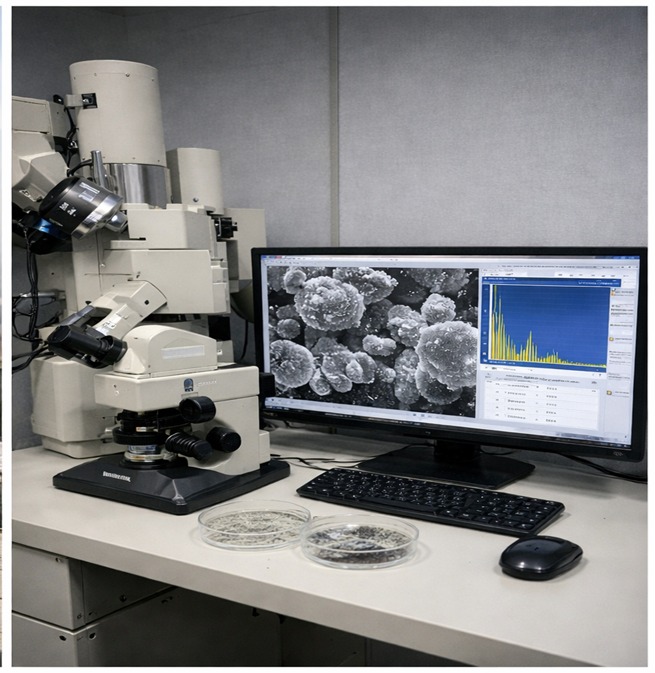
Another important aspect of the project is the morphological characterization of PM2.5 particles. Scanning electron microscopy combined with energy-dispersive X-ray spectroscopy is used to determine particle shape, size distribution, and elemental composition. This method enables accurate identification of pollution sources.
In addition, the oxidative potential (OP) of PM2.5 particles is investigated. Oxidative potential is an indicator of the ability of particles to generate reactive oxygen species in the human body. High oxidative potential is associated with inflammatory responses, respiratory diseases, and cardiovascular disorders.
The scientific novelty of the project lies in the fact that it represents one of the first comprehensive studies in Kazakhstan analyzing chemical composition, morphology, and oxidative potential of PM2.5 particles simultaneously. The obtained results will help improve understanding of the mechanisms of air pollution impact on human health.
The practical significance of the research is associated with the development of scientifically grounded recommendations for air quality improvement. The results can be applied to environmental monitoring systems, pollution control strategies, and national environmental policy development.
The project follows international scientific standards. Research findings are planned to be published in peer-reviewed scientific journals. The project also supports the training of young researchers and students, contributing to the development of scientific human resources.
Studying atmospheric air quality in Almaty is important for sustainable regional development. The scientific data obtained will help improve environmental monitoring efficiency, reduce ecological risks, and enhance environmental protection measures.
Overall, the comprehensive investigation of physical-chemical and biological characteristics of PM2.5 particles represents an important contribution to environmental science development in Kazakhstan and provides a scientific basis for improving air quality.
Other news