- Main
- AL-FARABI NEWS LETTERS
- KazNU Scientists Study a Nanosatellite-Based LoRaWAN Communication System
KazNU Scientists Study a Nanosatellite-Based LoRaWAN Communication System

The rapid development of information and communication technologies requires advanced communication systems capable of operating in challenging environments. One of the promising research directions is the expansion of Internet of Things (IoT) technologies for reliable data transmission in remote and hard-to-access regions. In this context, scientific research is being conducted at the Kazakh National University named after al-Farabi, where scientists are working on the development of modern space communication technologies.
The project is focused on studying the feasibility of installing a LoRaWAN base station on board a nanosatellite to create an energy-efficient and scalable data transmission system. LoRaWAN technology is characterized by low power consumption and the ability to transmit data over long distances, making it a promising solution for collecting small volumes of information from IoT devices. The research analyzes signal stability of LoRaWAN in low Earth orbit (LEO), energy consumption parameters, and communication characteristics.
One of the key objectives of the project is the development of the onboard communication system architecture for nanosatellites. For this purpose, LoRa modules, microcontrollers, and electronic components adapted for satellite platforms are selected. During the development of the experimental model, CubeSat platform standards are considered. The study also examines system resistance to vibration loads, temperature fluctuations, and electromagnetic interference.
The research methodology combines experimental and analytical approaches. The first stage involves theoretical analysis of LoRaWAN application in space environments. Subsequently, an experimental system model is developed, followed by laboratory testing. The main evaluation parameters include data transmission speed, signal loss rate, and communication stability.
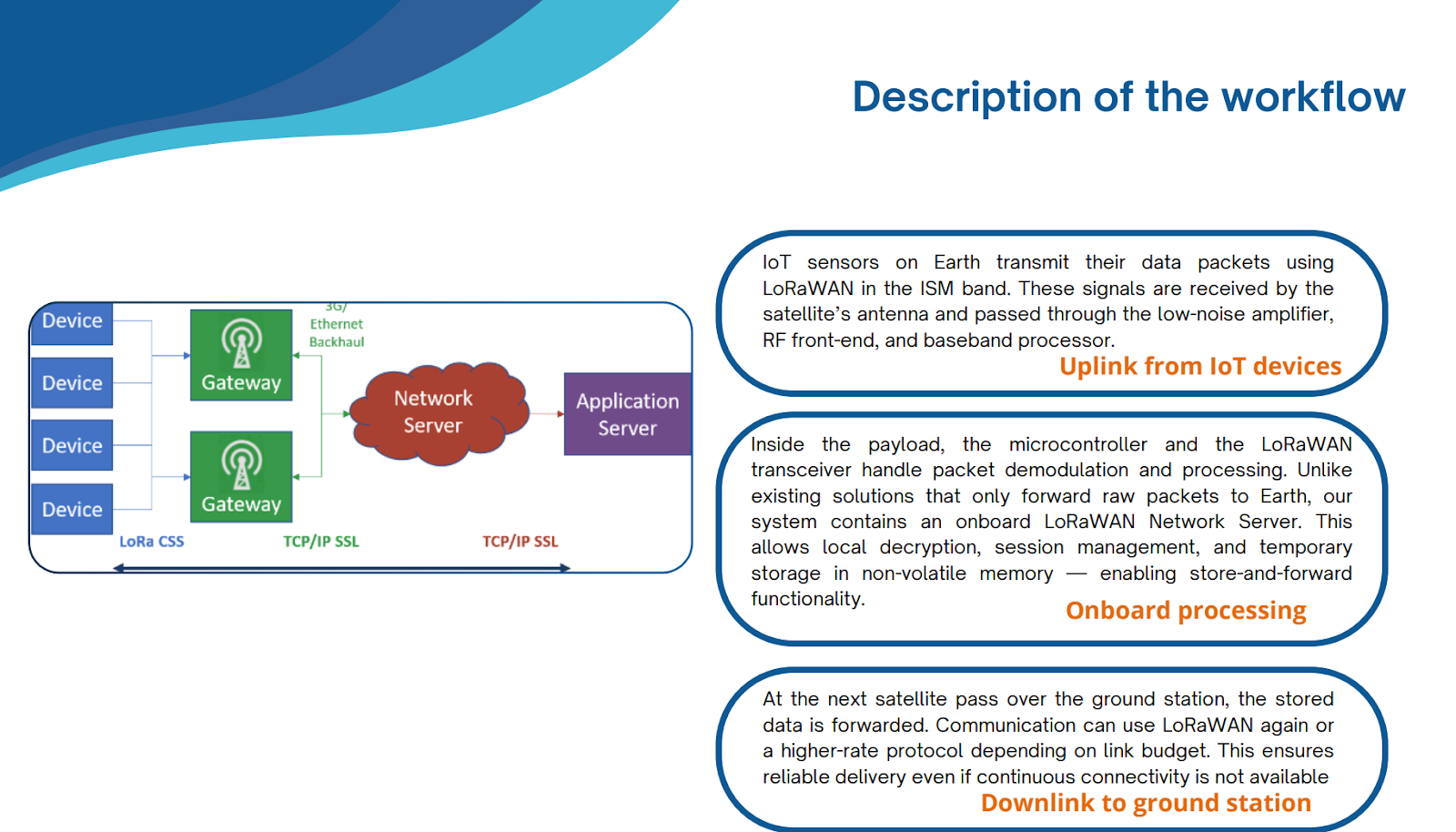
The project consists of four main tasks. The first task investigates the applicability of LoRaWAN technology in low Earth orbit communication. Signal stability, communication range, and energy consumption characteristics are analyzed, forming the scientific foundation for satellite communication system design.
The second task focuses on developing the onboard communication system concept. LoRa transceivers suitable for integration into satellite platforms are selected, and communication architecture is designed. This stage is essential for creating an experimental prototype.
The third stage involves assembling an experimental prototype of the LoRaWAN base station. The initial technology readiness level (TRL) of the project is TRL 3, and upon completion, the project aims to achieve TRL 6, which corresponds to prototype demonstration under near-real operational conditions.
The fourth stage includes laboratory testing of the prototype system. The resistance of the system to vibration impacts, extreme temperatures, and electromagnetic disturbances is evaluated. Additionally, data transmission quality and system functionality are assessed.
The scientific novelty of the project lies in the investigation of LoRaWAN technology application in space communication systems. Currently, most studies focus on terrestrial IoT networks. This project aims to adapt the LoRaWAN standard for nanosatellite platform usage.
Global practice demonstrates the development of satellite IoT solutions by companies such as Swarm and Lacuna Space; however, many existing systems rely on proprietary communication protocols. In contrast, this project focuses on applying standardized LoRaWAN technology for space applications. The research is conducted within the scientific activities of the Kazakh National University named after al-Farabi, contributing to the development of the national scientific school in space technologies.
The project has significant socio-economic importance. The development of nanosatellite communication systems opens new opportunities for agricultural monitoring, environmental control, and industrial data management. Considering the vast territory of Kazakhstan, such technologies may contribute to the development of communication infrastructure in remote regions.
The research results can be applied at both national and international levels. The project contributes to strengthening Kazakhstan’s scientific and technological potential and promotes international cooperation in space technology research. The findings may also stimulate the development of the IoT industry and the creation of new technological products.
To protect intellectual property, patenting of technological solutions and publication of scientific results are planned. Copyright protection will apply to scientific publications and technological developments. Patent protection mechanisms will ensure the possibility of commercialization of research outcomes.
Overall, the project aims to advance space communication technologies, develop energy-efficient communication systems, and enhance the scientific and technological potential of Kazakhstan. The research results will provide a scientific foundation for the future development of satellite-based IoT networks.
Other news