- Main
- AL-FARABI NEWS LETTERS
- Development of Environmentally and Economically Efficient Technologies for Metallurgical Waste Processing
Development of Environmentally and Economically Efficient Technologies for Metallurgical Waste Processing
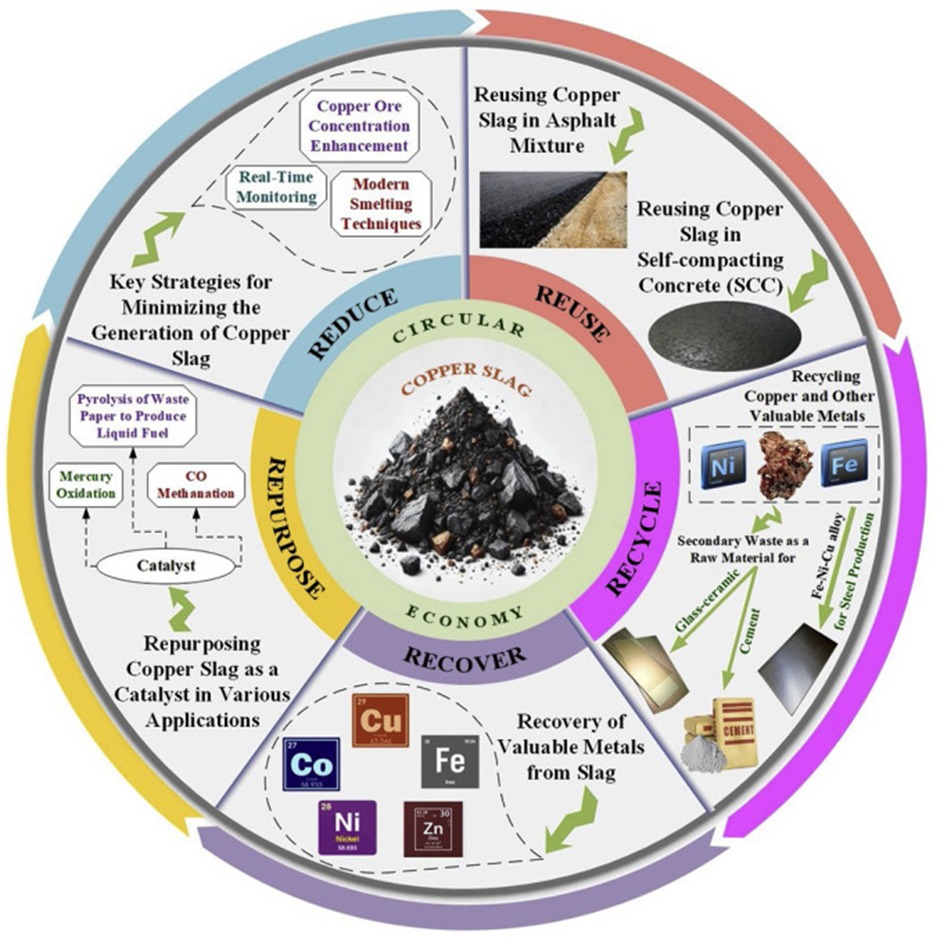
In the context of rapid industrial development, reducing the technogenic impact on the environment has become an increasingly important scientific and technological challenge. Around the world, research is being conducted to ensure efficient utilization of metallurgical waste, extraction of valuable components, and creation of environmentally safe processing technologies. One of such research directions is being implemented at the scientific environment of the Kazakh National University named after al-Farabi, where scientists are working on a comprehensive solution for metallurgical slag recycling.
Metallurgical slag is a by-product of non-ferrous metallurgy and may contain valuable metals such as copper and silver, as well as elements that can negatively affect the environment. Long-term accumulation of slag in storage sites leads to degradation of land resources, soil contamination, and disturbance of water ecosystems. Therefore, slag recycling has become an important scientific task combining economic efficiency and environmental sustainability.
The main objective of the program is to develop innovative and environmentally safe technologies for metallurgical slag processing that enable efficient extraction of copper and silver while allowing the remaining materials to be used in construction and road engineering. This direction is consistent with the principles of resource efficiency and the concept of the green economy.
The research is based on a comprehensive scientific approach. At the first stage, physicochemical analysis of dispersed and historically accumulated metallurgical slag is conducted. Modern analytical methods such as spectroscopy, X-ray phase analysis, and scanning electron microscopy are used to study structural features of materials. Such analysis makes it possible to determine the mineralogical form of valuable metal distribution and select optimal processing methods.
Mechanical preparation of slag is an important step. Massive historical slag formations are subjected to crushing and homogenization. Optimization of the grinding process ensures achievement of a rational particle size, which significantly increases the efficiency of flotation and leaching processes. Research shows that when particle size is reduced to below 100 micrometers, copper recovery efficiency increases considerably.
The program includes improvement of hydrometallurgical and flotation processing methods. For leaching processes, selective solvents are proposed. Solvometallurgical technologies based on organic solvents help reduce water consumption, minimize wastewater formation, and improve process selectivity. Additionally, optimization of sorption and desorption processes is planned for effective separation of copper and silver.
Special attention is given to flotation technology development. New flotation reagents based on xanthates and thiophosphates are planned to be synthesized. Combined reagent systems can modify mineral hydrophobic properties and improve extraction efficiency of valuable metals. Laboratory experiments focus on optimizing pH level, temperature, and reagent dosage.
As a result of program implementation, metallurgical waste can be used in construction material production. Slag residues can be applied in concrete and geopolymer composites. Such materials demonstrate high mechanical strength, wear resistance, and long-term durability. Furthermore, using industrial waste in construction contributes to reducing carbon dioxide emissions.
Environmental safety is a key component of the research program. During processing operations, potential atmospheric emissions, toxicity of chemical reagents, and long-term environmental effects of processed materials are evaluated. Methods such as life cycle assessment, leaching tests, and biotesting are applied to ensure technological safety.
Economic efficiency analysis is another important research direction. Slag recycling can reduce production costs, generate additional income from metal sales, and decrease environmental penalty expenses. To increase investment attractiveness, technology scaling strategies are being developed.
Compared with international practice, the proposed technology is characterized by a comprehensive approach. In many countries, slag is mainly used in the construction industry, while this program focuses on selective extraction of valuable metals. This approach contributes to the scientific and technological development of the metallurgical sector of Kazakhstan.
The research also supports human resource development in science. The project involves doctoral students, master’s students, and young researchers who gain experience in modern analytical and technological methods. This contributes to the development of the national scientific school.
In conclusion, the development of innovative metallurgical slag processing technologies is an important direction of modern science and industry. The research results will help ensure environmentally safe production, efficient resource utilization, and development of high-tech materials. Studies conducted by scientists of the Kazakh National University named after al-Farabi represent a significant contribution to the enhancement of the country’s scientific and technological potential.
Other news