- Main
- News
- “Artificial Intelligence: Opportunities and Future” - SDG № 9 – Industry, Innovation and Infrastructure.
“Artificial Intelligence: Opportunities and Future” - SDG № 9 – Industry, Innovation and Infrastructure.
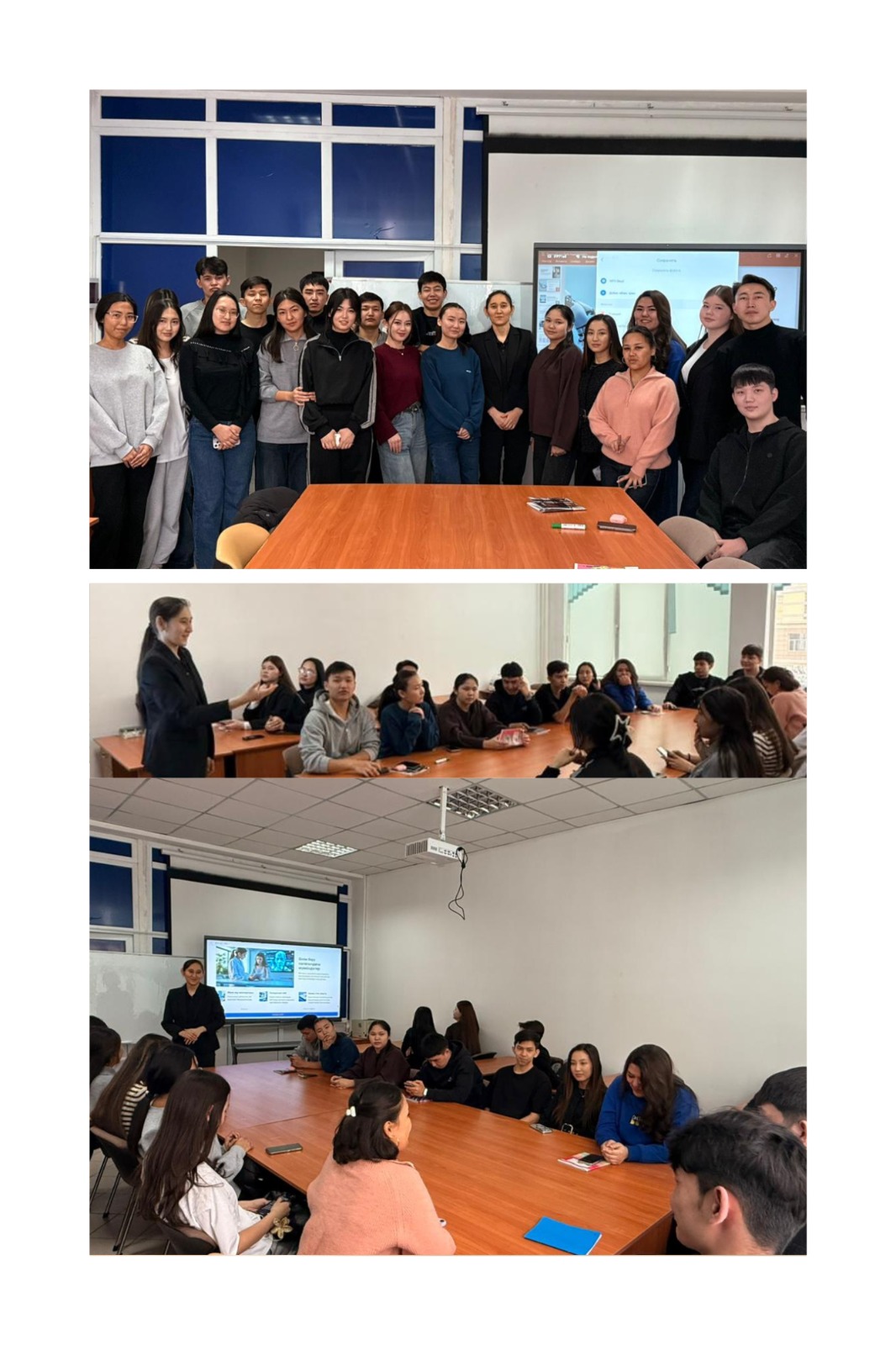
At the Al-Farabi Kazakh National University Faculty of Physics and Technology, a curatorial session was held with students of the educational program “6B05305 – Physics and Nanotechnology”, focusing on the principles of artificial intelligence and its impact on modern society. The meeting was organized by the group advisor and Acting Associate Professor, PhD A.B. Tazhen. The event formed part of the faculty’s educational and mentoring activities aimed at expanding students’ understanding of contemporary scientific and technological developments and strengthening their academic worldview.
The primary objective of the curatorial session was to introduce students to the fundamental principles underlying artificial intelligence systems, to discuss their growing role in science, technology, and the economy, and to promote responsible and ethical use of digital technologies. During the session, participants examined key areas of AI application, including big data analysis, machine learning, automation of scientific and industrial processes, and intelligent decision-support systems.
Particular attention was devoted to the opportunities presented by artificial intelligence technologies in the field of education. Students discussed how modern digital tools can be applied to personalize learning, analyze educational data, develop intelligent learning platforms, and enhance the efficiency of scientific research. At the same time, important issues related to data security, protection of personal information, and the principles of academic integrity in the use of digital technologies and AI tools were carefully examined.
During the discussion, special emphasis was placed on the importance of critical thinking when working with modern digital technologies. Participants noted that the use of artificial intelligence must be accompanied by a responsible approach to information sources, adherence to ethical standards, and awareness of potential risks associated with misinformation, misuse of digital content, or violations of intellectual property rights.
The session also addressed the state policy of the Republic of Kazakhstan in the field of digital transformation and artificial intelligence development. The President of the Republic of Kazakhstan, Kassym-Jomart Tokayev, recently emphasized during a roundtable discussion that the development of digital technologies and the integration of artificial intelligence are strategic factors in enhancing the country’s global competitiveness. In this context, Kazakhstan is implementing a number of national initiatives aimed at advancing the digital economy, supporting innovation, and training highly qualified specialists in information technologies and engineering sciences.
Students actively participated in the discussion, asking questions about the prospects of applying artificial intelligence in scientific research, industry, and education. Of particular interest were discussions on the integration of AI technologies in the fields of physics, nanotechnology, and materials science, as well as their potential for modeling complex physical processes and analyzing experimental data.
Holding such curatorial sessions contributes to the development of students’ comprehensive understanding of modern scientific and technological processes, fosters responsible attitudes toward digital technologies, and enhances their academic culture. Moreover, discussions of national development strategies help cultivate civic responsibility among students and deepen their understanding of the role of science and technology in the sustainable development of society.
The event also aligns with the implementation of the United Nations Sustainable Development Goals (SDGs). In particular, discussions of innovative technologies and digital transformation directly contribute to SDG 9 — Industry, Innovation and Infrastructure, which focuses on strengthening scientific and technological capacity, promoting innovation, and developing knowledge-based infrastructure. Consequently, educational initiatives of this kind support the preparation of a new generation of specialists capable of actively contributing to the development of Kazakhstan’s innovation-driven economy and digital future.