- Main
- AL-FARABI NEWS LETTERS
- Numerical Modeling of Magnetosphere–Solar Wind Plasma Interaction: Research Conducted by Scientists of Al-Farabi Kazakh National University
Numerical Modeling of Magnetosphere–Solar Wind Plasma Interaction: Research Conducted by Scientists of Al-Farabi Kazakh National University
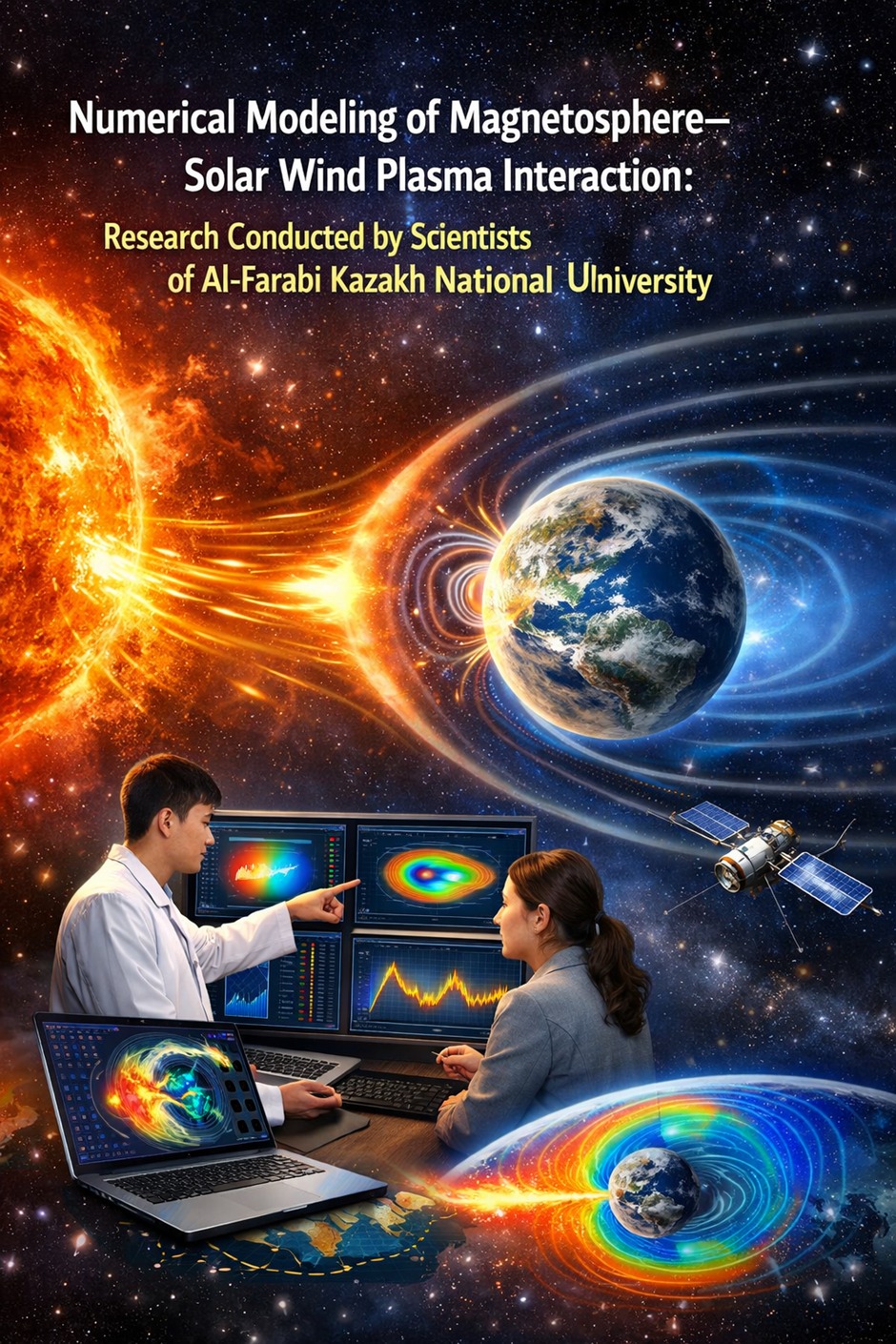
The rapid development of modern science provides new opportunities for studying space physics and near-Earth space. Changes in solar activity, coronal mass ejections, and solar wind dynamics significantly influence the Earth’s magnetospheric environment. Research in this field is important for forecasting space weather, ensuring radiation safety, and understanding the physical nature of geomagnetic phenomena.
The scientific project implemented by researchers of Al-Farabi Kazakh National University is aimed at studying the interaction between the Earth’s magnetosphere and solar wind plasma using numerical simulation methods. The main objective of the project is to develop an imitation model capable of predicting geomagnetic field dynamics under the influence of different types of solar coronal mass ejections.
Currently, semi-empirical models are widely used in space weather forecasting. Although these models have been developed over several decades and provide high prediction accuracy, they have limited capacity for revealing the underlying physical mechanisms of space processes. Therefore, this study focuses on constructing a model based on the description of real physical interactions.
The project considers the dynamics of proton and electron потоков that form the solar wind plasma. Coronal mass ejections generated on the solar surface produce plasma clouds with different velocity and density characteristics. When reaching the Earth’s magnetosphere, these plasma structures can distort the magnetic field configuration and trigger geomagnetic storms.
The scientific novelty of the project lies in the possibility of conducting comprehensive numerical studies of radiation belt dynamics under various solar activity scenarios. The obtained results will help deepen the understanding of charged particle motion mechanisms in near-Earth space.
Modeling is based on the particle-in-cell method, which allows simulation of charged particle motion in interaction with electromagnetic fields. Computational experiments are performed in a three-dimensional space covering regions from 10 to 100 Earth radii.
To systematize solar wind parameters, data from international space observatories are used. Information obtained from spacecraft such as ACE, SOHO, and SDO helps to construct typical dynamic profiles of coronal mass ejections.
The practical significance of the project lies in the potential application of the developed model in space weather prediction systems. This contributes to strengthening the scientific and technological potential of Kazakhstan in the field of space research.
During the research, daily variations of the geomagnetic field, particle density dynamics in radiation belts, and processes associated with solar activity are analyzed. Special attention is given to the formation of magnetospheric shock waves, charged particle transport in polar regions, and electric field gradients.
The project results have international scientific importance. It is planned to publish several papers in peer-reviewed journals indexed in Web of Science and Scopus databases.
The project is carried out by scientific researchers of Al-Farabi Kazakh National University and contributes to the training of young scientific specialists. The research also supports the preparation and defense of a PhD dissertation.
The research period covers 2025–2027. During the three-year project implementation, step-by-step verification of model accuracy will be conducted using high-performance computing systems.
The socio-economic significance of the project is associated with the possibility of forecasting geomagnetic phenomena that may affect energy systems, communication lines, and space technologies. Scientifically justified models help reduce potential risks associated with high solar activity.
The project is aimed at developing space physics research in Kazakhstan, expanding international scientific cooperation, and implementing modern computational technologies.
Overall, this research contributes to forming a new level of understanding of near-Earth space physics, deepening knowledge of solar-terrestrial interactions, and strengthening the international scientific reputation of Kazakhstani science.
Other news