
- Main
- AL-FARABI NEWS LETTERS
- Phase-Transition Thin Films of Indium Selenide – A New Direction in Scientific Research at KazNU
Phase-Transition Thin Films of Indium Selenide – A New Direction in Scientific Research at KazNU
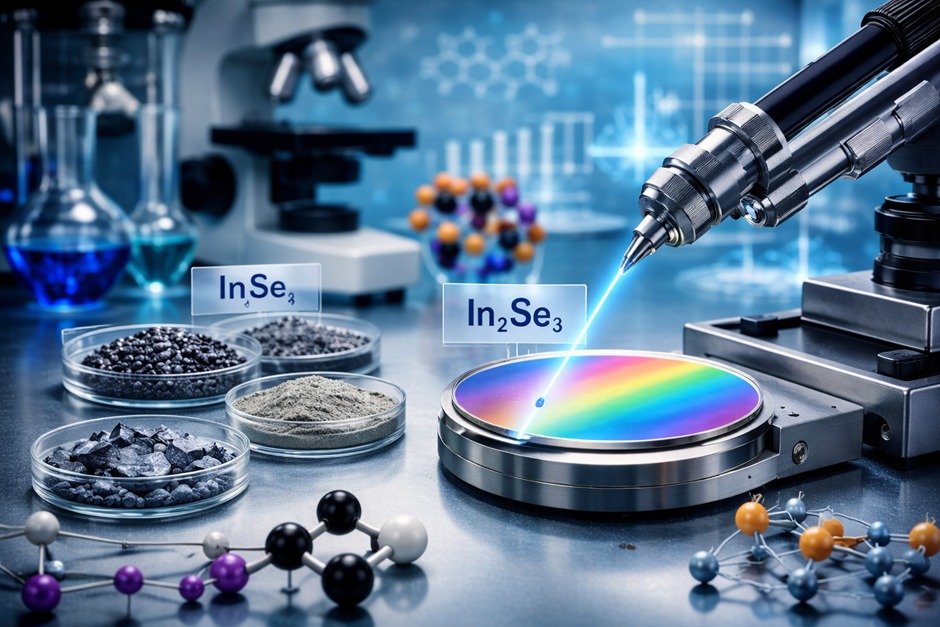
This research project is focused on obtaining thin films of indium selenide with phase transition properties and conducting a comprehensive study of their structural, optical, electrical, and photoelectrical characteristics. The study is conducted at the intersection of materials science, nanophotonics, and optoelectronics. The research is carried out in the laboratories of Al-Farabi Kazakh National University, where scientists and young researchers are studying the functional properties of new materials.
In modern science, the development of “smart” materials capable of responding to environmental influences is of great interest. Such materials include chalcogenide compounds with phase transition behavior. They can reversibly switch between amorphous and crystalline states, resulting in significant changes in electrical and optical properties.
The study considers the preparation of thin films of two indium selenide modifications — InSe and In₂Se₃ — and the investigation of their physical properties. These materials are characterized by high photosensitivity and high electron mobility. For example, electron mobility in crystalline InSe can reach extremely high values, making this material promising for nanophotonics and optoelectronics applications.
The research conducted by KazNU scientists includes the preparation of thin films using thermal evaporation of synthesized bulk crystals. First, bulk crystals are synthesized under vacuum conditions, and then they are evaporated to form amorphous films. After that, phase crystallization processes are studied using laser or electrical pulse exposure.
Optical properties are analyzed by measuring light transmission and reflection spectra in the range of 300–1550 nm. These studies allow determination of the optical absorption coefficient, optical contrast, and bandgap width. Ellipsometric methods are used to evaluate the refractive index and extinction coefficient of the films.
Additionally, photoconductivity spectra of the films are investigated. Spectral dependence of photosensitivity is determined in the range of 240–900 nm, which allows evaluation of the possibility of fabricating photodetectors based on the obtained materials.
An important scientific achievement of the project is the development of local laser crystallization technology. This method enables the formation of diffraction structures, photonic metasurfaces, and two-dimensional photonic crystals on the material surface. Such technologies are considered promising for the development of photonic information processing systems.
The layered structure of indium selenide determines its unique semiconductor properties. InSe is a direct bandgap material with a bandgap of approximately 1.3 eV, while In₂Se₃ has several polymorphic phases. The ferroelectric properties of In₂Se₃ are observed at relatively low temperatures, making it promising for nonvolatile memory devices.
The research results may contribute to the development of photonic integrated circuits, neuromorphic computing systems, and energy-efficient electronic devices. Currently, phase-transition materials are actively studied worldwide for the creation of next-generation photonic platforms.
The project employs comprehensive experimental methods including synthesis, thermal evaporation, spectroscopic analysis, electron microscopy, and electrical measurements. All experiments are conducted in an inert atmosphere since material oxidation may affect the results.
The social and economic significance of the project is high. The obtained results may contribute to the development of photonic device manufacturing, reduction of energy consumption, and creation of innovative electronic systems. The possibility of patenting and commercialization of research results is also considered.
This research is aimed at developing the scientific potential of Al-Farabi Kazakh National University, improving the qualification of young scientists, and strengthening Kazakhstan’s competitiveness in the international scientific community.
Scientific ethical standards are strictly observed. Data falsification and academic misconduct are not allowed. All results will be processed in accordance with international scientific standards.
This scientific research is aimed at advancing nanophotonics and optoelectronics through the study of phase-transition thin films of indium selenide. The obtained results may contribute to the innovative development of materials science in Kazakhstan and support the creation of new technological solutions.
Other news