- Main
- AL-FARABI NEWS LETTERS
- Development of Multifunctional Polymers with Macromolecular Design Based on Research of KazNU Scientists – A New Direction in Science and Technology
Development of Multifunctional Polymers with Macromolecular Design Based on Research of KazNU Scientists – A New Direction in Science and Technology
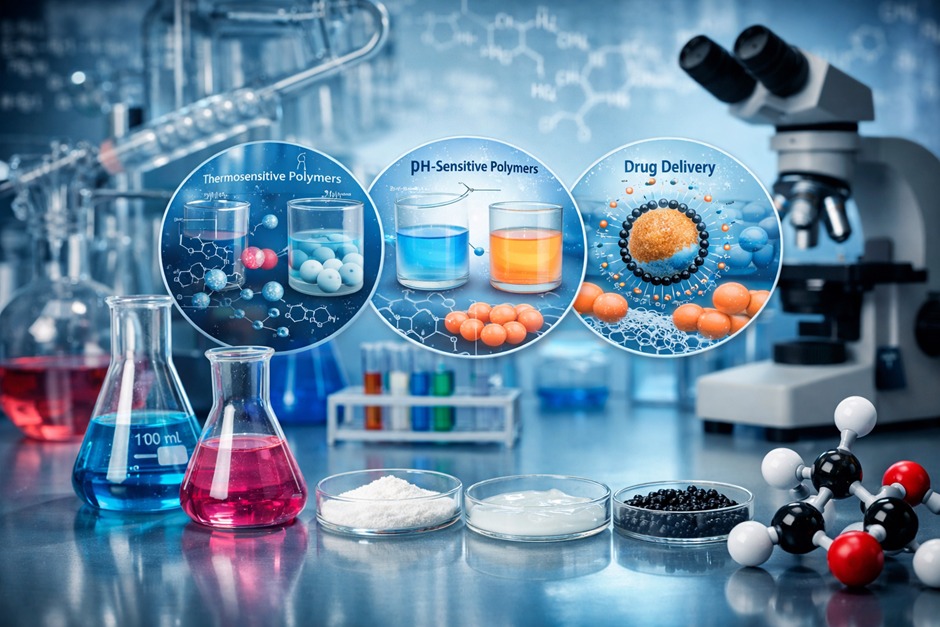
This research is focused on studying macromolecular design, synthesis of stimulus-responsive polymers, and their practical applications. The work is conducted at the intersection of chemistry, physics, biology, medicine, and engineering sciences. The research is carried out at Al-Farabi Kazakh National University, where scientists are engaged in studying new functional properties of polymeric materials.
In modern science, the study of “smart” or environment-responsive polymers is rapidly developing. Such materials are capable of responding to changes in temperature, pH level, or electromagnetic fields. Thermoresponsive polymers are of particular scientific interest because they exhibit lower critical solution temperature behavior in aqueous solutions, which is associated with the amphiphilic structure of macromolecules.
The amphiphilic macromolecular structure is characterized by the presence of both hydrophilic and hydrophobic fragments simultaneously. This structure increases the surface activity of polymers and enhances their ability to function as foaming agents, emulsifiers, flocculants, and solvents for physiologically active substances. These properties expand the potential applications of polymer materials in medicine, pharmaceuticals, and the oil industry.
The main objective of the research project is to develop scientific foundations for creating multifunctional polymers and to determine their practical application possibilities. Within the project, methods for obtaining polymers with controlled amphiphilic macrostructure are studied. Such materials can be used as highly efficient foaming agents, emulsifiers, flocculants, and depressant additives for the oil industry.
During the scientific research, the phase behavior of thermoresponsive polymers in aqueous solutions, their complexation ability, and their response to external stimuli are investigated. Polymer complexation reactions are studied through interactions with surfactants and polyacrylic acid. The physicochemical properties of the obtained polycomplexes are analyzed using viscometry and turbidimetry methods.
Copolymerization plays an important role in the project. Radical copolymerization is used to study the combination of hydrophilic and hydrophobic monomers. This process allows control over macromolecular structure and regulation of thermoresponsive properties. In addition, modification of ethylene-vinyl acetate copolymers is considered for producing depressant additives.
In the oil industry, depressant additives play an important role. They improve the rheological properties of oil under low-temperature conditions. This is especially important in pipeline oil transportation because it helps reduce energy consumption.
The scientific novelty of the study lies in developing methods for obtaining new thermoresponsive polymers and controlling their macromolecular structure. While previous studies mainly focused on linear or network polymers, this project places special emphasis on regulating macrostructural amphiphilicity.
The project also considers international scientific experience. Analysis of global scientific literature shows that stimulus-responsive polymers are widely studied in medicine, biotechnology, electronics, and energy sectors. In Kazakhstan, the production and research of such materials are still developing, making this project important for domestic science.
Experimental work is planned within the research. Polymer synthesis will be carried out using radical copolymerization methods. Phase transitions, complex formation processes, and rheological properties will be studied depending on temperature and concentration. The obtained results will be processed using specialized software.
The social and economic significance of the project is substantial. The development of highly efficient polymer surfactants will improve the efficiency of industrial processes. The use of new depressant additives in the oil industry will help reduce energy costs during pipeline oil transportation.
This research is being conducted using the scientific potential of Al-Farabi Kazakh National University. University scientists are studying polymer material properties and developing new technological solutions.
The project results are planned to be published in international scientific journals and presented at scientific conferences. Additionally, a monograph, a textbook, and analytical materials will be prepared.
An important aspect of the study is adherence to scientific ethical standards. Data falsification, plagiarism, and distortion of scientific results are strictly prohibited. All research will be conducted in accordance with international scientific standards.
In conclusion, this scientific project is aimed at studying new polymer materials based on macromolecular design. The obtained results may contribute to the development of polymer science, technological innovation, and increased efficiency in the oil industry.
Other news