- Main
- AL-FARABI NEWS LETTERS
- Scientists at Al-Farabi Kazakh National University Develop Biodegradable “Smart” Packaging for Food Products
Scientists at Al-Farabi Kazakh National University Develop Biodegradable “Smart” Packaging for Food Products
In the modern world, issues of environmental safety and sustainable development are becoming increasingly relevant. One of the most serious environmental challenges is the pollution of the environment with plastic waste, a significant portion of which is generated from packaging materials. This problem is particularly acute in the case of food packaging, which is used in enormous quantities and often cannot be recycled. For this reason, the scientific community is actively searching for new environmentally friendly materials that could replace conventional plastics.
Research in this direction is also being conducted at Al-Farabi Kazakh National University, where scientists are working on the development of innovative biodegradable packaging of a new generation. The scientific project focuses on developing a technology for producing a biopolymer film based on cellulose with functional properties that not only protect food products but also help monitor their freshness.
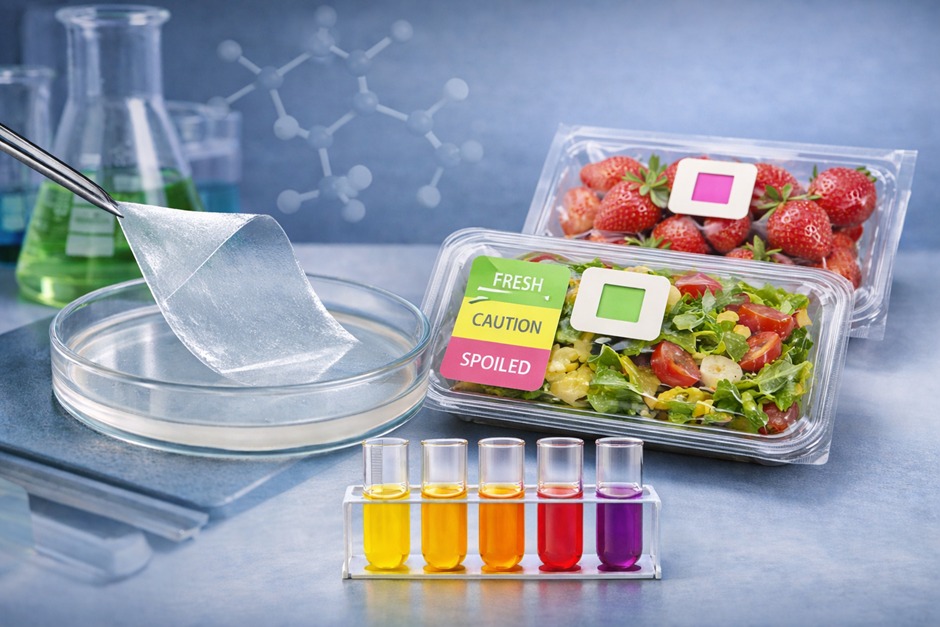
The main goal of the research is to create a multifunctional packaging material with antimicrobial and antioxidant properties, as well as the ability to indicate the condition of food products. Such packaging belongs to the category of so-called “smart” packaging systems that can signal the beginning of food spoilage processes.
Modern packaging technologies are increasingly oriented not only toward protecting products from external factors but also toward monitoring their quality throughout the entire storage period. In this regard, the development of materials capable of changing their properties or appearance depending on the condition of the product has become one of the most promising areas of research in the fields of food technology and materials science.
Within the framework of the project, bacterial cellulose is used as the main material. This is a natural biopolymer synthesized by microorganisms. The material is characterized by a high level of purity, strength, flexibility, and biocompatibility. Moreover, bacterial cellulose is fully biodegradable, making it a promising alternative to synthetic polymers.
Scientists note that bacterial cellulose is already being actively studied in many countries around the world and is considered a promising material for various industries, ranging from medicine to the food sector. However, its use as a base material for functional food packaging still requires additional research aimed at improving its physical and chemical properties.
During the research process, scientists plan to modify the structure of cellulose using modern biotechnological methods. One of the key stages is the production of nanocellulose — a material with unique properties formed from nanoscale crystalline structures of cellulose. Nanocellulose is known for its high mechanical strength, improved barrier properties, and ability to form strong and thin films.
The use of nanocellulose significantly increases the material’s resistance to moisture and gas penetration, which is an important factor in food packaging applications. In addition, such films can effectively protect food products from ultraviolet radiation and other environmental influences.
Another important aspect of the research is the functionalization of the resulting film with biologically active compounds. In particular, curcumin is planned to be used as an active component. Curcumin is a natural compound found in the turmeric plant and is widely known for its beneficial properties.
Curcumin possesses strong antioxidant activity, which helps slow down oxidation processes in food products. In addition, it exhibits antimicrobial properties, allowing it to inhibit the growth of microorganisms responsible for food spoilage.
Of particular interest is curcumin’s ability to change color depending on the acidity level of its environment. When the pH level changes, the substance may alter its color, making it a convenient natural indicator. This property allows curcumin to be incorporated into packaging materials for the visual monitoring of food freshness.
When food products begin to spoil, biochemical processes occur within them, leading to the formation of various volatile compounds and changes in acidity. Under such conditions, the color of the indicator incorporated into the packaging material may change, signaling to consumers the current state of the product.
Thus, the developed packaging material can perform several functions simultaneously: protecting the product from external influences, extending its shelf life, and informing consumers about its freshness.
During the research, scientists conduct a comprehensive study of the properties of the developed films. Their physicochemical characteristics, mechanical strength, thickness, transparency, thermal stability, and resistance to moisture are carefully analyzed. These properties are studied using modern laboratory methods and analytical equipment.
In addition, the barrier properties of the material are evaluated, including its ability to regulate the transmission of oxygen, carbon dioxide, and water vapor. These parameters play a crucial role in food preservation because they directly influence the rate of spoilage.
Special attention is also given to studying the antimicrobial activity of the developed material. For this purpose, microbiological tests are conducted to determine how effectively the film inhibits the growth of various microorganisms.
Furthermore, the antioxidant activity of the material is examined, as well as its ability to prevent oxidative processes in food products. These characteristics are particularly important for maintaining the taste, nutritional value, and overall quality of food.
At the final stage of the project, experimental testing of the new packaging material will be carried out under real food storage conditions. In particular, the developed cellulose film is expected to be used for packaging meat and fish products.
During these experiments, researchers will evaluate how the packaging affects the shelf life of the products, their organoleptic characteristics, and their microbiological safety. Such studies will allow scientists to assess the practical effectiveness of the developed material.
Another important aspect of the project is the evaluation of the environmental characteristics of the new packaging material. Scientists plan to study the biodegradation rate of the film under natural conditions and determine its impact on the environment.
Biodegradable materials offer significant advantages compared with conventional plastic packaging, as they are capable of decomposing under natural conditions without producing toxic substances.
An interesting feature of the project is the use of food industry waste as a raw material for producing bacterial cellulose. In particular, the possibility of using brewing industry waste is being considered, since such waste contains nutrients necessary for the growth of microorganisms.
This approach allows researchers to address two important challenges simultaneously: reducing industrial waste and creating new environmentally friendly materials.
According to the researchers, such technologies may become an important step toward the development of a circular economy, in which the waste of one industry becomes a resource for another.
Within the framework of the project, special attention is also given to the development of international scientific cooperation. Scientists plan to publish the results of their research in international scientific journals and present their findings at scientific conferences.
It is expected that the results obtained may form the basis for new technological solutions in the field of environmentally friendly packaging. In addition, the research outcomes may lead to patents and the future implementation of the technology in industrial production.
It is important to note that such scientific projects play a significant role not only in advancing science but also in training young researchers. Graduate students and doctoral candidates participate in the project, for whom this research becomes an important part of their academic and professional development.
Overall, the research conducted at Al-Farabi Kazakh National University aims to address pressing challenges in modern science and industry. The development of biodegradable smart packaging has the potential to make a significant contribution to environmentally friendly technologies and improve the quality and safety of food storage.
In the long term, such innovative materials could help reduce the negative environmental impact of plastic waste while opening new opportunities for the development of sustainable technologies in the food industry.
Other news