Sustainable Development Goal No. 16 (SDG 16)
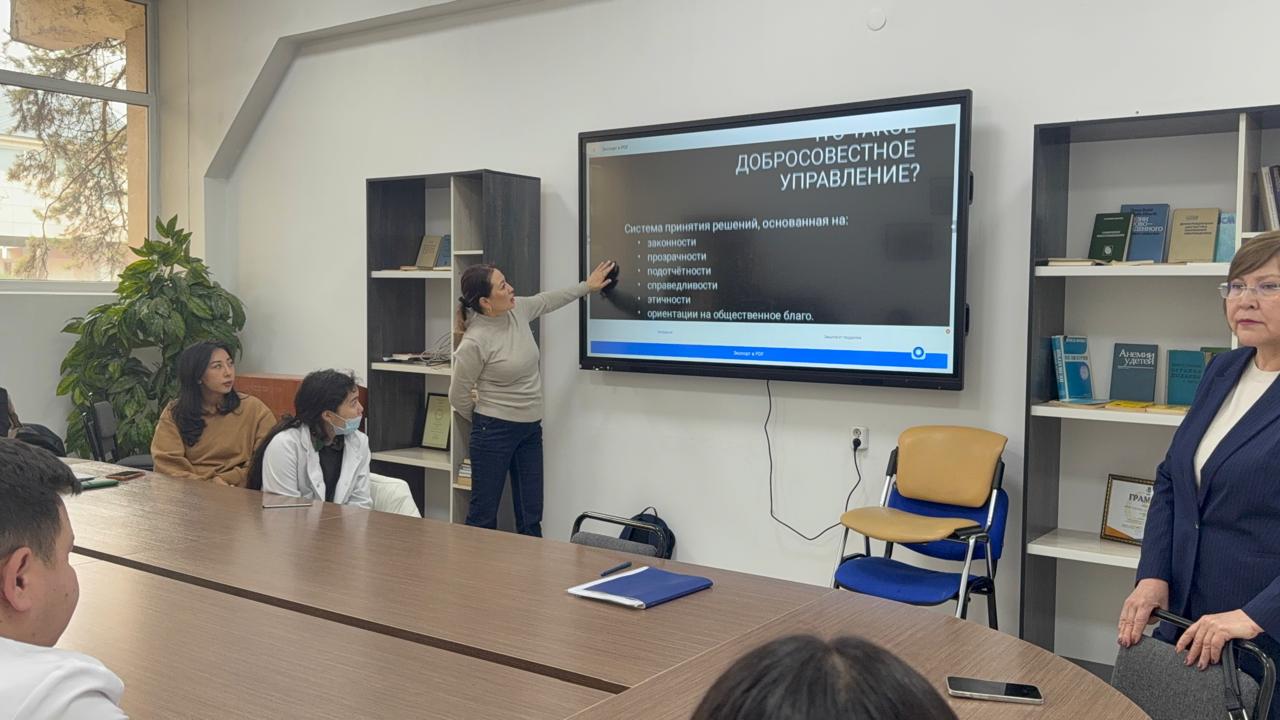
An open lecture on the principles of good governance in the context of the implementation of Sustainable Development Goal No. 16 (SDG 16) was held at the Faculty of Medicine and Healthcare of Al-Farabi Kazakh National University. The event was organized by B.N. Maulenova, Candidate of Law, Associate Professor of the Department of Health Policy and Organization, and A.G. Kenembayeva, a 1st-year master's student specializing in Law in Healthcare. for students of the faculty in order to strengthen professional ethics, as well as to create a culture of transparency and accountability in the academic and future professional environment.
The Sustainable Development Goals (SDGs), adopted by the UN General Assembly in 2015, represent a universal call to action for all countries of the world, regardless of their level of economic development. Encompassing 17 interrelated areas, this document serves as a "blueprint for achieving a better and more sustainable future for all." The key idea of the agenda is that the eradication of poverty and inequality is inextricably linked to increasing economic growth, addressing issues of education, health, social protection, as well as environmental protection and combating climate change.
The lecture focused on Goal 16, which calls for building peaceful and open societies for sustainable development, ensuring access to justice for all, and creating effective, accountable, and inclusive institutions at all levels. The speakers emphasized that for future doctors, understanding these principles has not only theoretical, but also deep practical significance.
The healthcare system is a complex social institution, the effectiveness of which directly depends on the quality of management, the level of trust in society and the ethical standards of its employees. The formation of a culture of transparency and accountability among students lays the foundation for their future work, where the principles of integrity become an integral part of the treatment process and interaction with patients. Inclusivity, as one of the key aspects of SDG 16, means equal and equitable access to medical care for all segments of the population, which is a core value of professional medicine.
The lecture participants discussed how global sustainable development goals are reflected in the daily activities of a doctor. It was noted that it is in the medical environment that issues of ethics, fighting corruption and ensuring equal rights become vital. Transparency in decision-making, from the precise operation of administrative structures to clarity in the doctor-patient relationship, is the key to the sustainable development of both an individual institution and the entire healthcare system in the country.
Holding such events underlines the commitment of our university not only to high-quality professional training of specialists, but also to fostering civic responsibility. Integrating the principles of sustainable development into the educational process helps future doctors realize their role in building a just and healthy society where everyone can count on quality care and respect. The lecture was an important step in understanding how the daily work of each of us contributes to the achievement of global goals aimed at improving human well-being and protecting our planet.
Other news