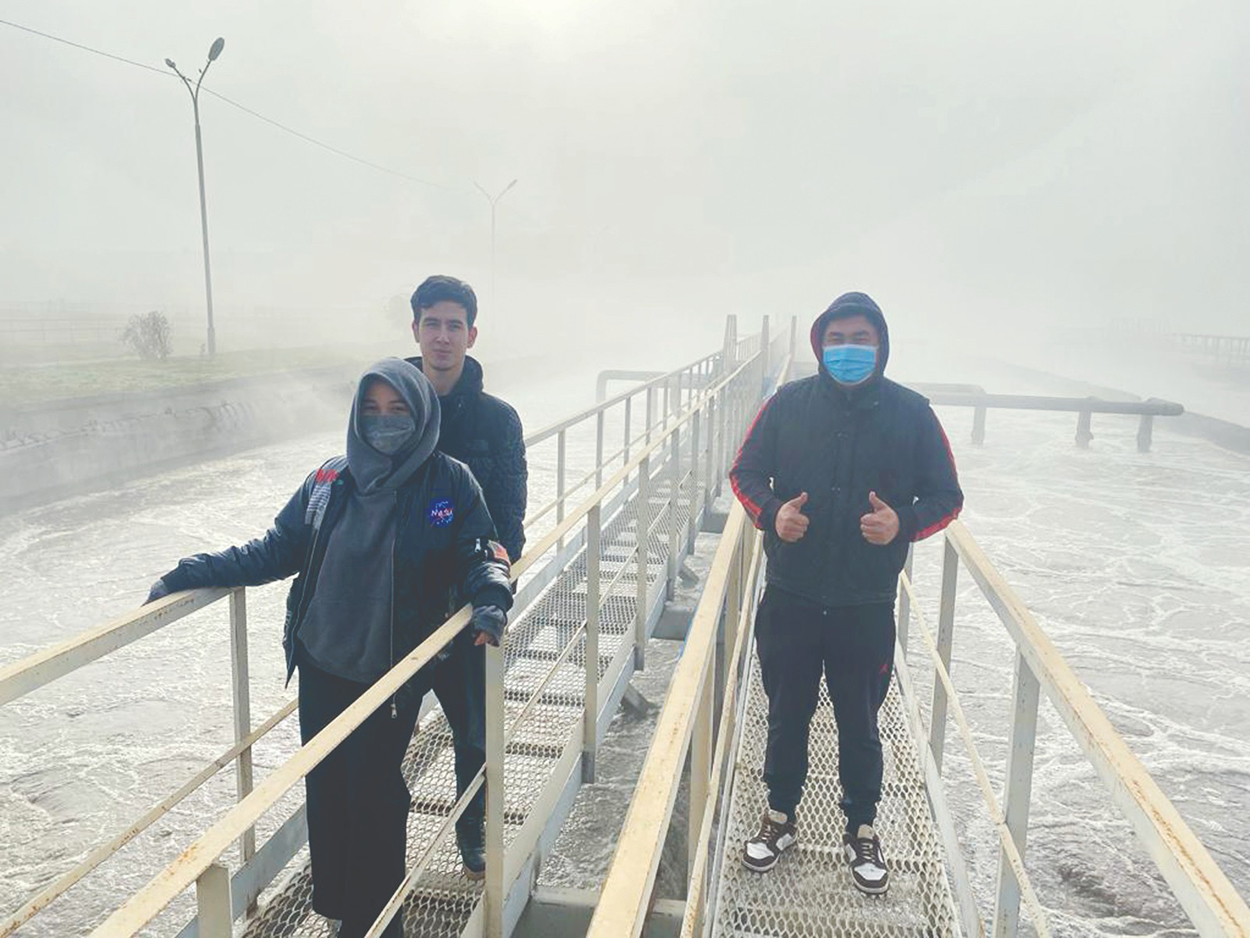
As part of the implementation of the SDG "Quality Education", teachers of the UNESCO Department of Sustainable Development organized an excursion for 4th-year students of the Ecology, Safety of Life and Environmental Protection to the Almaty Su aeration station in order to familiarize themselves with the technological processes of wastewater treatment. During the tour, the students got fully familiar with the treatment facilities of Almaty, the technologies of mechanical and biological wastewater treatment.
It should be noted that a distinctive feature of urban wastewater is the diversity and variability of its composition, uneven inflow over time both during the day and by months and seasons, as a result of which technological regimes change, which negatively affects the quality of treatment and the environmental component as a whole. The technologies, equipment and techniques currently used for wastewater treatment are very diverse. In urban wastewater treatment systems, the methods of mechanical and biological wastewater treatment have become the most widespread. This is exactly the classical wastewater treatment scheme used at the Almaty aeration plant.
The sewerage system of the city of Almaty operates according to an incomplete separate system, one of them is stormwater (irrigation ditch) – with the discharge of water into small rivers, the other is citywide – for industrial and domestic wastewater. The capacity per day is 640 cubic meters of water. The city's wastewater, which has entered the citywide sewer system, is treated at an aeration station, which includes three workshops: mechanical treatment, biological treatment, and a wastewater disposal workshop. 60% of the cleaning takes place in the machine shop. A receiving chamber is used to equalize the speeds and evenly distribute the drains through the supply channels of the grids. From the chamber, the drains are directed through reinforced concrete channels to mechanical gratings.
The waste trapped on the grates is pre-rinsed under pressure with industrial water (hydraulic washing), then collected in a special container, where it is dewatered and, together with solid household waste from the aeration station, exported by a specialized organization, on contractual terms, to a landfill. The retention of heavy solid particles (mainly of mineral origin) is carried out in horizontal sand traps. The solid particles and sand that have precipitated are moved by the hydraulic system to the pit, from where they are pumped by a hydraulic elevator to the sand platforms. There are 5 active and 3 reserve sand traps.
After the sand traps, the drains are fed into the distribution bowl of the primary radial settling tanks using a common tray in which they are quantified. In order to improve deposition, excess activated sludge from the sludge channel of the biological treatment plant can be piped here. The removal of suspended solids from wastewater, which can settle or float under the influence of gravity, occurs in primary radial settling tanks. The raw sediment deposited in each sump is moved by scrapers installed on the mud scraper farm to the pit, from which it is pumped out by a pump to the silt pads. After settling in the sump, clarified wastewater is collected in a common channel and sent along the Almaty dyuker to biological treatment facilities.
A regulator gateway is installed in an open earth channel before biological treatment, which can distribute wastewater either into the channel supplying biological treatment, or (bypassing biological treatment facilities) through the discharge channel into the storage system. After the second stage of biological treatment is put into operation, all wastewater is treated at its facilities, and the regulator lock is closed and sealed.
The treatment facilities of the aeration plant operate continuously, around the clock, purifying all wastewater from the city and its suburbs to the required degree of purification. Biologically treated wastewater is discharged through a discharge channel to a Sorbulac storage tank. The Aeration Station has all the necessary administrative, laboratory, household and service buildings and facilities, including: mechanical repair shops, garage, concrete-mortar unit, pumping stations and storage facilities.
Nurgul BERGENEVA,
docent
Aknur ZHOLDASBEK,
the teacher.
UNESCO Chairs on Sustainable Development