- Main
- News
- Legal Science in the Era of Artificial Intelligence: New Paradigms and Scientific Dialogue
Legal Science in the Era of Artificial Intelligence: New Paradigms and Scientific Dialogue
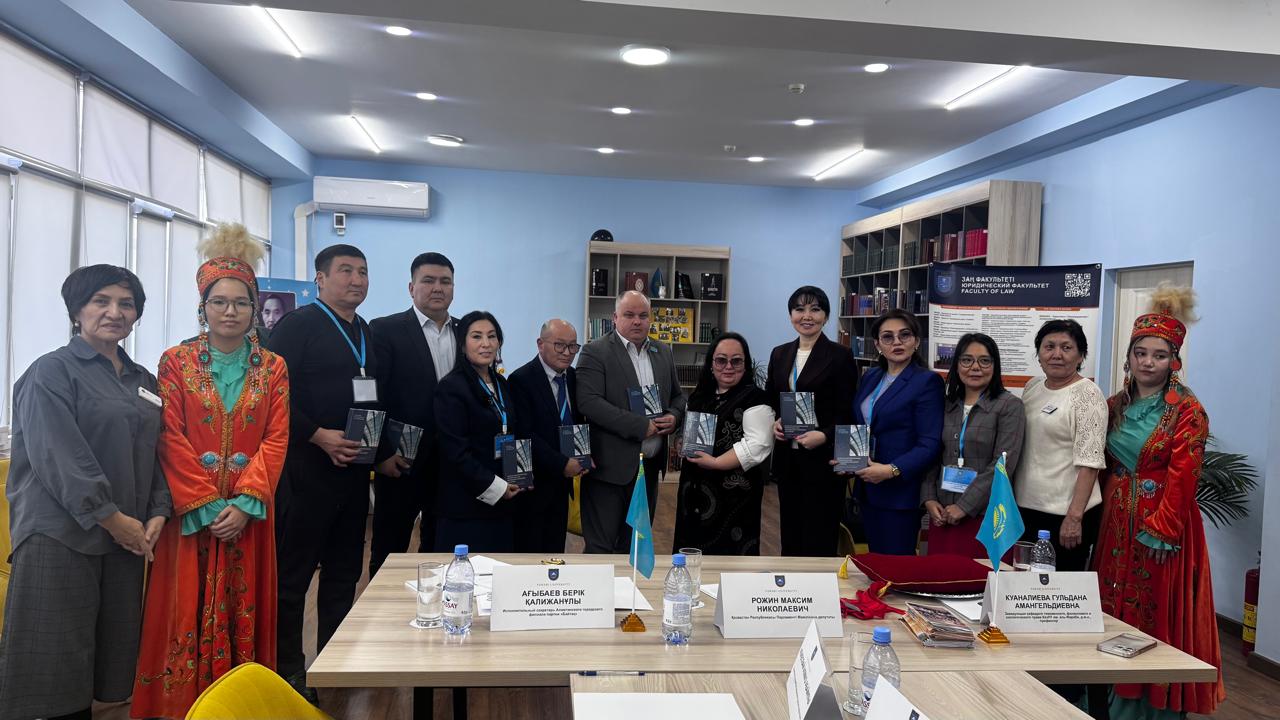
On January 10, 2026, the Department of Customs, Financial and Environmental Law of Al-Farabi Kazakh National University organized an international educational and methodological conference entitled “The Development of Legal Science in the Era of Artificial Intelligence: Transformation of Scientific Schools and Doctrines”, which took place at the I.A. Krylov Library. The event brought together domestic and foreign scholars, legal practitioners, and representatives of public authorities.
The main purpose of the conference was to conduct a theoretical and methodological analysis of the impact of artificial intelligence on legal science, to identify the processes of transformation of legal scientific schools and doctrines, and to determine key directions for improving legal education and research in the context of digital technologies.
At the opening of the conference, the moderator, Doctor of Law and Professor Guldana Amangeldievna Kuanalieva, delivered a welcoming address, emphasizing that the integration of artificial intelligence into legal science requires new scientific perspectives and methodological innovations.
During the plenary sessions, a welcoming speech was delivered by Maxim Nikolaevich Rozhin, a Deputy of the Mazhilis of the Parliament of the Republic of Kazakhstan. Berik Kalizhanovich Agibaev, a representative of the Almaty city branch of the “Baytaq” Green Party, highlighted the environmental and social dimensions of legal science. Leading national and international scholars also presented their research findings.
In addition, the conference featured the presentation of the textbook “Issues of Organic Agriculture in the Republic of Kazakhstan”, authored by Bakytzhan Kalymbek, Acting Professor of the Department of Customs, Financial and Environmental Law, as well as Zhanna Kalymbekova and Aizhan Sundetovna Moldagaliyeva from the Department of Accounting and Auditing. The publication attracted considerable interest and was recognized as an important scientific and methodological contribution.
As a result of the conference, participants reached a consensus on the need to systematize key theoretical approaches to the impact of artificial intelligence on legal science, to integrate digital technologies into the legal education process, and to foster the development of new scientific directions in the field of law.
Other news