- Main
- News
- KAZNU LAUNCHES THE ONLINE WINTER SCHOOL “INTELLECTUAL HISTORY IN CONTEMPORARY CENTRAL AND SOUTH ASIA”
KAZNU LAUNCHES THE ONLINE WINTER SCHOOL “INTELLECTUAL HISTORY IN CONTEMPORARY CENTRAL AND SOUTH ASIA”
.png)
At the initiative of the Department of Middle East and South Asia of the Faculty of Oriental Studies, the online Winter School “Intellectual History in Contemporary Central and South Asia” has begun its work.
The educational event is held on February 10-12, 2026, within the framework of the implementation of the United Nations Sustainable Development Goals – “Quality Education” (SDG 4) and “Partnerships for the Goals” (SDG 17) – at Al-Farabi Kazakh National University. The event is organized in accordance with Clause 2.1.4 of the Memorandum of Cooperation between KazNU and the National University of Modern Languages (NUML, Islamabad), signed in 2025, which provides for cooperation within short-term and long-term academic programs.
The main objective of the online Winter School is to study the methodology, key concepts, evolution of ideas, literary and folklore traditions, and historiographical practices in the context of intellectual history in Kazakhstan and Pakistan.
The classes are conducted by leading Kazakhstani and international scholars, faculty members of KazNU, Khoja Akhmet Yassawi International Kazakh-Turkish University, young researchers, as well as lecturers from the University of Peshawar and the University of the Punjab. The Winter School is attended by master’s and doctoral students, as well as young university lecturers from both countries studying Oriental Studies, Foreign Philology, Political Science, and International Relations.
The opening ceremony of the Winter School began with a welcoming speech by N. Kairanbayev, Deputy Dean of the Faculty of Oriental Studies for Scientific and Innovative Activities and International Cooperation. A congratulatory address was delivered by Dr. Hazrat Umar, Associate Dean of the National University of Modern Languages (NUML, Islamabad).
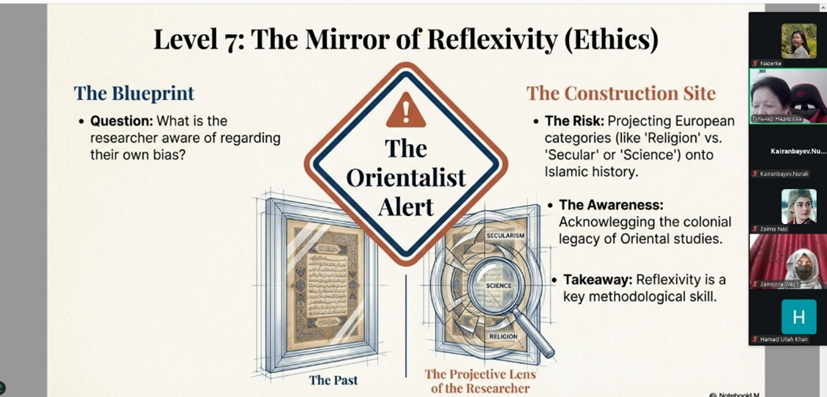
The first session of the Winter School was devoted to the methodology and research methods of intellectual history. Professor G.Nadirova presented the theoretical foundations of intellectual history and modern approaches to working with literary sources and historiographical analysis. Research-Professor L.Yereksheva outlined the conceptual framework of intellectual history, its main schools, and issues related to nomadology. During the discussion, the lecturers answered participants’ questions.
The program aims to develop students’ critical thinking and deepen their understanding of the social and intellectual context of Eastern societies. Special attention is paid to the formation of knowledge and ideas, the role of creative activity in public life, and issues of social history.
The online Winter School contributes to strengthening international scientific cooperation, expanding academic dialogue, and promoting the professional development of young researchers. The implementation of the program creates new opportunities for developing modern scientific approaches to studying intellectual processes in Central and South Asia and enhances the academic potential of its participants.