- Main
- AL-FARABI NEWS LETTERS
- Al-Farabi Kazakh National University Researchers Study the Archaeological Landscapes of the Zaysan Basin
Al-Farabi Kazakh National University Researchers Study the Archaeological Landscapes of the Zaysan Basin
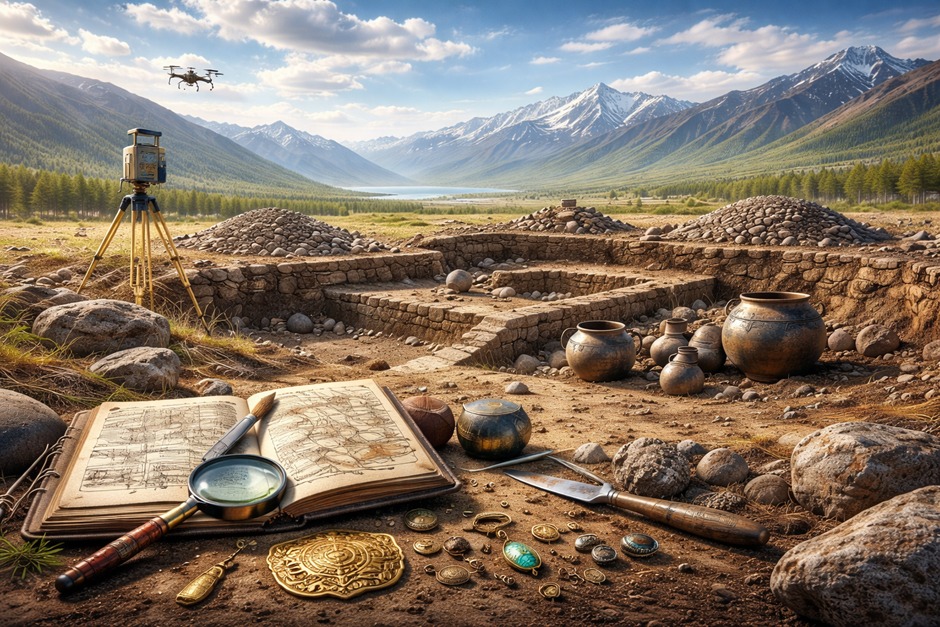
Eastern Kazakhstan, including the Altai-Tarbagatai region, represents one of the key areas for studying the ancient and medieval history of Eurasia. Of particular importance is the Zaisan Basin, a natural corridor located between the Altai and Tarbagatai mountain systems. Historically, this territory played a significant role in migration processes, trade interactions, and cultural exchange among populations of Central Asia.
The project is aimed at the comprehensive study of archaeological landscapes of the Zaisan Basin. The main objective is to reconstruct historical and cultural processes in the region based on the spatial organization of ancient and medieval archaeological sites.
Special attention is given to the relationships between different types of archaeological objects. The study covers settlements, fortifications, irrigation systems, ritual complexes, and economic zones. This approach allows researchers to reconstruct patterns of territorial development by ancient populations and identify models of their economic activities.
Field archaeological investigations are being conducted in the northeastern part of the Zaisan Basin, particularly in the area where the Kalzhyr River flows into the Kara Irtysh River. The research includes systematic recording of all discovered archaeological objects, clarification of site chronology, and identification of previously unknown archaeological complexes. Urban-type settlements receive special attention, as they may indicate early urbanization processes in the region.
The methodological framework of the project is interdisciplinary. In addition to traditional archaeological methods, natural science techniques are actively applied. Radiocarbon dating is used to determine the age of organic materials. Paleobotanical analyses help reconstruct ancient vegetation, agricultural crops, and environmental conditions.
Spatial analysis of archaeological complexes is conducted using geographic information systems (GIS). The application of GIS technologies enables the identification of settlement distribution patterns, reconstruction of economic zones, and modeling of historical resource utilization.
Remote sensing technologies play an important role in the research. Aerial photogrammetry using unmanned aerial vehicles allows the creation of three-dimensional terrain models and recording of microtopographic features. This significantly increases the efficiency of archaeological site detection without large-scale destruction of cultural layers.
Geophysical methods, including magnetometric surveys and ground-penetrating radar investigations, are used to detect hidden underground structures. These technologies enable the study of architectural features of ancient constructions without extensive excavation.
Paleo-economic research focuses on reconstructing the economic systems of ancient populations. Paleobotanical analysis includes the study of pollen, phytoliths, plant macroremains, and starch grains, which helps determine ancient vegetation composition and agricultural practices.
Archaeozoological analysis is applied to study animal husbandry activities. The ZooMS mass spectrometry method allows species identification even from small bone fragments. A promising research direction is sedimentary ancient DNA (sedaDNA) analysis, which is used for paleoenvironmental reconstruction and biodiversity assessment of ancient ecosystems.
All obtained data are systematized in a unified geographic information database. Spatial and chronological analysis of archaeological complexes will help reveal patterns in the formation of archaeological landscapes of the Zaisan Basin and reconstruct historical models of territorial economic development.
The project has significant social value. The study of ancient history of Kazakhstan contributes to the formation of patriotic awareness, popularization of cultural heritage, and development of historical science. Archaeological discoveries provide a scientific basis for regional tourism development, creation of excursion routes, and increasing public interest in historical monuments.
The research is implemented at the Al-Farabi Kazakh National University with the participation of faculty members, students, master’s and doctoral candidates. The results of the research are planned to be integrated into the educational process through the updating of archaeological academic programs.
No experiments involving humans or animals are planned within the project. Ethical principles of the study are based on the preservation of archaeological heritage as an important part of national and world culture. During fieldwork, priority will be given to archaeological sites that are under threat of destruction.
Overall, the project contributes to the development of archaeological science in Kazakhstan, preservation of historical and cultural heritage, and expansion of knowledge about the formation of ancient societies in Central Eurasia.
Other news