- Main
- AL-FARABI NEWS LETTERS
- Scientists of the Al-Farabi Kazakh National University are implementing a project on the development of biotechnological methods for enhancing oil recovery from mature oil fields.
Scientists of the Al-Farabi Kazakh National University are implementing a project on the development of biotechnological methods for enhancing oil recovery from mature oil fields.
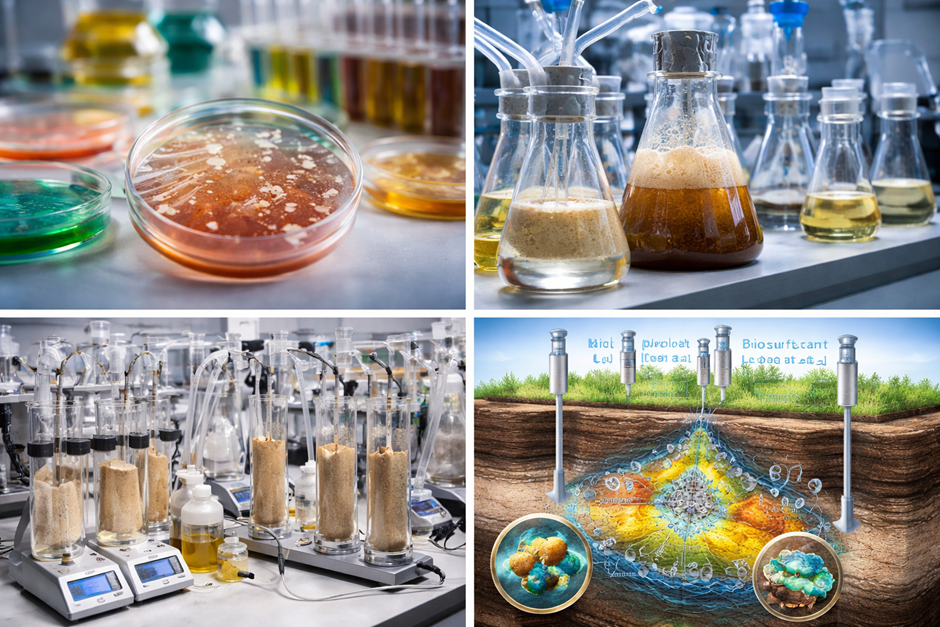
The research project aims to develop a biotechnological platform for microbial enhanced oil recovery based on biosurfactant- and biopolymer-producing microorganisms. The study focuses on creating innovative methods for extracting residual oil from mature fields and improving technologies for the development of difficult-to-recover hydrocarbon resources.
Modern oil and gas industry faces the problem of gradual depletion of conventional oil fields. A significant portion of global hydrocarbon reserves belongs to difficult-to-recover resources, characterized by high oil viscosity, low reservoir permeability, and long production lifetime. Therefore, there is a growing need to implement environmentally safe and economically efficient technologies to increase the oil recovery factor.
The project team studies microbial enhanced oil recovery technology, a promising direction in oil biotechnology based on using microbial metabolic activity to modify the physicochemical properties of oil reservoirs. Biosurfactants and biopolymers synthesized by microorganisms can reduce interfacial tension, decrease hydrocarbon viscosity, and increase oil mobility within porous geological structures.
Special attention is given to selection of active indigenous microorganisms isolated from oil fields of Western Kazakhstan. Screening is conducted using modern microbiological, molecular genetic, and physicochemical analytical methods.
For accurate identification of promising cultures, 16S rRNA gene sequence analysis is used to determine the taxonomic affiliation of microorganisms. Additionally, whole-genome sequencing of selected strains is planned to evaluate the genetic potential for synthesis of target metabolites.
The scientific novelty of the project lies in developing a synergistic association of biopolymer- and biosurfactant-producing microorganisms with enhanced functional activity under extreme reservoir conditions. The combined use of microorganisms is expected to improve oil displacement efficiency through simultaneous action of multiple mechanisms: reduction of interfacial tension, modification of reservoir filtration properties, and stabilization of emulsion systems.
The experimental work includes model and bench-scale ex-situ tests to simulate reservoir conditions. Sand column models are used to evaluate microbial association efficiency by analyzing oil saturation, water saturation, produced hydrocarbon volume, and residual oil saturation.
Optimization of microbial cultivation conditions and enhancement of metabolic activity are important research directions. The study involves selecting carbon and nitrogen sources, as well as evaluating emulsifying activity. Emulsification properties will be determined by calculating the emulsification index, while surface tension will be measured using tensiometric methods.
Biological compatibility of strains is studied using the perpendicular streak method to identify possible antagonistic interactions. Additionally, genes responsible for biopolymer synthesis are analyzed.
The project is implemented using modern laboratory infrastructure and international research standards. Particular attention is given to scientific ethics, data reliability, and reproducibility of results.
International scientific collaboration is an important part of the study. Cooperation with foreign research centers is planned for conducting high-precision genomic analysis and experimental validation of developed biotechnological solutions.
The project results are expected to contribute to the development of biotechnological methods in the oil and gas industry, creation of a scientific basis for microbial enhanced oil recovery technologies, and expansion of environmentally friendly hydrocarbon production technologies.
Other news