- Main
- News
- Scientific Seminar on Functional and Pragmatic Aspects of Genre in Professional Discourse нeld at the Department of Chinese Studies
Scientific Seminar on Functional and Pragmatic Aspects of Genre in Professional Discourse нeld at the Department of Chinese Studies
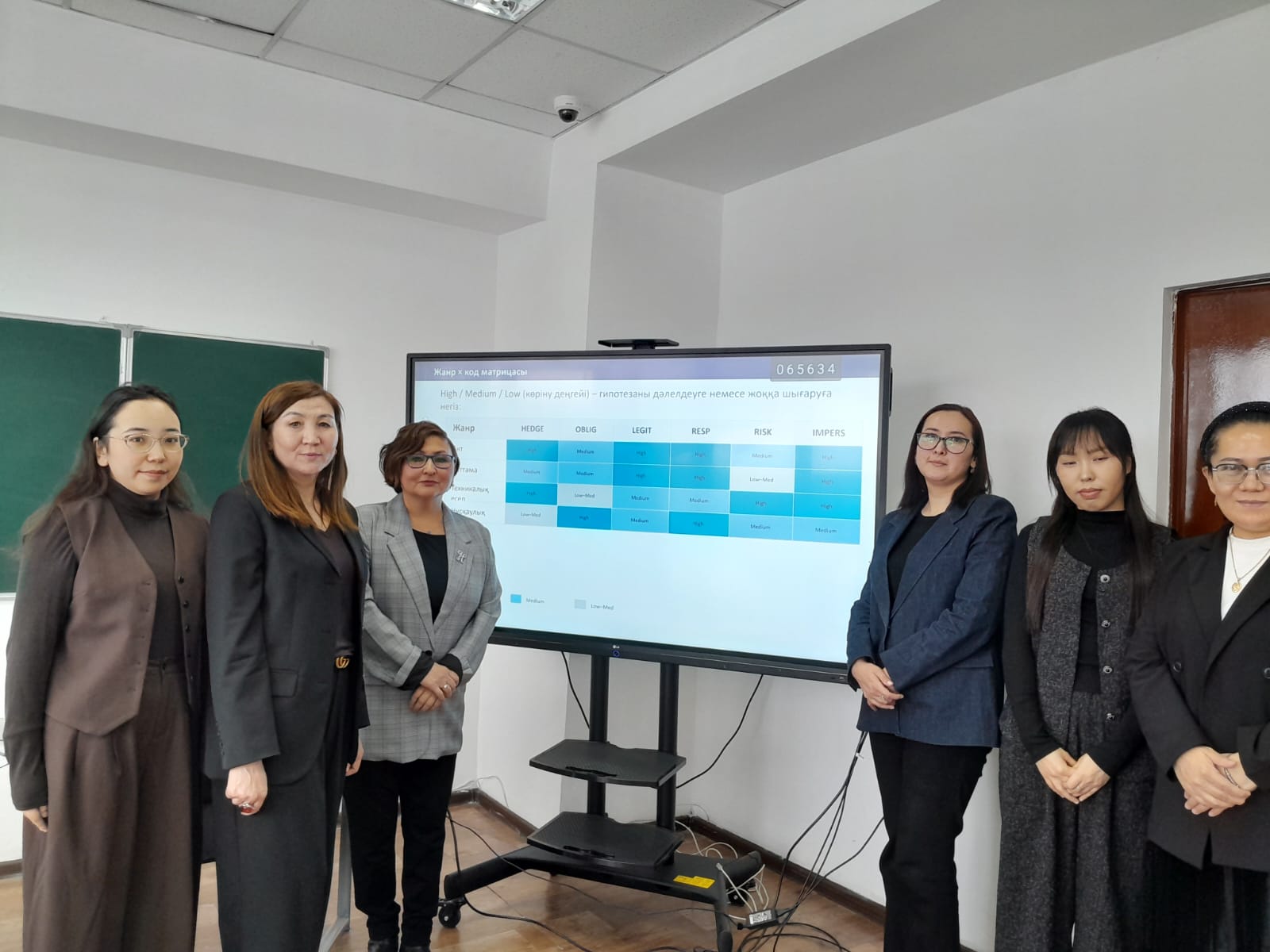
On 26 February 2026, the Department of Chinese Studies at the Faculty of Oriental Studies, Al-Farabi Kazakh National University, hosted a scientific seminar entitled “Functional and Pragmatic Aspects of Genre in Professional Discourse.” The seminar was organized within the framework of the ongoing research conducted by G.K. Rakhimbayeva, a second-year doctoral student of the educational program 8D02209 – Oriental Studies.
The seminar was attended by faculty members of the Department of Chinese Studies, doctoral students, master’s students, and undergraduate students. During the seminar, the participants discussed the genre-specific features of professional discourse in Chinese (business, technical, and academic texts) and their communicative functions. The seminar also addressed the issues of genre, function, and pragmatics in the professional discourse of the oil and gas industry.
The functional aspects of the research were presented in detail. In particular, the main functions of professional genres were described as informative, regulatory, evidential, legal-fixative, coordinative, and controlling. The presentation particularly emphasized that the function of a genre demonstrates what it does in a professional environment, that is, what kind of action it performs.
In addition, the seminar provided a detailed discussion of the pragmatic aspects of the research. Pragmatics was considered an important component that explains how a professional text influences its recipient, as well as which linguistic mechanisms are used to realize obligation, restriction, legitimization, distribution of responsibility, risk management, and impersonalization. In this regard, the main pragmatic mechanisms highlighted included obligation/prohibition, mitigation, legitimization, identification of the responsible person, and the indication of conditions and boundaries.
At the conclusion of the seminar, it was emphasized that the proposed research approach has significant theoretical and practical value, and the doctoral student’s research work was positively evaluated.