- Main
- News
- Open Lecture by Professor Saltanat Tolepbekovna Nazarbekova: “The Modern System of Ochrophyte Algae (Division Ochrophyta)”
Open Lecture by Professor Saltanat Tolepbekovna Nazarbekova: “The Modern System of Ochrophyte Algae (Division Ochrophyta)”
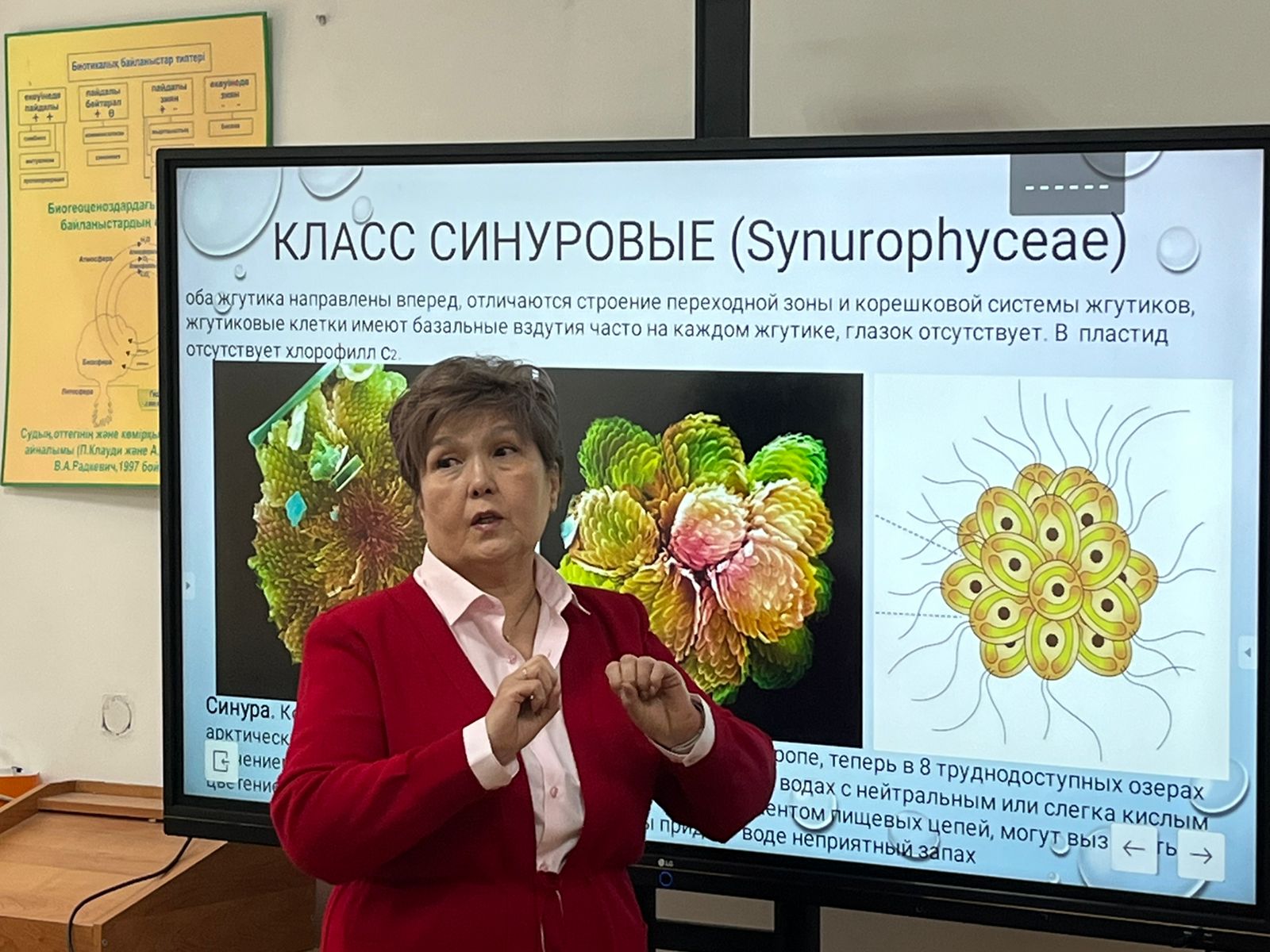
On 26 February 2026, an open lecture was held at Al-Farabi Kazakh National University, Faculty of Biology and Biotechnology, Department of Botany and Agroecology. The lecture was delivered by Professor Saltanat Tölepbekovna Nazabekova and was titled “The Modern System of Ochrophytic Algae: the Division Ochrophyta.” The event stood out for its depth of content, high academic standard, and clear, accessible delivery. The material was carefully structured: core concepts and complex issues were presented consistently and in a logically connected sequence, incorporating up-to-date scientific evidence, terminology, and current approaches in systematics.
The lecture discussed the general characteristics of the major groups within Ochrophyta, including aspects of cellular organization, pigment systems, ecological adaptations, and life cycles. The speaker briefly explained the role of ochrophytes in ecosystems (primary production, nutrient cycling, and support of trophic chains) and demonstrated why their diversity and morphological plasticity make classification particularly challenging. Key evolutionary ideas were also integrated at the conceptual level, including the significance of secondary endosymbiosis, the origin of plastids, and the taxonomic relevance of pigments.
While maintaining continuity with classical morphology-based perspectives, Professor Nazabekova illustrated—through concrete examples—how recent molecular-genetic studies have reshaped views on ochrophyte relationships and classification. Of particular value to the audience were explanations of how to interpret phylogenetic trees, why relationships among taxa are sometimes revised, the practical meaning of “monophyly vs. polyphyly,” and the scientific rationale behind taxonomic re-arrangements. This approach highlighted the dynamic nature of science and emphasized that systematics is not merely about organizing names, but about understanding evolutionary history. The lecture also provided a brief overview of major lineages (such as diatoms, brown algae, golden algae, and yellow-green algae), comparing traditional diagnostic traits with modern genetic markers used for delimitation.
The role of contemporary methods (DNA barcoding, multigene analyses, metagenomics) in systematics was outlined alongside the applied relevance of these results: monitoring aquatic ecosystems, bioindication, assessing water “bloom” events, and evaluating the ecological status of irrigation canals and ponds in agroecosystems. The professor stressed the importance of sound data practices (modeling, metadata, identification tools, and principles of international nomenclature) and recommended relying on authoritative review works and verified online resources. The lecture concluded with a Q&A session, during which students and early-career researchers received practical advice on terminological precision, study design, and proper interpretation of results.
Professor Saltanat Tölepbekovna Nazabekova is an experienced academic and researcher at the department, who effectively integrates modern methodologies with topics in algal studies and systematics. Her teaching style is evidence-based, source-oriented, and interactive: she explained complex concepts step by step and encouraged questions and scientific discussion. Overall, the open lecture was regarded as a meaningful academic event that enriched the university’s educational and research environment, showcased the department’s academic capacity, strengthened professional ties among faculty, students, and young researchers, and promoted exchange of experience, scientific dialogue, and a culture of scientific thinking.
Department of Botany and Agroecology