The Hindi Department of the Faculty of Oriental Studies is 25 years old!
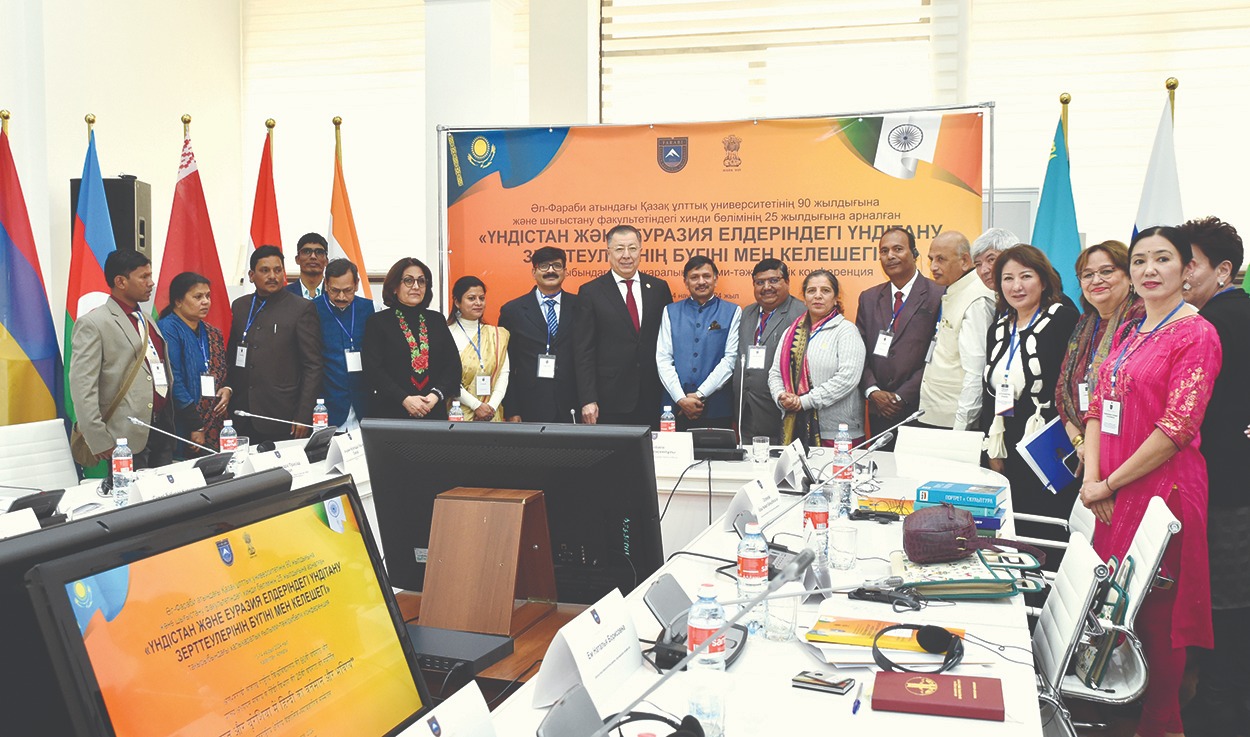
On March 13–14, 2024, the Farabi Library hosted the international scientific-practical conference “The Present and Future of Indology in Eurasian Countries and India”, dedicated to the 90th anniversary of Al-Farabi Kazakh National University (KazNU) and the 25th anniversary of the Hindi Department at the Faculty of Oriental Studies. The conference was organized by the Faculty of Oriental Studies in cooperation with the Embassy of the Republic of India in Kazakhstan and the Indian Cultural Center.
Opening the conference, KazNU Rector Zh.K. Tuymenbayev highlighted the high level of participants, which included the Extraordinary and Plenipotentiary Ambassador of the Republic of India to Kazakhstan Mr. T.V.N. Prasad, representatives of the Government of India, and scholars and faculty members from leading universities in India. During the conference, participants discussed current issues in the development of Indological research, linguistics, and literary studies, as well as methodologies for teaching Hindi in Eurasian countries and India.
Hindi ranks as the fourth most widely spoken language in the world. It is the heir of the great ancient language Sanskrit and is considered a rich and beautiful language. Hindi is studied and researched globally, including in CIS countries, as emphasized by the speakers. All participants’ presentations were included in the conference proceedings. Additionally, guests had the opportunity to explore the city of Almaty and visit Chimbulak, leaving a lasting impression.
KazNU takes pride in being the only domestic university with an Indian Studies department. The Hindi Department at the Faculty of Oriental Studies was established in September 1998 through the efforts of then-dean Professor Aldabek Nurzhamal Abdrasakovna and the first Urdu language instructor Professor Dosova Senimgul Nauryzbayevna. Since its inception, over 100 Indology specialists have graduated, including diplomats, scholars, educators, and employees of international corporations.
Kazakh Indology is a young but actively developing field. Faculty members prepare educational materials, conduct scientific research, defend dissertations, and publish monographs and teaching aids. Notable publications include:
-
Kazakh-Hindi and Hindi-Kazakh Dictionary
-
Hindi-Kazakh Phrasebook for Banking
-
Indian Literature: Antiquity and Middle Ages
-
Introduction to Indian Philology
-
Methods of Teaching Hindi
-
History of Indian Religions
-
The Nature of Synonymy in Hindi
-
Hinduism
-
Language Contactology: Elements of Borrowing in Hindi
-
The Central Asian Factor in India’s Energy Policy
-
Religion and Politics in South Asia: Indian National Congress and the Indo-Muslim Question in British India, among others.
Kazakh translations of two famous ancient Indian epic poems (Ramayana and Mahabharata), one of the key Buddhist philosophical works (Dhammapada), and selected poems of Rabindranath Tagore—the first Asian Nobel Laureate in Literature—have also been published by poet A. Nilibayev.
In India, with the support of the Indian Council for Cultural Relations (ICCR), a collection of Abay’s works was published in Hindi, containing 40 poems and 45 prose pieces from Words of Edification (Қара сөздер). The book is titled Shabd Manjusha, meaning “Treasury of Words.” One of the major streets in Delhi is named after Abay, while Almaty has a street named after Mahatma Gandhi. A monument to Gandhi, a gift from the Republic of India, is installed in the square bearing his name. Every year on October 2, the Gandhi Jayanti—celebration of Gandhi’s birthday—is held here. The spiritual heritage of Abay and Gandhi represents not only the legacy of our peoples but of all humanity, as their works are imbued with humanism, enlightenment, mercy, justice, service to the people, and the primacy of public over personal interests.
Modern India is one of the most dynamically developing countries in the world. Relations with Central Asian countries, including Kazakhstan, hold strategic importance for India. Our nations share cultural ties rooted in history and strengthened by the Great Silk Road. Bilateral relations between Kazakhstan and India remain traditionally friendly, with unified positions on many aspects of foreign policy, regional, and global security. Actively developing areas of bilateral economic and humanitarian cooperation include IT, oil and gas, healthcare and pharmaceuticals, agriculture, science, and education. Hundreds of Indian students come to Kazakhstan for higher education annually, reflecting the high demand for our diplomas.
Students at the Indian Department have full opportunities to acquire professional knowledge and expand their country-specific expertise. In January 2018, the Mahatma Gandhi Center was opened at the Faculty of Oriental Studies. The Indology program covers a wide range of country-specific disciplines. Beyond the study of Hindi, students learn Indian history, politics, economy, culture, and literature.
The Indian Embassy actively supports year-long language internships for students. Each year, KazNU sends several students to study at different universities in India. Besides the intensive academic program, cultural and educational tours to historical sites in India are organized. A year-long internship in India significantly improves students’ language skills and broadens their professional horizons.
The Indian Department at the Faculty of Oriental Studies is truly a small India in Kazakhstan. It hosts meetings with Indian scholars and public figures, online classes with Indian professors, scientific seminars and round tables, competitions, debates, and celebrates national holidays of both countries. As the first Hindi instructor in Kazakhstan, I proudly observe the growth of Kazakh Indology, the deepening love for India, and the understanding of its importance. I wish all Indology students new professional heights and creative achievements.
Zaure Iskakova
Faculty of Oriental Studies
Department of the Middle East and South Asia
Indian Department