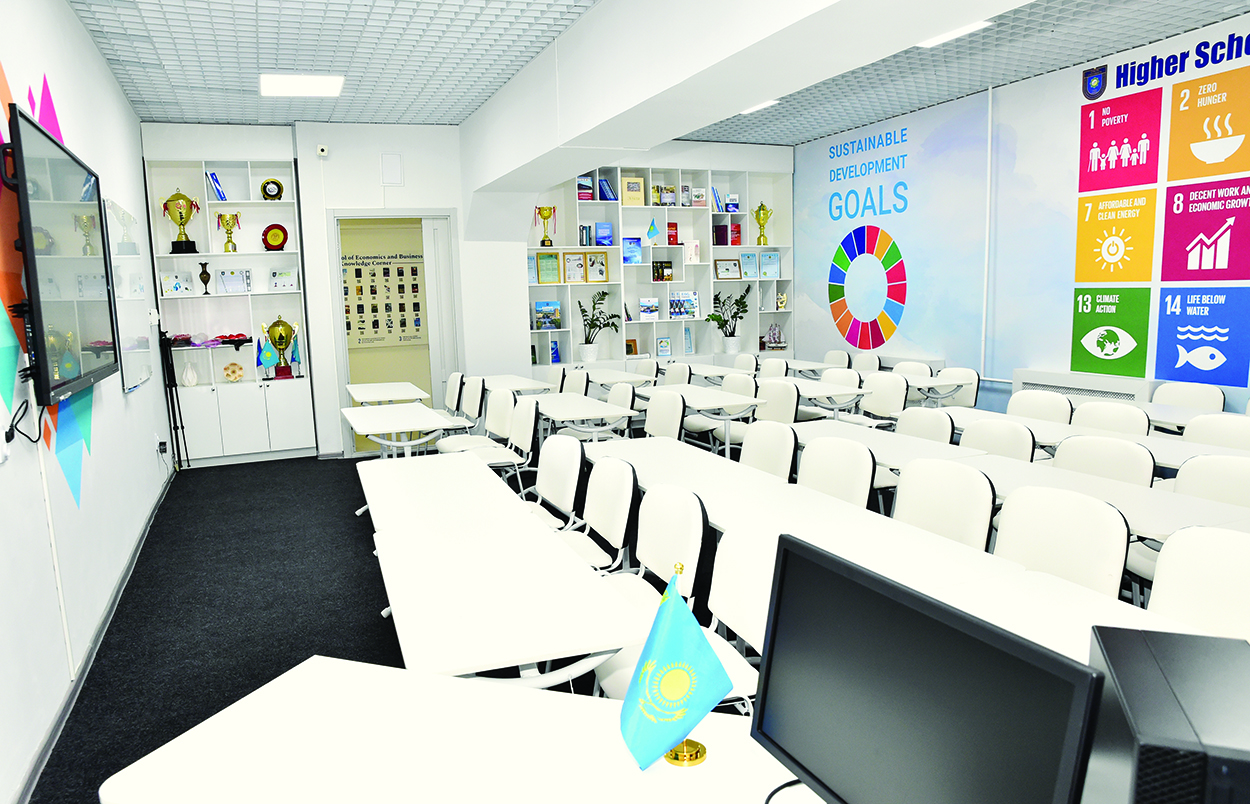
At the School of Economics and Business, the official opening of the new “Sustainable Development Goals” classroom took place. The mentioned classroom reflects Al-Farabi Kazakh National University’s strategic position in the field of sustainable development, as well as the scope of its scientific and social mission.
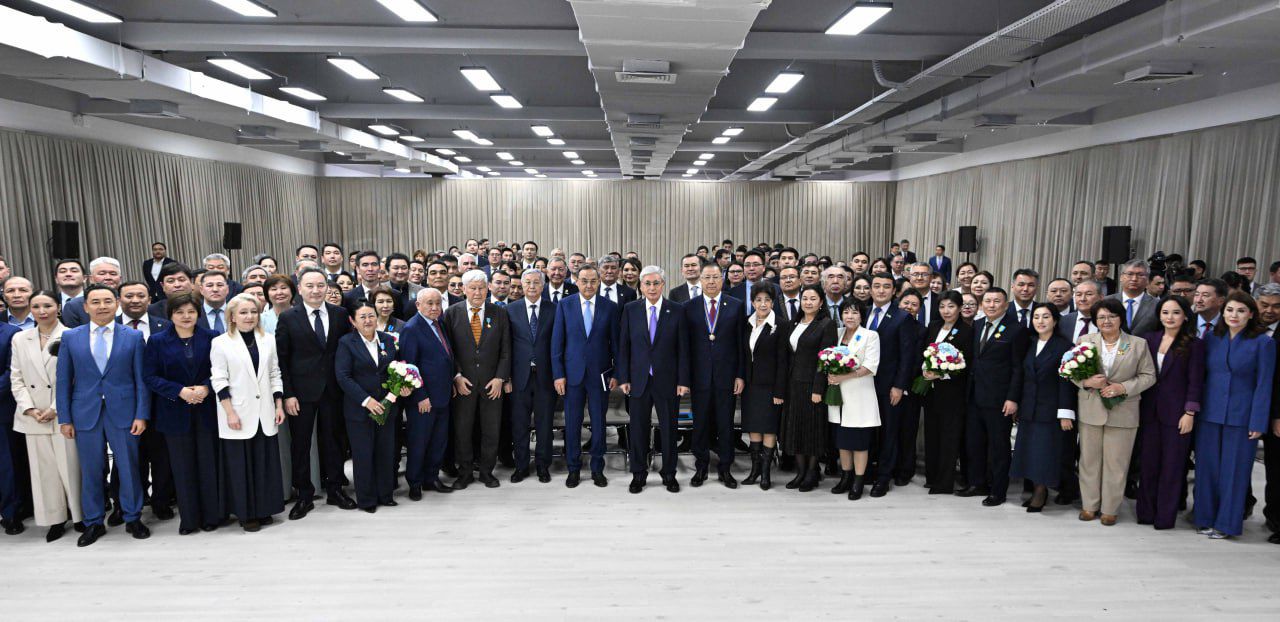
The ceremonial opening was attended by a member of the University Board – acting Vice-Rector for Scientific and Innovative Activities, PhD, Associate Professor Marghulan Ibraimov, the classroom’s sponsor, employer partner – CEO of “PSK Stroy-Invest” LLP Saken Abenov, as well as the teaching and professorial staff, doctoral students, and students. The classroom is opened as a scientific-cognitive, research, and discussion space aimed at promoting the principles of sustainable development within the university walls. Here, future experts and researchers will have the opportunity to propose comprehensive ways to solve social issues.
After the classroom opening, within the framework of the III International Scientific-Practical Conference “The Paradigm of Sustainable Economic Development in the Context of Global Changes: Challenges, Consequences, Opportunities,” an extended focus group session was held on the topic “Implementation of SDG-1 and SDG-8 in the Regions of Kazakhstan: Mechanisms for Reducing Income Inequality and Poverty”.
The focus group AP23489032 was organized within the project “Studying the Impact of Small and Medium Enterprises on Reducing Income Inequality and Poverty Levels in Kazakhstan Regions in Terms of Reducing Local Risks of Social Turbulence.” The event focused on effective policies and practical solutions aimed at reducing income inequality and poverty at the regional level.
The goal of the focus group is to discuss the progress of the implementation of the Sustainable Development Goals in Kazakhstan’s regions, particularly SDG-1 (No Poverty) and SDG-8 (Economic Growth and Decent Work), and to search for effective solutions. The event considered the impact of social policy, state support programs, entrepreneurship, and innovative approaches on reducing income inequality and poverty.
The work of the focus group covered the following issues:
• The current state of income inequality and poverty in Kazakhstan;
• Regional practices within the framework of SDG-1 (No Poverty) and SDG-8 (Economic Growth and Decent Work);
• Transformation of targeted social assistance and the “Family Digital Card”;
• The social impact of business incentives and their influence on the regional economy;
• Ways to improve state support.
Representatives of local executive bodies, entrepreneurs, and employers actively participated in the focus group, exchanging opinions on regional experiences, current problems, and alternative ways to solve them. Specifically, reports were made by Nurtugan Oralbaev (Deputy Director of the SDG Secretariat, Institute of Economic Research JSC, Ministry of National Economy of the Republic of Kazakhstan), Asel Zhamasheva (Chief Inspector, Labor Inspectorate, Enbekshikazakh District, Almaty Region), Alua Alisherkyzy (Head of the Department of Social Assistance, Work with People with Disabilities and Veterans, Employment Coordination and Social Programs, Zhambyl Region Administration), Gulmira Zheksembaeva (Head of the Department for Labor Market Analysis, Forecasting and Development), Rafkhat Lesuly (Head of Employment and Social Programs Department, Atyrau City), Galiya Dmitrieva (Associate Director, KPMG), Aziza Akimkhan (Investment Analyst, IFC, World Bank Group).
These events clearly demonstrated the global-level social responsibility, scientific potential, and contribution to sustainable development of Kazakh National University. The university conducts comprehensive work in the SDG 1-17 areas through education and research. The newly opened classroom and focus group are only the beginning of the sustainable dialogue and research platform within the university. In the future, KazNU will continue to develop new scientific projects and practical recommendations in cooperation with state bodies, international organizations, and business structures to improve regional policy, reduce income inequality, and combat poverty.
Galiya DAULIEVA,
Acting Dean of the SEB School