
One of the objectives of the 4th Sustainable Development Goal "Quality Education" (SDG 4) is to significantly increase by 2030 the number of young and adult people with in-demand skills, including vocational and technical skills, for employment, decent work and entrepreneurship.
Practice-oriented teaching methods are an approach to learning based on the active interaction of students with practical tasks, situations, and problems they may encounter in real life. Unlike traditional methods, where the learning process is based on the transfer of knowledge from teacher to student, practice-oriented methods emphasize the practical application of knowledge and skills.
Practice-oriented teaching methods may include such forms of work as internships, project activities, game technologies, case technologies, dual education, practical excursions, cooperation technologies (internships, trainings, educational seminars, master classes), and other active learning forms. These methods allow students to apply the acquired knowledge in real situations, develop their skills and abilities, as well as learn to work in a team and make decisions based on analysis and evaluation of various factors.
Now let us focus on the methods used by the lecturers of the Department of Physical Chemistry, Catalysis and Petrochemistry of the Faculty of Chemistry and Chemical Technology of Al-Farabi Kazakh National University within the framework of practice-oriented education.
Employment and accelerated adaptation of graduates in their future professional activity are primarily facilitated by competent and purposeful methodological assistance in organizing and conducting student internships.
During the academic practice, students became familiar with the achievements of the departments of the Faculty of Chemistry and Chemical Technology, as well as the Center for Physicochemical Research Methods and Analysis, and the Science and Technology Park of Al-Farabi Kazakh National University. This provided students with general knowledge about their future profession, including specific professional competencies required for performing job duties at the workplace, the sequence and methods of their formation during the period of study at the university, which should contribute to a conscious choice of the bachelor’s training profile.
Students met with representatives of scientific directions of the Department of Physical Chemistry, Catalysis and Petrochemistry, particularly those engaged in projects under the supervision of Professors A.K. Ospanova, G.A. Seilkhanova, and Acting Associate Professor Q. Toshtai. These groups attracted students’ attention because younger students are actively involved in them.
During industrial practice, students gain experience in professional activities as trainees or assistants to specialists: studying production technology, becoming familiar with the technological equipment of the production process, learning the specifics of control and management of the technological process, etc. They acquire experience in solving specific production tasks under the supervision of a professional in accordance with individual assignments.
Below is a list of enterprises that serve as practice bases for students studying under the educational programs “6B07104 – Chemical Technology of Organic Substances” and “6B05301 – Chemistry”.
Project-based technologies involve the independent activity of students (individual, paired, or group), carried out over a specified period of time.
Under the guidance of Associate Professor of the Department, Candidate of Chemical Sciences Zh.Kh. Tashmukhanbetova, senior students and undergraduates carry out research projects as part of their independent work. Such projects are also implemented within the framework of final control. In this case, assignments are given in advance during the semester. The duration may be several days or weeks, at the discretion of the lecturer. The submission deadline corresponds to the examination schedule. Such assignments are also practiced by Professor G.A. Seilkhanova.
Case technologies are aimed at forming qualified graduates through solving real or simulated problem situations in the context of professional activity, presented in the form of a case. Senior Lecturer of the Department A.A. Batyrbayeva practices case tasks in independent student work and final control. The technology involves presenting students with a situation containing a problem, contradiction, or question that can provoke discussion and active debate. The optimal solution may be one, while alternative solutions are several. The situation encourages students to discover the new in the familiar.
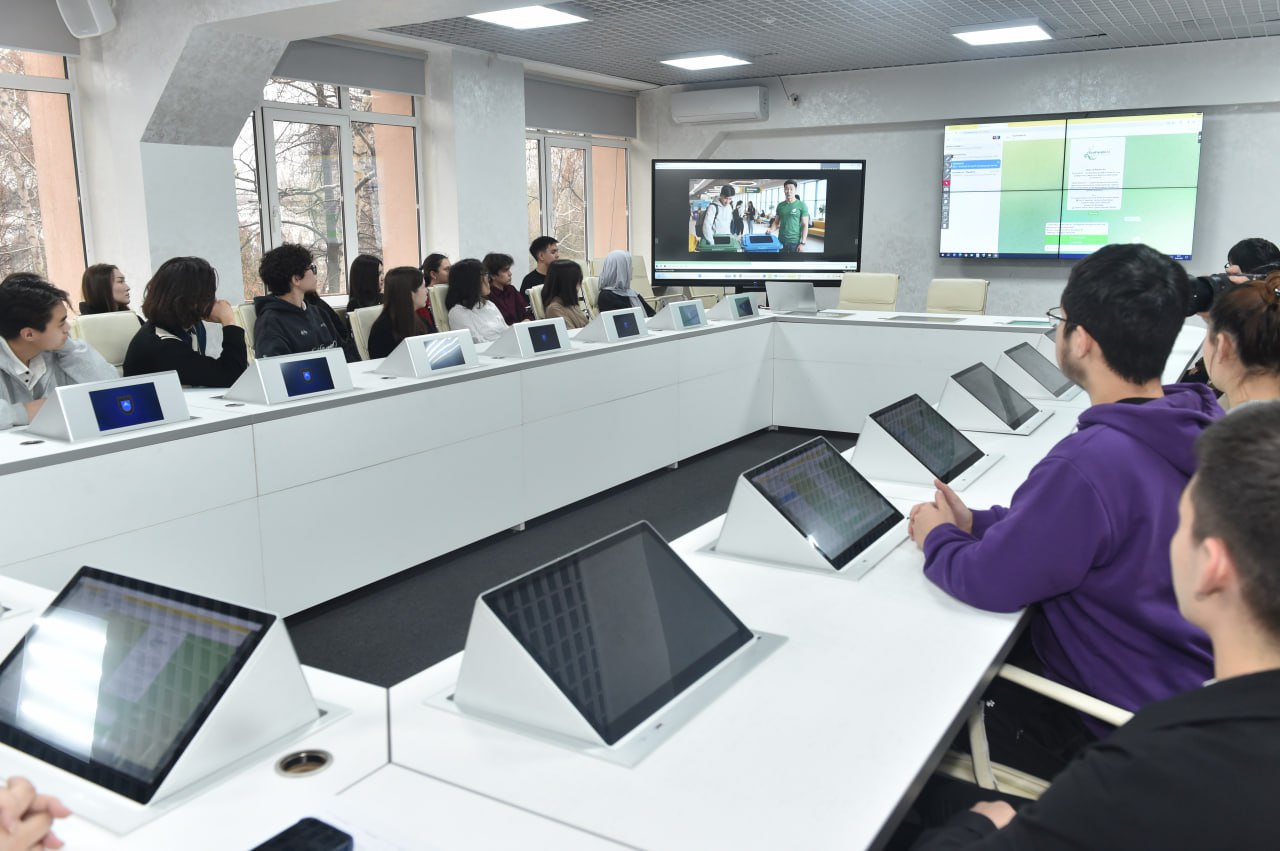
Practical classes in the discipline “Metrology and Standardization” are conducted by lecturer R.A. Iskakova in the form of a business game, according to a plan developed by the students themselves, taking into account the assignments to be completed according to methodological recommendations. Student-organizers monitored knowledge in various game formats, which made the class quite engaging and lively.
Practical excursions are an excellent way to show students how theoretical knowledge is applied in practice. Lecturers of the Department R.A. Iskakova and S.M. Narenova organized excursions for 3rd-year students this academic year to the A.B. Bekturov Institute of Chemical Sciences, as well as to the enterprise “LUKOIL Lubricants Central Asia,” in particular, to a modern plant for the production of lubricants, where students became acquainted with the robotic production workshop, finished product storage facilities, and the modern quality control laboratory.
Now let us outline the problems arising during the implementation of practice-oriented learning in higher education institutions:
-
Overcoming the stereotype of thinking among teachers in organizing the learning process: moving from the technology of knowledge transfer to the technology of experiential learning.
-
Insufficient organization by university lecturers of professional development programs for enterprise employees and lack of industrial internships for teaching staff.
-
Dual education, as the main form of practice-oriented technology, has not received sufficient development.
-
Dual education presupposes the active participation of enterprises, which currently presents certain difficulties.
-
The participation rate of junior students in research projects is less than 50%, although research activity at any stage of study contributes to increasing the scientific level of higher education specialists.
The development of practice-oriented technology in a university can be achieved through the following tasks:
-
Increasing the professional competence of teachers in knowledge of production.
-
Developing long-term mutually beneficial relations with enterprises and organizations in the training profile.
-
Developing research and design-engineering projects with student participation.
-
Practicing the assignment of continuous creative projects to junior students, later transformed into final qualification works.
-
Expanding dual education, since according to the Rules for the Organization of Dual Education in Higher and (or) Postgraduate Education Institutions (Order of the Minister of Science and Higher Education of the Republic of Kazakhstan dated July 27, 2023, No. 361), it can be implemented both by individual disciplines and by modules.
Thus, practice-oriented technologies provide freedom in choosing an educational trajectory and are flexible in restructuring the structures and content of professional education in the rapidly changing labor market environment.
Rauiya ISKAKOVA
Saule NARENOVA
Acting Associate Professors of the Department of Physical Chemistry,
Catalysis and Petrochemistry