Contribution of the academician to modern robotics science
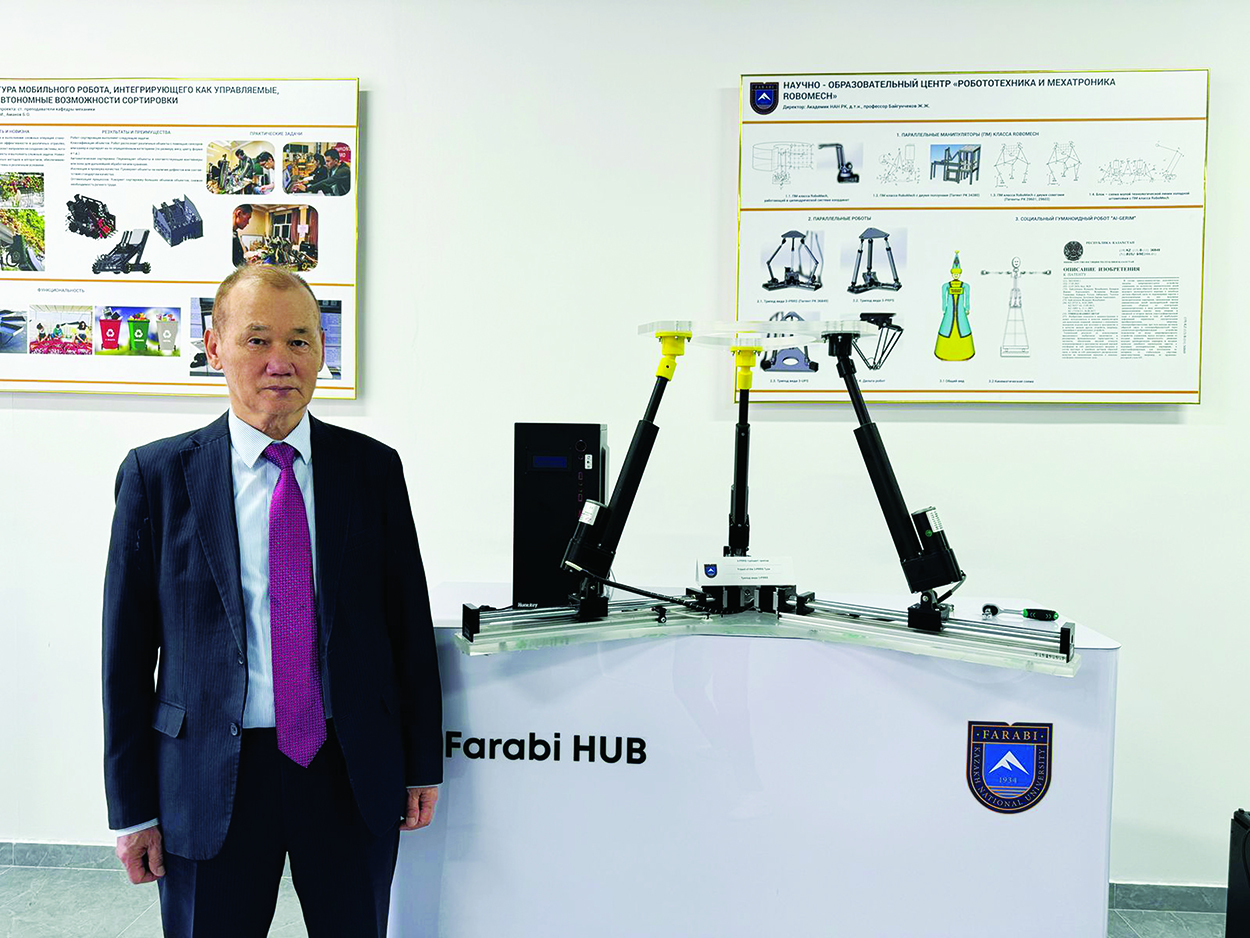
Zhumadil Baygunshyekov is a Doctor of Technical Sciences, Professor, and Academician of the National Academy of Sciences of the Republic of Kazakhstan. He currently serves as the Director of the Scientific and Educational Center for Robotics and Mechatronics at Al-Farabi Kazakh National University. He has been awarded the V.G. Shukhov Gold Medal from the International and Russian Engineers’ Union, the “Honored Worker of Education” badge from the Ministry of Education and Science of Kazakhstan, and the Order of Parasat.
– “From 1974 to 1977, I studied in the postgraduate program at Kazakh State University under the supervision of the then-university rector, Academician Omirbek Arslanuly Zholdasbekov. In 1977, I defended my candidate dissertation on the theory of mechanisms and machines, and in 1985, my doctoral dissertation. My candidate dissertation focused on the analytical kinematics of high-class mechanisms, while my doctoral dissertation was dedicated to the synthesis of these high-class mechanisms and the creation of new manipulators based on them”,- says Zhumadil Zhanabayuly.
– “The theory of mechanisms and machines is one of the leading fields of the modern Industry 4.0 concept and forms the foundation of robotics. Robotics integrates mechanics (machine mechanics), electronics, and information systems, which are the core principles of mechatronics. In line with the development of modern robotics and mechatronics, our university established the RoboMech Scientific and Educational Center for Robotics and Mechatronics, which has been operating since November 2017. The center contributed to the launch of the Robotic Systems program and conducts research in robotics and mechatronics. Current research focuses on parallel robots, RoboMech-class parallel manipulators, humanoid robots, and walking robots”.
According to Zhumadil, parallel robots consist of closed kinematic chains, which gives them higher load capacity, positioning accuracy, and speed compared to open-chain anthropomorphic (arm-type) industrial robots such as KUKA or PUMA. The center studies new types of parallel robots—tripods—consisting of three closed kinematic chains. These tripods can be used as motion simulators, testing devices, and medical prostheses. Additionally, the center researches DELTA-parallel robots for additive construction and control tripods for managing thrust vectors of solid-fuel rocket engines.
– “RoboMech-class parallel manipulators possess properties that allow their robot members to perform predetermined motions, transmitting motion laws through the actuating joints. This makes RoboMech-class manipulators simple, fast, and suitable for automated machines. At the center, RoboMech-class parallel manipulators working in cylindrical coordinate systems with two sliders and two working members are being developed and tested. These can be applied in automated cold-stamping production lines. From a theoretical perspective, the scientific program for high-class mechanisms created by my mentor, Academician Omirbek Zholdasbekov, over half a century ago, now aligns with modern programs for parallel robots and manipulators”,- notes the academician.
– “At RoboMech, we are developing the Ai-Gerim social humanoid robot and a six-legged walking robot (hexapod). The Ai-Gerim robot has 21 degrees of freedom. Its head and torso move via parallel manipulators—tripods—enabling human-like motion and stability. The Ai-Gerim robot can assist physically challenged individuals (PCIs), allowing them to work remotely via Wi-Fi. It can also serve as a guide, consultant, or sales assistant in museums, supermarkets, and other public spaces”.
Currently, RoboMech conducts international-level research and trains PhD students. The center collaborates with Lawrence Technological University (USA), University of Bridgeport (USA), University of Poitiers (France), University of Calabria (Italy), and Shandong Academy of Sciences (China).
Zhumadil Zhanabayuly is a prominent scholar in mechanisms and machine theory, mechatronics, and robotics, establishing a new international scientific program in RoboMech-class parallel manipulators. He is a member of the IFToMM (International Federation for the Promotion of Mechanism and Machine Science) Technical Committee on Robotics and Mechatronics. He has held visiting professorships at Dresden Technical University (Germany, 1991), Middlesex University (UK, 1998–2000), and Nottingham University (UK, 2001). He has presented at nearly 80 international conferences, symposia, and congresses, authored over 400 scientific works, and holds 80 patents. Under his supervision, 10 doctoral, 20 candidate, and 3 PhD dissertations have been defended.
Gulnar ZHUMABAYKYZY