Research centers – experimental platform
The development of science and education is the foundation of a country’s socio-economic progress. To achieve this, involving students in research centers, introducing them to scientific work, and supporting young researchers are among the key priorities today.
In research centers, students combine theoretical knowledge with practical experience, gaining access to new scientific ideas and innovations. To ensure that research generates tangible industrial and economic benefits, the government can implement programs supporting innovative ideas and link them to research centers. This approach allows young scientists to explore new ideas and solutions.
Research centers work closely with university departments, increasing the volume of scientific work and addressing obstacles to the development of science. Such collaboration fosters scientific innovation in education and opens up new opportunities in science and education. It also develops students’ critical thinking and problem-solving skills. Engaging in research enables students to cultivate their investigative abilities and encourages them to seek innovative solutions.
According to the United Nations Sustainable Development Goal 4—quality education—research centers provide students with opportunities to conduct research, participate in scientific projects, and present their work internationally. This strengthens students’ scientific potential and introduces them to the global scientific community. Moreover, research experience enhances students’ competitiveness in the labor market, as many employers seek specialists with high-level research experience.
To attract students to research centers, strong collaboration between universities and scientific institutions is essential. For example, the Department of Chemical Physics and Materials Science works closely with research centers such as the D. V. Sokolsky Institute of Fuel, Catalysis, and Electrochemistry, the Institute of Combustion Problems, and the Zhalyn Scientific-Technical Research Center. Through participation in scientific projects, students gain new knowledge and skills, paving the way for their scientific careers. At the same time, research centers enable young researchers to realize their potential and implement innovative projects.
Thus, involving students in research centers ensures the integration of education and science, fostering the development of young scientists’ potential. Scientific discoveries and technological advancements transform all areas of public life.
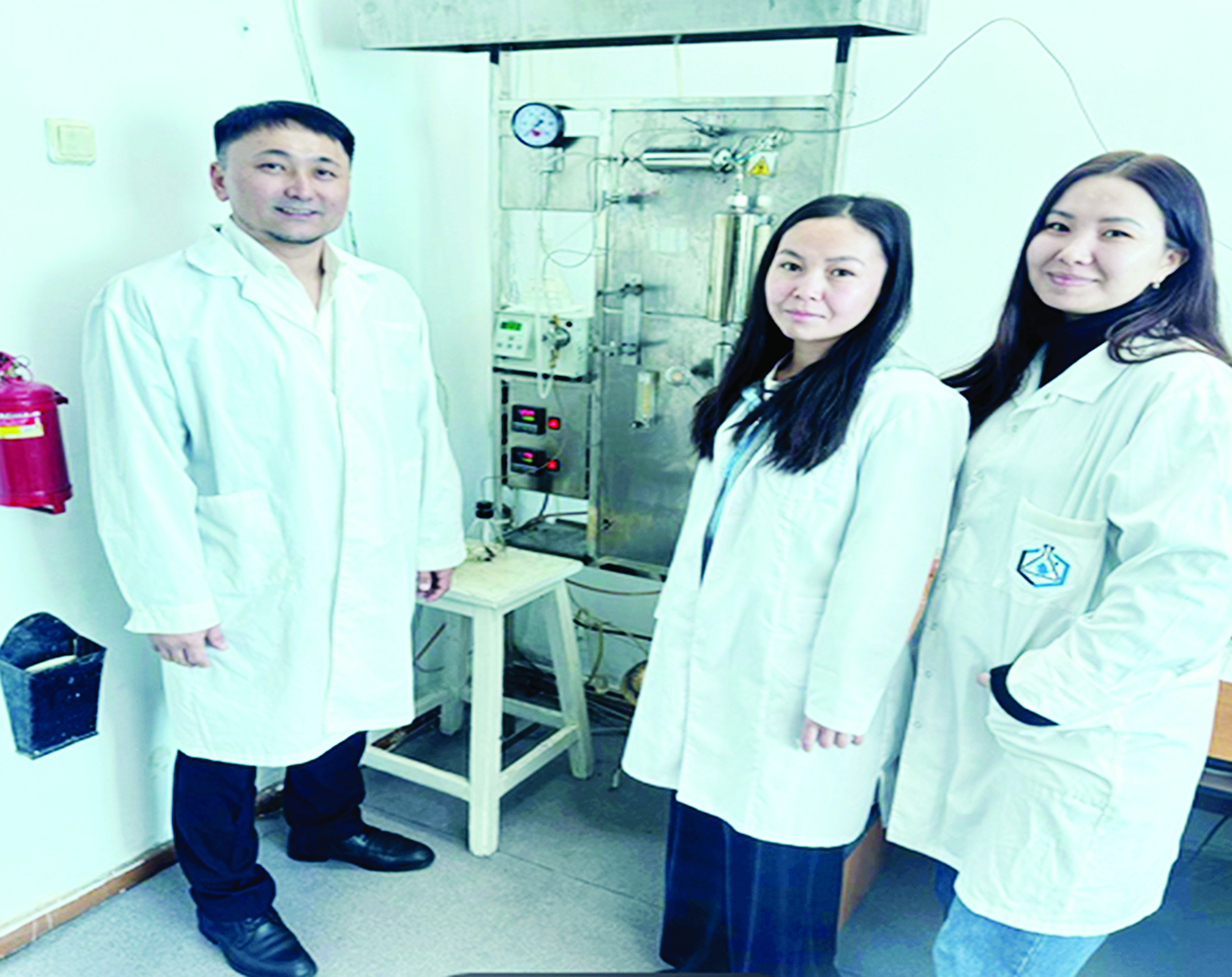
For example, young scientists work on single-stage flow-type model units for processing hydrocarbon feedstocks.
The D. V. Sokolsky Institute of Fuel, Catalysis, and Electrochemistry focuses on combining research, education, and industrial processes in the fields of fuels, oil chemistry, catalysis, and electrochemistry. At the institute, students collaborate with skilled scientists to develop nano-scale catalysts and test them in oil refining processes. Deep processing of hydrocarbon feedstocks and creating new catalysts using single-stage technology is a critical and promising scientific and practical task. Newly developed catalysts are tested extensively in flow-type model units. The global priority in oil refining is to create and implement new catalytic technologies, improving oil processing quality.
Currently, the Laboratory of Oil Refining Catalysts exchanges knowledge with young scientists, fostering their interest in science. Research leads to new technologies, methods, and solutions. Graduates of the institute gain experience that allows them to work in various fields of industry and science, making significant contributions to the development of the country.
Aizhan Omarova,
PhD, Associate Professor