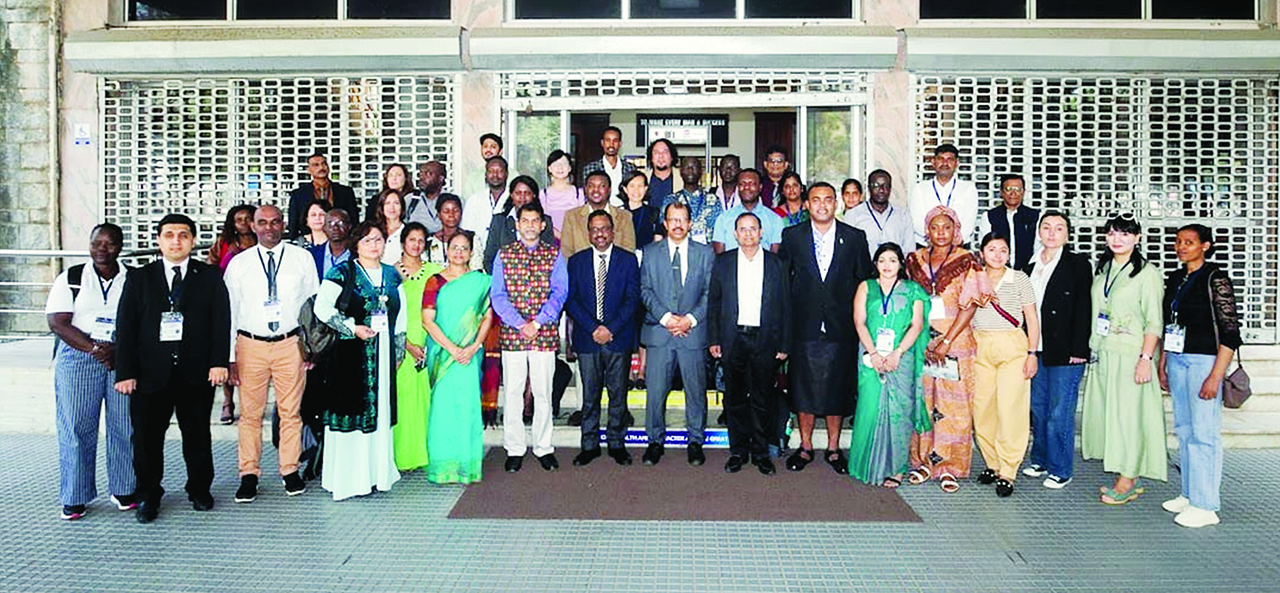
The program focused on understanding the role of education as a strategic resource in achieving the Sustainable Development Goals (SDGs), especially in the context of global challenges facing emerging economies. According to the UN concept, it is education – in a broad sense, encompassing both academic and vocational training – that plays a key role in ensuring sustainable employment, stimulating innovation, reducing social inequality and strengthening national competitiveness. Participation in this program allowed us to look at these tasks through the prism of international experience, especially based on Indiaeducational practices and cases presented by the participating countries.
The key topics of the training were:
1. SDG 4 (Quality education) – development of vocational education programs, introduction of modular training, advanced training of teachers, introduction of hybrid formats using digital technologies;
2. SDG 5 (Gender Equality) – women's participation in TVET systems, mechanisms for engagement and creation of an inclusive educational environment;
3. SDG 8 (Decent work and economic growth) – ensuring graduates' competence that meets the requirements of the labor market and the digital economy;
4. SDG 9 (Industrialization, innovation and infrastructure) – development of regional educational hubs, integration of TVET with industrial clusters, examples of sustainable partnership of institutions with business and the IT sector;
5. SDG 17 (Partnership for Sustainable Development) – transnational academic cooperation, the ITEC program as a model of south-South cooperation.
The classes were conducted in the form of lectures, panel discussions, project seminars and international symposia, where each country presented an analysis of the progress achieved on selected Sustainable Development Goals. Special attention was paid to national strategies for sustainable development, including the integration of the SDGs into educational policy. The presented cases from India, Haiti, Kenya, Argentina, Chile, Fiji, Niger and Nigeria and other countries demonstrated a wide range of approaches to solving the problems of inequality, unemployment and the educational gap.
One of the key areas of discussion was the role of international cooperation in achieving the SDGs: participants shared experiences from bilateral and multilateral initiatives such as specialist exchanges, joint research projects, and digital educational platforms. Emphasis was placed on the importance of building sustainable partnerships between universities, Governments and NGOs. These approaches make it possible not only to scale successful practices, but also to form a global community of professionals focused on building a fair and sustainable future.
The ITEC format deserves special attention as an effective experience exchange platform for the countries of the Global South. Since its establishment in 1964, ITEC has established itself as the most flexible mechanism for institutional cooperation and the formation of human resources. Thanks to the academic component based on the international agenda, participants had the opportunity not only to master the theoretical aspects of sustainable development policy, but also to consider innovative implementation mechanisms, including digitalization of education, multi-level certification schemes, the introduction of ESG approaches and interdisciplinary training modules.
A special place in the program was given to practical sessions on the development of indicators for evaluating the effectiveness of TVET in the context of the SDGs; creation of cooperation networks between educational institutions and employers; analysis of sustainable development policies at the national level; implementation of green skills and the principles of circular economy. The academic part of the program was accompanied by visits to technology parks, industrial colleges, startup incubators and women's technical centers, which allowed participants to verify the practical feasibility of the educational and innovative models presented. International conferences, seminars and master classes were also an important component, during which strategies for implementing the SDGs were discussed, methodological developments were exchanged and professional academic ties were formed between representatives of different countries and educational systems.
In conclusion, I would like to express my sincere gratitude to the Government of India, the organizers of the ITEC program, as well as all the teachers and curators of the National Institute for Training and Research in Technical Teaching (NITTTR) in Chennai for their professionalism, goodwill and great work to promote the goals of sustainable development through education.
The experience of public speaking at international seminars and conferences organized within the framework of the ITEC program has become especially valuable for me. During these events, I was lucky enough to present an analytical report on the implementation of the Sustainable Development Goals in Kazakhstan, identify national priorities and strategic initiatives aimed at achieving the SDGs in areas such as education, gender equality, sustainable cities and climate action.
No less significant was the opportunity to present his author's teaching methodology, based on an interdisciplinary approach and critical thinking, to colleagues from around the world. It has become a platform not only for the exchange of experience, but also for professional dialogue, in which ideas for the transformation of the educational space are born. I deeply appreciate the feedback I have received from international participants – it has allowed me to take a fresh look at my own practice and strengthened my confidence that we are moving in the right direction.
For me, it wasn't just an internship – it was a powerful impetus to rethink my teaching role and my contribution to the future. When I returned, I tried to bring to my work the inspiring energy that I received in India, and now I can say with even more confidence that even one month in such an environment can change the way I look at my profession, education, and my own mission in life.
I urge my university colleagues to actively participate in similar international programs such as ITEC. These are not just training courses, but an intellectual platform where a new perspective on global challenges is being formed, professional connections are being formed and academic cooperation is being built. Participation in such initiatives allows us to go beyond the usual, expand our horizons, reflect on our own experience in an international context and contribute to sustainable development – not in words, but in practice.
Fatimabibi DAULET,
Associate Professor Departments of Chinese Studies