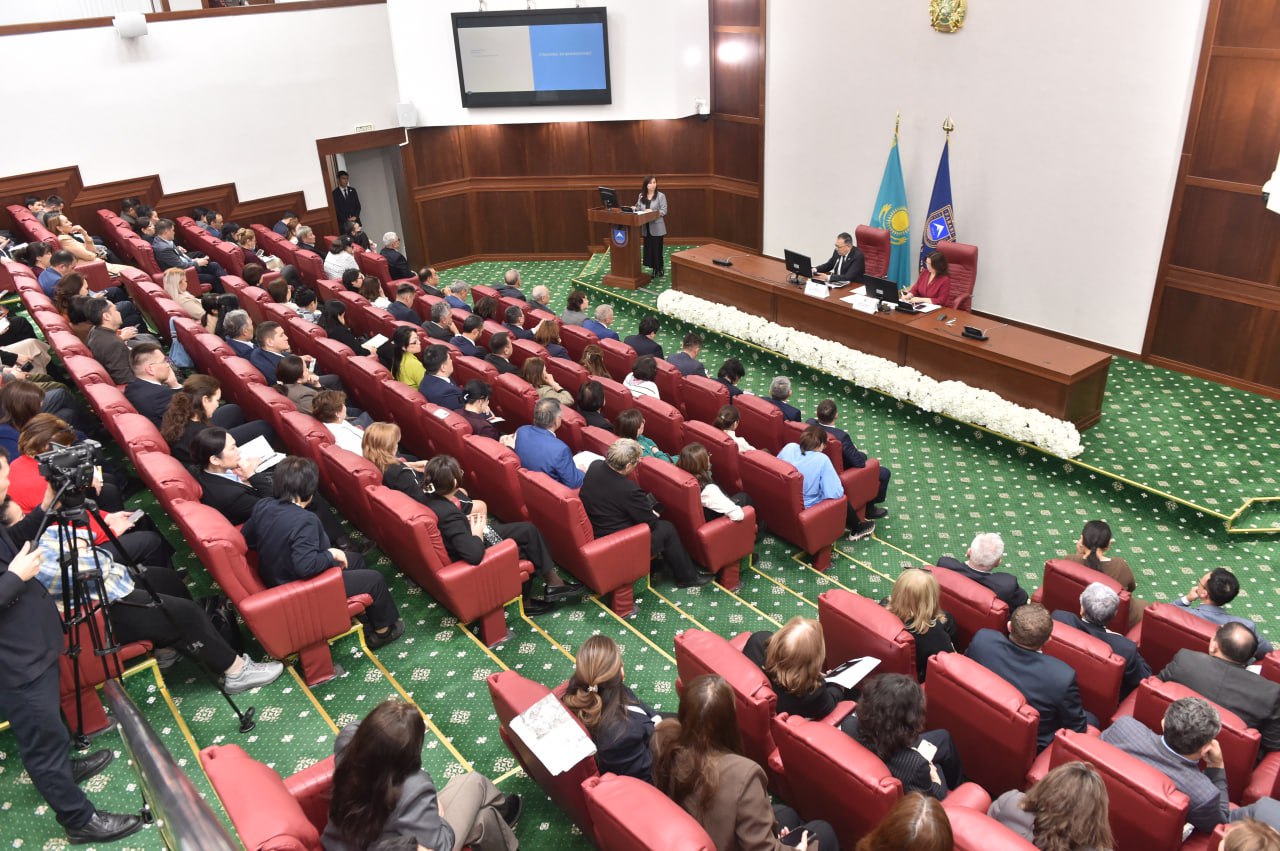
Guest Lecture on «Law and Order in the New Kazakhstan»

The “Law and Order” Project is one of the key initiatives for Kazakhstan, aimed at ensuring security through the development of law-enforcement structures and public order, and is being implemented in line with the President’s September Address to the nation.
Within the framework of the project, the Faculty of Law of Al-Farabi KazNU conducts activities under SDGs 4, 16, and 17 of the UN, aimed at increasing the legal literacy of student youth. Thus, on November 20, 2025, a guest lecture titled “Law and Order in the New Kazakhstan” was held for graduates of the Faculty of Law by our partners from the Academy of the Ministry of Internal Affairs.
The speaker of the event was the Head of the Faculty of the M. Yesbulatov Almaty Academy of the Ministry of Internal Affairs of the Republic of Kazakhstan, Police Colonel Kan Aleksandr Gerasimovich, who delivered a leadership lecture on strengthening legality and public order, cybersecurity, and presented new types of cyber offenses emerging in Kazakhstan as well as modern methods of protecting the population from them.

The event was organized by Doctor of Law, Associate Professor of the Department of Theory and History of State and Law, Constitutional and Administrative Law Kalisheva N.Kh., with the support of speakers — members of the scientific community “Fair Law” Zhakitov B., Zhaksybayev R., Kuandykov A., and Aresimova S. Thе newly launched digital service “Law and Order” is aimed at strengthening citizens’ legal consciousness and promoting a healthy lifestyle. Overall, law and order is a fundamental principle of state policy, focusing on ensuring the safety of citizens. It implies that the state must guarantee security, stability, and the fair enforcement of laws by all citizens and institutions.
This principle includes strengthening the legal system, law-enforcement bodies, and enhancing the legal literacy of the population to create a stable and secure society. It is not merely a punitive policy but a foundation for democracy and the rule of law.
The main components of this principle are: the rule of law; law enforcement and security; active work of law-enforcement agencies aimed at preventing offenses (for example, drug crimes, gambling addiction) and protecting citizens; legal literacy and education; social stability; justice and protection of rights; and, of course, responsibility, since implementing this principle requires not only adopting laws but ensuring their strict compliance, forming an understanding of the inevitability of punishment for violations.
Department of "Theory and History of State and Law, Constitutional and Administrative Law"
Other news