Development of National Bibliography: Modern Technologies and Integration Issues
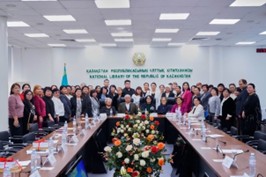
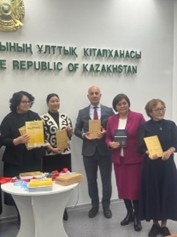
On November 12, 2025, the National Library hosted the Republican conference "Development of National Bibliography: Modern Technologies and Integration Issues." The event was attended by library specialists from all regions of the country, scientific experts, young researchers, as well as experienced bibliographers and public figures who have made a significant contribution to the development of the national bibliographic school. The conference clearly demonstrated the need to revise the role of bibliographic services in the modern information space and their adaptation to new technological requirements.
Topical issues addressed at the conference:
1. The use of outdated bibliographic standards During the discussion, it was noted that libraries in Kazakhstan still rely on standards developed 20–25 years ago, which do not reflect the realities of the digital ecosystem and do not account for the capabilities of modern technologies, including artificial intelligence. With changing methods of bibliographic data processing, updating standards and methodologies is becoming a key condition for the sustainable development of the industry.
2. The need to transition to modern international models Participants emphasized the importance of implementing and adapting modern standards such as ISO 690:2021, RDA, MARC21, Dublin Core, CSL, and BIBFRAME in order to improve bibliographic description processes, data management, and repository functioning. These models allow for the structuring of bibliographic information, ensure data compatibility, and facilitate international integration.
3. Implementation of Artificial Intelligence in bibliographic activity The potential of artificial intelligence in bibliography was noted as highly significant. AI technologies provide automatic metadata population, data identification, the formation of bibliographic descriptions, and the analysis of large arrays of information. It was cited as an example that in a number of countries, 70–80% of bibliographic processes are already automated.
4. Underdevelopment of national scientific repositories It was pointed out that the lack of a centralized open repository in Kazakhstan hinders the development of scientific communication. In this regard, questions were discussed regarding the formation of an Open Access policy, the use of Creative Commons licenses, integration with DOI assignment systems, and the creation of a unified platform accumulating the national scientific heritage.
Master's students of the educational programs "Library and Information Systems" and "IT-Archival Science and Records Management" of the Department of World History, Historiography, and Source Studies of the Faculty of History of Al-Farabi Kazakh National University took an active part in the event. They prepared substantive proposals and analytical reviews corresponding to their research directions.
Lecturers and Master's students of the department:
-
Contributed to the organization of the event;
-
Provided informational support for the conference;
-
Prepared scientifically grounded presentations on issues of digital bibliography, open repositories, and international standards;
-
Presented the results of their own research with academic precision;
-
Took an active part in the professional discussion.
The high scientific level of the Master's students, the reasoned nature of their proposals, and their ability to correctly interpret modern technological trends testify to the quality of training, the innovativeness of the educational process, and the systematic nature of the department's scientific activity.
Based on the results of the conference, the following directions for the renewal and modernization of national bibliography were formulated:
-
Updating current standards;
-
Harmonization with international models and classifications;
-
Implementation of artificial intelligence technologies;
-
Formation of a national scientific repository;
-
Modernization of educational programs in accordance with the digital transformation of the industry.
Kazakhstan's libraries are entering a new stage of digital transformation, and the success of this process largely depends on the level of professional training, the renewal of scientific approaches, and the flexibility of the education system.