“The Role of Land Resources in Ensuring Food Security in the Republic of Kazakhstan”
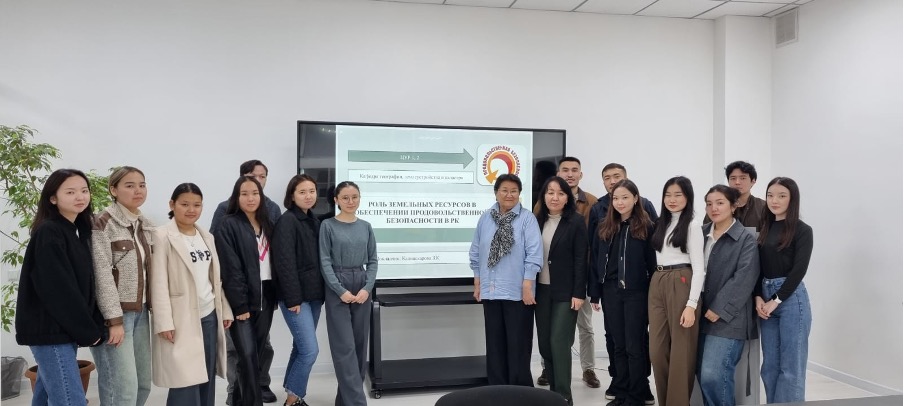
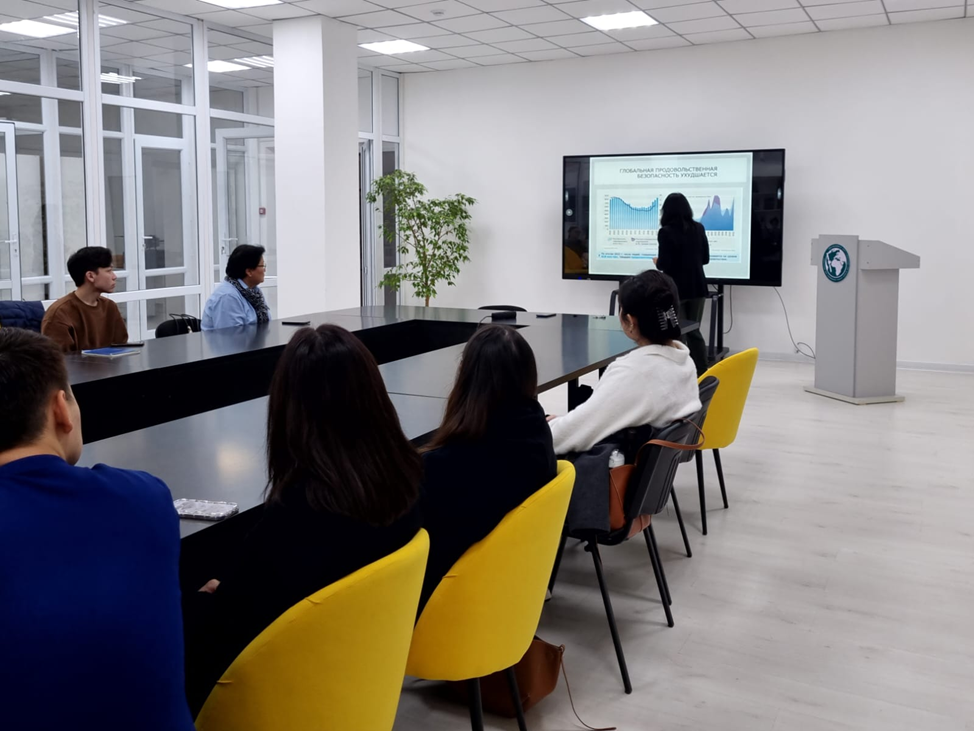
On October 2, 2024, at the Faculty of Geography and Environmental Management, Associate Professor Z.K. Kaliaskarova of the Department of Geography, Land Management, and Cadastre held a discussion with Professor K.D. Abubakirova and students of the specialties “Geography” and “Land Management” on the topic “The Role of Land Resources in Ensuring Food Security in the Republic of Kazakhstan.” This event was organized within the framework of achieving the Sustainable Development Goals (SDGs 1, 2, 13, 15).
Food security in Kazakhstan is a key component of national security. In the context of global challenges — climate change, population growth, limited natural resources, and international instability — providing the population with sufficient and quality food is a strategically important task.
SDG 1 – No Poverty and SDG 2 – Zero Hunger emphasize the importance of ensuring access to nutritious food for all social groups. Kazakhstan, with extensive agricultural resources (over 74% of its territory suitable for agriculture), has the potential to ensure food security and reduce food vulnerability among its population.
SDG 13 – Climate Action and SDG 15 – Life on Land highlight the need for sustainable land use and ecosystem protection. Climate change and land degradation negatively affect crop yields, agricultural productivity, and food availability. Therefore, implementing environmentally safe technologies, preserving soil fertility, and adapting to extreme climatic conditions are essential for sustainable development.
To ensure sustainable food security and achieve the SDGs, Kazakhstan needs a comprehensive set of measures:
-
Developing agriculture with sustainable and innovative technologies.
-
Improving infrastructure and logistics to ensure equitable food distribution.
-
Strengthening food reserves to reduce dependency on imports.
-
Environmental protection of land and biodiversity conservation.
-
Social support for vulnerable populations and reduction of food poverty.
-
International cooperation for knowledge exchange and sustainable resource management.
Thus, ensuring stable food supply for all citizens not only improves the quality of life but also strengthens national security, while simultaneously contributing to achieving the SDGs aimed at eliminating poverty, ending hunger, adapting to climate change, and conserving land resources.