- Main
- News
- The 2nd International Congress of Young Scientists of Kazakhstan United Leading Researchers and the Scientific Diaspora
The 2nd International Congress of Young Scientists of Kazakhstan United Leading Researchers and the Scientific Diaspora
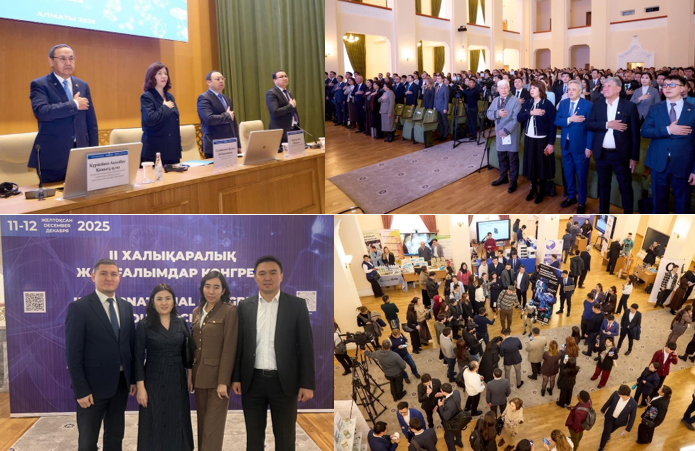
On December 11–12, 2025, the II International Congress of Young Scientists of Kazakhstan was held in Almaty. The event was organized by the National Academy of Sciences under the President of the Republic of Kazakhstan and was dedicated to UNESCO’s theme “Trust, Transformations and Tomorrow: Science Needed for 2050.” The plenary session took place at the “Gylym Ordasy,” while sectional meetings were hosted by five leading universities of the city. The Congress brought together more than 1,000 young researchers, over 80 foreign scientists from 24 countries, representatives of the scientific diaspora, academicians, members of parliament, and heads of scientific organizations.
State Counselor Erlan Karin delivered a congratulatory message, emphasizing that supporting young scientists is a key priority of national policy. He highlighted the expansion of funding, internship programs, and social support measures initiated under the President’s directives.
Minister of Education Zhuldiz Suleimenova presented new initiatives aimed at strengthening the research environment in schools, developing STEM laboratories, expanding Olympiad and project-based programs, and supporting talented students in cooperation with the National Academy of Sciences.
President of the National Academy of Sciences, Academician Akylbek Kurishbayev, introduced the Academy’s model for improving the national research system and presented 220 scientific–technical challenges and 65 scientific–technical tasks (STTs) developed through foresight studies, which will form the basis of future grant and program-targeted funding competitions. New initiatives such as the AI SilkNet Foresight and Predictive Analytics Center, a spatio-temporal artificial intelligence laboratory, and the domestic DeepBas AI model were announced. Proposals were made to enhance PhD training quality, expand access to research equipment, and strengthen regional science.
During the plenary session, international and domestic scientists discussed artificial intelligence, interdisciplinary integration, global scientific collaboration, and big-data management. Representatives from the USA, Europe, and Asia outlined opportunities for Kazakhstani researchers to engage in global programs. Kazakh scientists highlighted the importance of strengthening research infrastructure, developing scientific schools, expanding access to equipment, and engaging the scientific diaspora.
Sectional meetings covered a wide range of modern scientific fields: natural sciences, space, artificial intelligence, agrobiological resources, biomedicine, ecology, education, and social development. The program also included master classes, workshops, consultations on grants and publications, and an exhibition of innovative projects by young researchers.
In their final resolution, young scientists expressed support for the President’s strategic direction for the development of science and emphasized the importance of implementing the “Youth in Science” concept. They proposed integrating STTs into future funding competitions, improving PhD training, expanding access to research infrastructure, and fostering interdisciplinary research. Based on the Congress materials, an infographic abstract collection will be prepared and published on the NAS RK website.
Head of the Department, Zhandos Toregululy Tauanov, served as the moderator of the “Earth, Space, and Communication” section organized at Al-Farabi Kazakh National University.