- Main
- News
- Research Projects of KazNU’s Faculty of Biology and Biotechnology in Support of SDG 14 (Life Below Water) and SDG 15 (Life on Land)
Research Projects of KazNU’s Faculty of Biology and Biotechnology in Support of SDG 14 (Life Below Water) and SDG 15 (Life on Land)
28 december, 2025
The Faculty of Biology and Biotechnology at Al- Farabi KazNU implements a comprehensive approach to achieving Sustainable Development Goals 14 (Life Below Water) and 15 (Life on Land) through grant-funded research projects funded by the Ministry of Science and Higher Education of the Republic of Kazakhstan. The faculty's research encompasses the study and conservation of biodiversity in aquatic and terrestrial ecosystems, the development of biomonitoring and bioremediation methods, and the impact of anthropogenic factors on natural systems.
Preservation of aquatic ecosystems (SDG 14)
Biomonitoring and assessment of the state of aquatic ecosystems
The project "Biotesting of Water and Bottom Sediments of the Ile River and Kapshagay Reservoir, Predicting Environmental Risks to the Biodiversity of the Ecosystems Under Study," led by Professor T.M. Shalakhmetova , aims to comprehensively assess the condition of the region's largest water bodies and develop an early warning system for environmental risks.
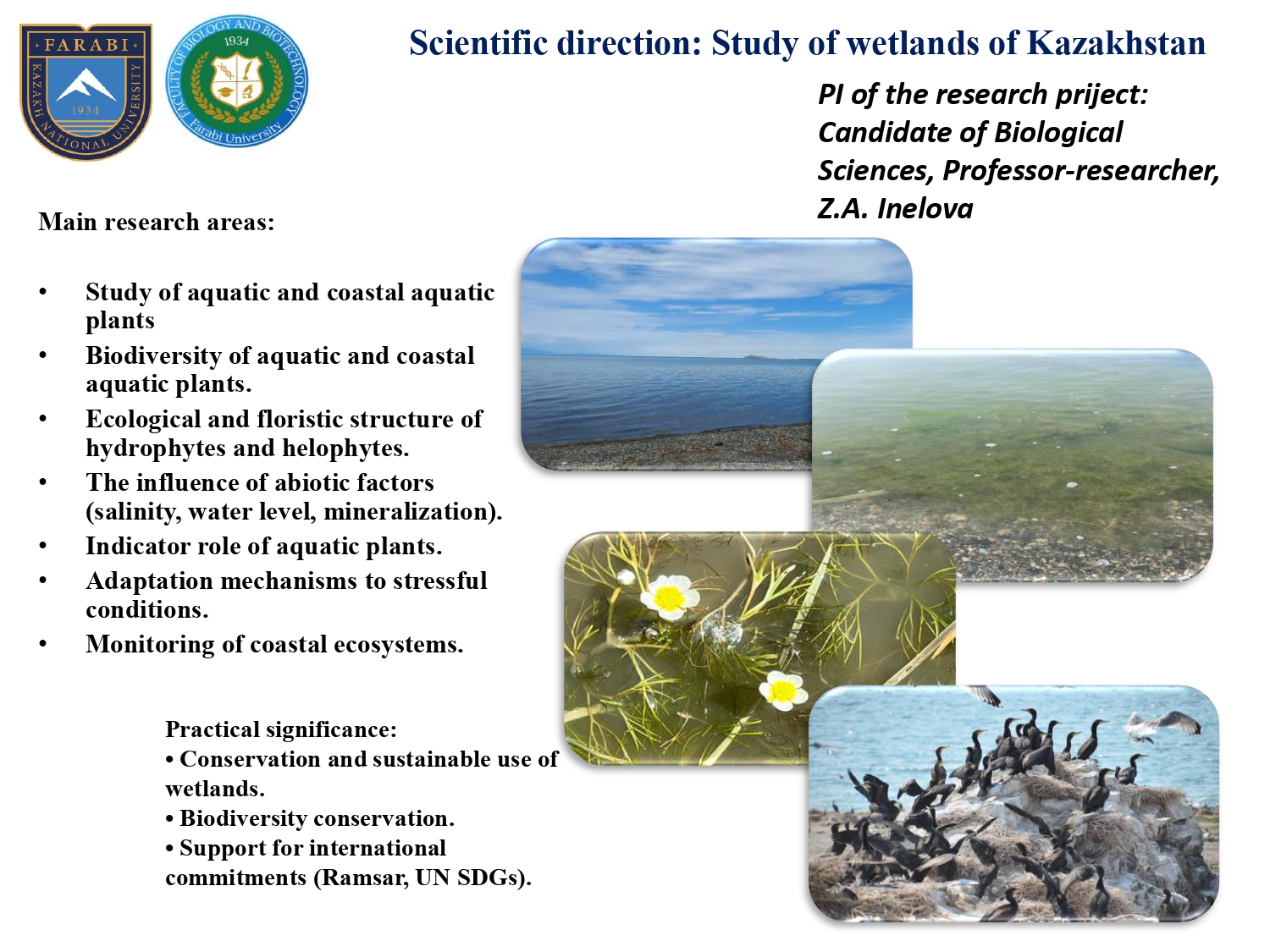
The project "Innovative Multispatial Integrated Approach to Biomonitoring Saltwater Ecosystems of Lake Alakol, " led by Z.Z. Inelova, uses modern methods to study the unique ecosystem of one of Kazakhstan's largest lakes, which is critical for preserving its biodiversity.
The study "Study of the reactivity of the eastern organ systems of the main commercial fish species of the Ile- Balkhash basin under anthropogenic pressure" under the supervision of candidate of biological sciences I.M. Zharkova allows us to assess the impact of pollution on fish resources and develop measures for their conservation.
The new project "Study of the taxonomic and functional diversity of the Alatau ichthyofauna" (2025-2027) under the direction of S.E. Sharakhmetov expands knowledge about the biodiversity of mountain aquatic ecosystems.
Protection of high-mountain aquatic ecosystems
The project "Comprehensive ecotoxicological assessment of high-mountain-glacial watersheds of the main rivers of the Northern Tien Shan" led by M.A. Suvorova is of strategic importance for preserving the region's freshwater sources and understanding the impact of climate change on mountain ecosystems.
Bioremediation of aquatic ecosystems
The project "Development of a technology for bioremediation of wastewater contaminated with petroleum products based on an algal-cyanobacterial consortium" led by faculty researchers offers environmentally friendly methods for cleaning contaminated water.
The research, "Creating a scientific and technical foundation for constructing a consortium of aquatic plants and microalgae effective for water phytoremediation ," aims to develop biotechnological solutions for restoring the quality of water bodies.
Life on land (SDG 15)
Study and conservation of rare plant species
The project "Multi-vector study of a rare relict species of Rheum compactum L. - a scientific approach to the conservation of species included in the Red Book of Kazakhstan" under the guidance of a young scientist creates a scientific basis for the conservation of endangered species.
The study "Study of the state of populations and intraspecific phenotypic variability of rare species of medicinal plants from the genus Adonis L. in Northern Kazakhstan" under the supervision of PhD Zhumagul M.Zh. contributes to the conservation of biodiversity of steppe ecosystems.
Project "Tian Shan Tauynda" Osetin , Ondiriste igeruge prospects Ranunculus L. tuysynyn 3 darilik өсімдік түрін keshendi " zertteu " under the direction of Ydyrys A. is aimed at a comprehensive study of promising medicinal plants of the Tien Shan.
The study "Comprehensive studies of some promising medicinal plant species from the Asteraceae family for industrial development" under the direction of Ydyrys A. contributes to the conservation and sustainable use of valuable plant species.
The new project "Consider the possibility of studying and practically using the current state of natural populations of some valuable medicinal plant species in Kazakhstan" (2025-2027) under the direction of Professor B.M. Tynybekov continues work on monitoring the state of rare plant populations.
The project "Research of stevia breeding lines for the creation of specialized drinks with improved functional properties" (2025-2027) under the direction of Professor S.Sh. Asrandina combines the conservation of plant resources with their sustainable use.
Bioremediation of degraded soils
The project " Phytostrategy : Restoration of hydrocarbon-contaminated soils in the Atyrau region using plants and bioinoculants " under the direction of R. Berzhanova is aimed at restoring ecosystems affected by oil pollution.
The study "Obtaining and Studying Algocyanobacterial Biofilms for the Restoration of Saline and Polluted Soils" led by M.O. Bauyenova offers innovative solutions for the reclamation of degraded lands.
The project "Study of the biotechnological potential of microalgae and cyanobacteria in the biodegradation of pesticides and their impact on increasing soil fertility" contributes to the restoration of soil ecosystems contaminated with agrochemicals .
Research "Development of decontamination technology "Biochar for sustainable conversion of biomass waste into value-added products" is aimed at creating environmentally friendly waste disposal technologies.
The project "Development of a technology for producing and testing algal-bacterial biopreparations that ensure the sustainability and increased productivity of agroecosystems " led by faculty researchers contributes to maintaining the productivity of agricultural lands.
Assessment of anthropogenic impact on ecosystems
The project "Study of the biological consequences of the influence of man-made pollutants on biota , public health, and the natural environment" under the direction of Professor A.B. Bigaliev studies the complex impact of pollution on natural ecosystems.
The new project "Study of the toxicogenetic effects of pesticides widely used in Kazakhstan ( Solito , Gulliver, Rainbow ) on biological objects" (2025-2027) under the direction of Professor T.M. Shalakhmetova assesses the impact of agrochemicals on biodiversity.
The study "Cadmium Toxicity in Rice Plants and the Use of Physicochemical Methods to Enhance Resistance" (2025-2027) under the direction of Professor S.D. Atabaeva examines the mechanisms by which plants protect themselves from heavy metal pollution.
The project "Study of potential genotoxicity and mutagenicity of microplastics in test systems in vivo " (2025-2027) under the supervision of Acting Associate Professor A.V. Lovinskaya studies the impact of modern pollutants on living organisms.
Sustainable use of bioresources
The project "Development of Agrobiological Foundations for Cultivating Perennial Rice to Increase the Productivity of Arable Land in the Almaty and Kyzylorda Regions," led by Professor M.S. Kurmanbaeva , promotes soil fertility through the implementation of sustainable agricultural practices.
The study "Integration of selective molecular marking and inoculation of plants with nitrogen fixers to form an optimal sainfoin gene pool" is aimed at preserving and improving valuable forage crops.
Interdisciplinary projects
The program-targeted financing of the project "Development of environmentally friendly technologies for producing innovative products from natural and man-made raw materials of Kazakhstan" combines efforts to preserve both aquatic and terrestrial ecosystems through the creation of waste-free technologies.
The project "Developing Chemical and Biochemical Solutions for Carbon Footprint Reduction and Ecosystem Restoration" contributes to achieving both goals by developing integrated solutions for the restoration of degraded areas.
Creation of scientific infrastructure
The project "Creation of a biobank of a collection of microalgae and cyanobacteria , and the study of their biotechnological potential for use in applied research" under the direction of B.K. Zayadan creates the basis for the long-term conservation of microbial biodiversity and their use for environmental purposes.
Thus, the research activities of the Faculty of Biology and Biotechnology at KazNU represent a comprehensive system of measures to preserve Kazakhstan's aquatic and terrestrial ecosystems. The projects being implemented cover the entire spectrum of environmental activities—from fundamental biodiversity research to the development of practical technologies for restoring degraded ecosystems, making a significant contribution to achieving SDGs 14 and 15.
Faculty of Biology and Biotechnology of al-Farabi Kazakh National University