- Main
- News
- KAZAKHSTAN–PAKISTAN: WINTER SCHOOL WITHIN THE FRAMEWORK OF COOPERATION IN EDUCATION AND SCIENCE
KAZAKHSTAN–PAKISTAN: WINTER SCHOOL WITHIN THE FRAMEWORK OF COOPERATION IN EDUCATION AND SCIENCE
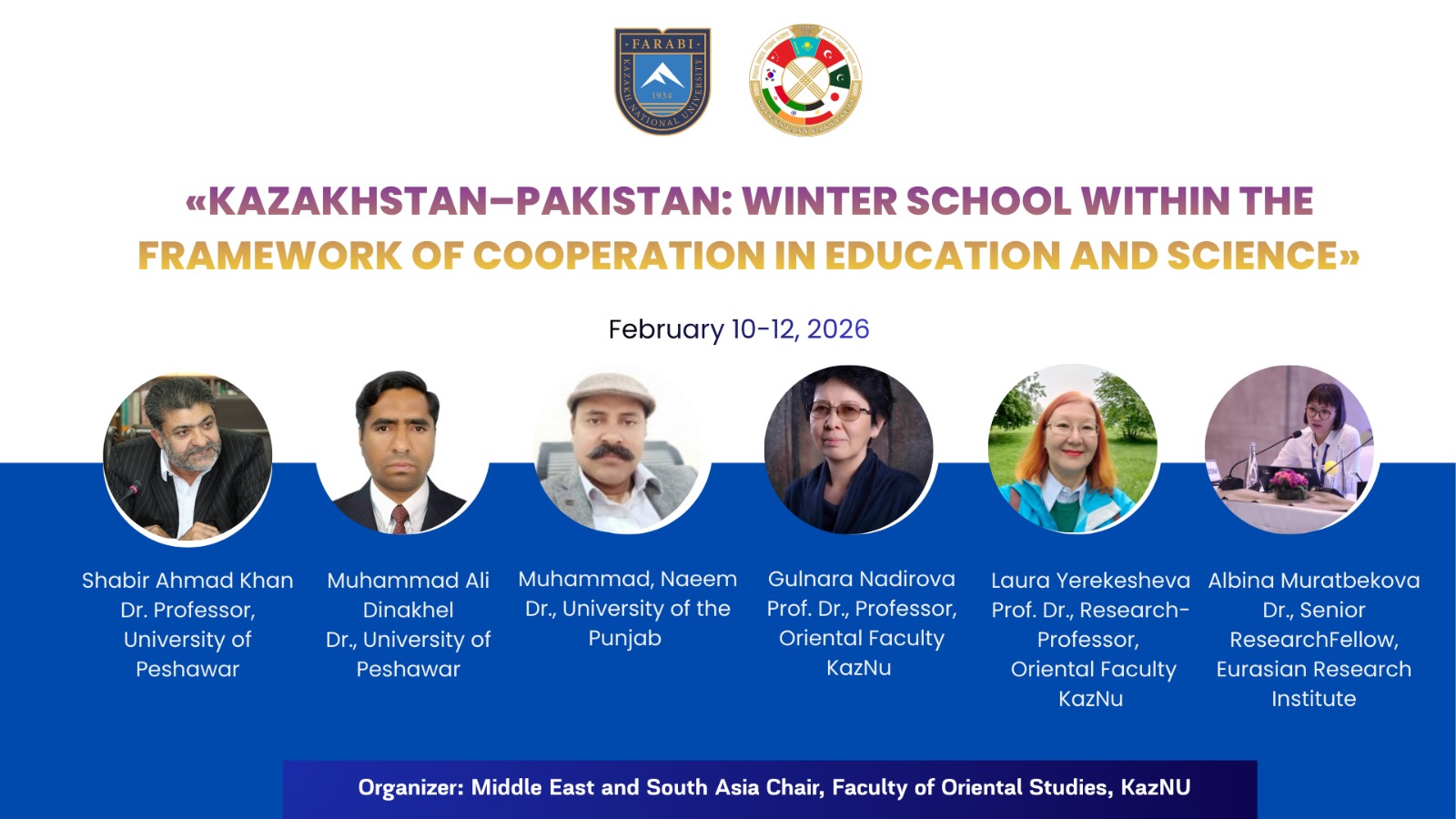
From February 10 to 12, 2026, Al-Farabi Kazakh National University hosted the online Winter School “Intellectual History in Contemporary Central and South Asia.” The event was held within the framework of the United Nations Sustainable Development Goals, Quality Education (SDG 4) and Partnerships for the Goals (SDG 17). The Winter School was organized by the Department of the Middle East and South Asia of Al-Farabi Kazakh National University.
The event is organized in accordance with Clause 2.1.4 of the Memorandum of Cooperation between Al-Farabi Kazakh National University (KazNU) and the National University of Modern Languages (NUML, Islamabad), signed in 2025, which provides for cooperation within short-term and long-term academic programs.
The main objective of the online Winter School is to study the methodology, key concepts, evolution of ideas, literary and folklore traditions, and historiographical practices in the context of intellectual history in Kazakhstan and Pakistan.
The lectures covered theoretical and methodological foundations of intellectual history, including philosophical approaches to interpreting the historical past and modern methods of analyzing literary and historical sources. Particular attention was given to conceptual models of intellectual history, including the theory of the “Third Space” and nomadology, which allow intellectual processes to be examined within frameworks of cultural interaction and transnational connections.
Participants explored the evolution of Pashtun intellectual traditions in the context of Central and South Asia, including their literary, religious, and socio-political heritage, as well as the role of folklore as a source of intellectual thought. The sessions also addressed social and philosophical ideas reflected in modern Urdu poetry, the influence of Soviet foreign studies on the formation of the scientific and geopolitical discourse of Central Asia, and the role of literature as a space for searching cultural identity in the age of globalization. Special attention was also paid to historiographical approaches to the study of Pashtun intellectual history.
During the lectures, participants examined theoretical and methodological foundations of intellectual history, including philosophical approaches to interpreting the past and modern methods of working with literary and historical sources. Particular attention was paid to conceptual frameworks such as the theory of the “Third Space” and nomadology, which allow intellectual processes to be studied within cross-cultural and transregional contexts.
The Winter School brought together leading scholars from Kazakhstan and Pakistan, faculty members of KazNU, Khoja Akhmet Yassawi International Kazakh-Turkish University, as well as researchers and professors from the University of Peshawar and the University of the Punjab.
The Winter School participants included master’s and doctoral students, as well as young university lecturers from both countries specializing in Oriental Studies, Foreign Philology, Political Science, and International Relations. In total, 40 students took part in the program.
Speakers included:
Doctor of Philological Sciences, Professor G.E. Nadirova delivered a lecture titled “Constructing the Past: Methodological Approaches in Intellectual History – from Philosophical Foundations to Empirical Analysis.” Professor Nadirova presented the theoretical foundations of intellectual history, modern approaches to working with literary sources, and historiographical analysis.
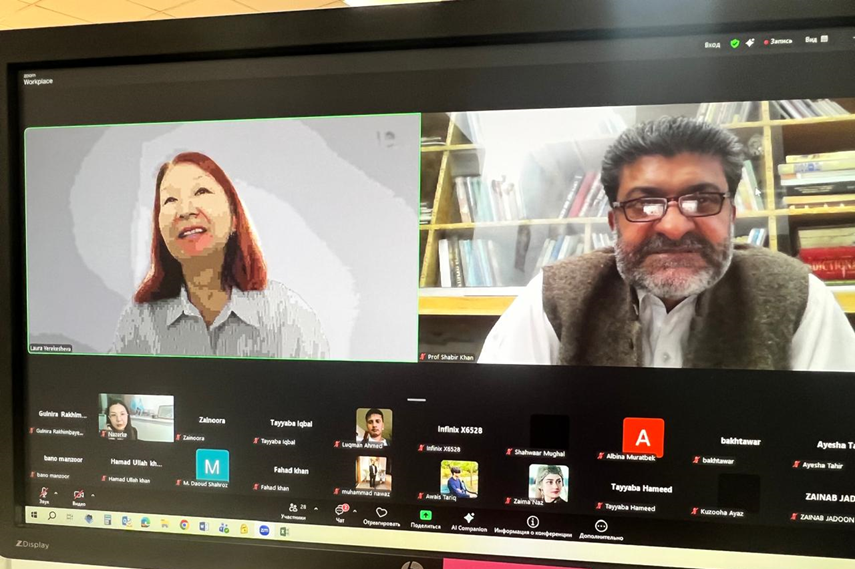
Doctor of Historical Sciences, Research-Professor L.G. Yerekesheva delivered a lecture titled “Intellectual History in a Third Space: Conceptual Frame and Nomadology.” In her presentation, Professor L.G. Yerekesheva outlined conceptual frameworks of intellectual history, its major schools, and key issues of nomadology.
PhD, Professor at the University of Peshawar, Shabir Ahmad Khan presented “Intellectual History of Pakhtuns/Pashtuns in the Context of Central and South Asia.” The speaker discussed the formation of Pashtun intellectual traditions within historical and cultural contexts of Central and South Asia, highlighting the role of literary heritage, religious thought, oral traditions, and socio-political ideas in shaping Pashtun intellectual culture.
Research-Professor L.G. Yerekesheva also delivered a lecture titled “Hybridity, Nomos and the Search for Identity in the Intellectual History of Kazakhstan (Based on the Early Works of O. O. Suleimenov).” The lecture explored the concept of nomadism in literature and its philosophical reinterpretation in contemporary humanities through the early works of Olzhas Suleimenov, reflecting the search for cultural identity in Kazakh society.
Dr. A.M. Muratbekova, Phd, Senior Research Fellow at the Eurasian Research Institute of Khoja Akhmet Yassawi International Kazakh-Turkish University, delivered a lecture titled “Soviet Foreign Studies in Central Asia as a Geopolitical Intellectual Project.” Dr. A.M. Muratbekova examined diplomatic representation of Central Asian peoples, the role of Oriental studies in shaping Soviet foreign policy strategy, and the influence of Soviet academic policy on the development of regional research institutions.
Dr. Muhammad Ali Dinakhel from the University of Peshawar presented “Intellectual History in Pashtun Folklore: Traditions and Thought.” The speaker examined Pashtun folklore as a source of intellectual thought and cultural values, demonstrating how oral traditions, legends, and poetic creativity transmitted social norms, historical memory, and philosophical ideas of the Pashtun people.
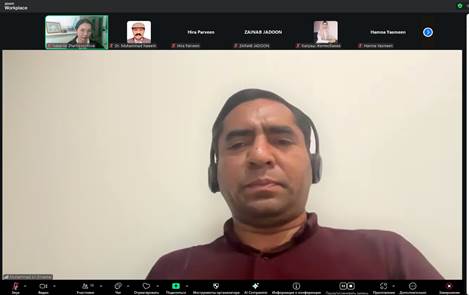
Dr. Muhammad Naeem from the University of the Punjab delivered a presentation titled “Social and Intellectual Discourses in Modern Urdu Poetry.” In his lecture, the speaker demonstrated how poets address themes of social justice, cultural transformation, and spiritual values through artistic imagery.
T. Urumova, Master of Arts and Senior Research titled “Literature as a Space for Searching Cultural Identity in the Age of Globalization.” The speaker examined how literary texts reflect processes of cultural transformation, the dialogue between tradition and modernity, and contribute to the preservation of national identity.
N. Zharbossynova, a first-year doctoral student at the Faculty of Oriental Studies, presented “Historiography of the Intellectual History of the Pashtuns.” The speaker highlighted the contributions of various scholars to the development of academic approaches to studying Pashtun intellectual heritage and outlined current historiographical trends in this field.
During the discussions, participants exchanged views and lecturers answered questions from the audience. The program aimed to develop students’ critical thinking skills and deepen their understanding of the social and intellectual context of Eastern societies. Particular attention was paid to issues related to the formation of knowledge and ideas, the role of creative activity in public life, and the study of social history.
The Winter School contributed to strengthening international scientific cooperation, expanding academic dialogue, and supporting the professional development of young researchers. The implementation of the program opened new opportunities for developing modern academic approaches to studying intellectual processes in Central and South Asia and enhanced the academic potential of participants.
Nazerke Zharbossynova
Chair of the Urdu Language Department