A Lecture on the Political and Legal Role of the Kurultai Delivered to KazNU Students
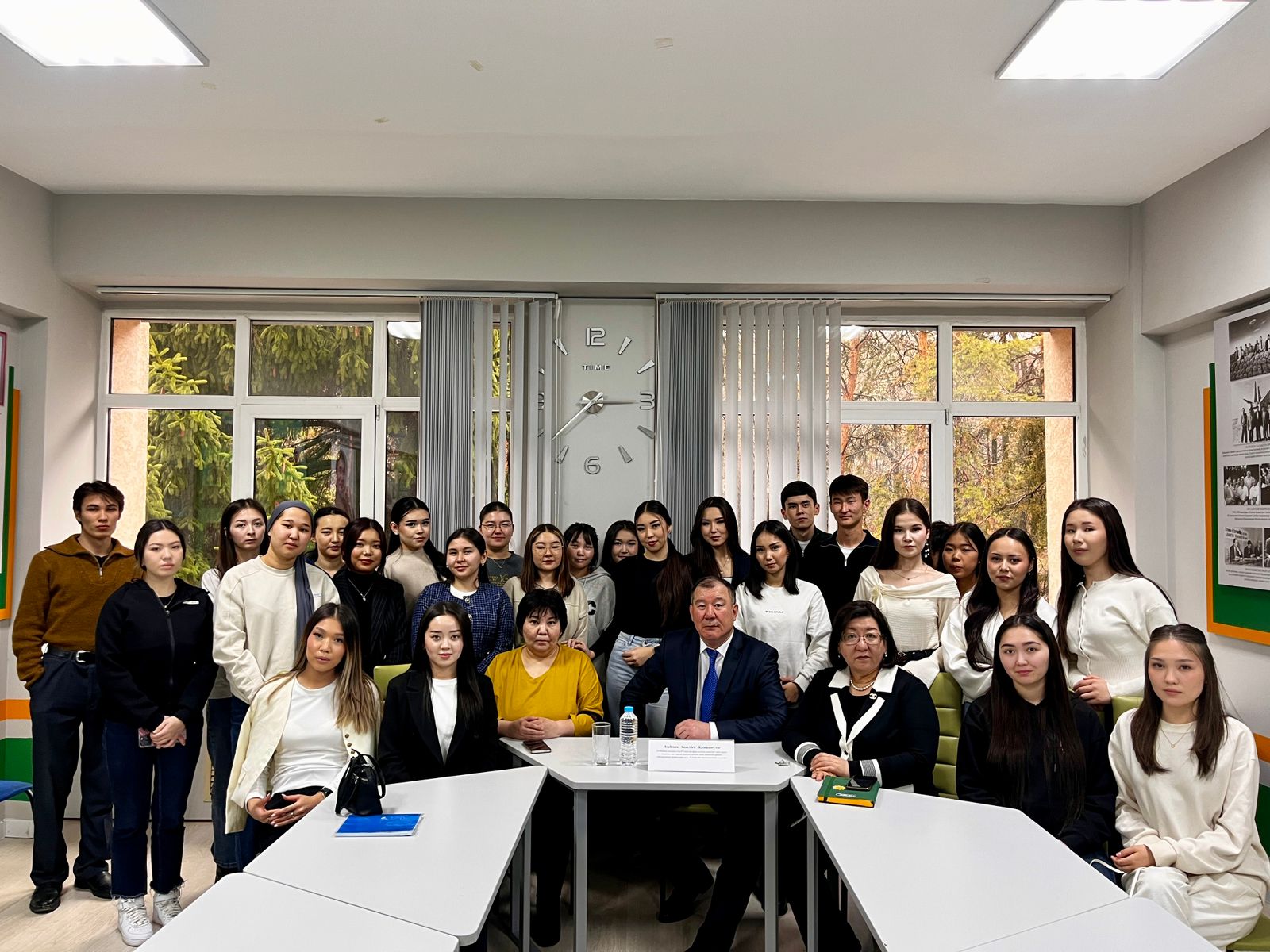
A lecture titled “The Political, Legal, and Historical Role of the Kurultai in the Formation and Development of the Institution of Parliamentarism: An Overview of Representative Power” was organized for students of the Department of Publishing, Editing, and Design Art at Al-Farabi Kazakh National University.
The lecture was delivered by Akylbek Kashkynuly Isabekov, Professor of the Department of Theory and History of State and Law, Constitutional and Administrative Law at the Faculty of Law of Al-Farabi Kazakh National University, Candidate of Legal Sciences, and Academician of the National Academy of Law. During the meeting, students were provided with a comprehensive explanation of the historical formation of representative institutions of power, the concept of parliamentarism, and the political and legal significance of the Kurultai institution.
In his speech, the professor emphasized that parliamentarism is one of the key institutions of a democratic system of governance. This system is based on the implementation of legislative activities through a representative body that expresses the will of the people. In addition, parliamentarism helps maintain the balance between branches of government, increase the efficiency of the legislative process, and ensure that public interests are reflected in state policy.
The lecture also highlighted the special role of the Kurultai institution in the traditional governance system of Kazakh society. According to historical sources, the Kurultai was a consultative and representative assembly where important issues of public life were discussed. At such gatherings, tribal leaders, biys, and batyrs considered major political matters, including state security, issues of war and peace, and the succession of power. In this regard, the Kurultai is viewed as a manifestation of early democratic traditions in Kazakh society.
The meeting also addressed issues related to current constitutional reforms. It was noted that the Constitution of the Republic of Kazakhstan is the fundamental legal document that defines the principles of state governance, the rights and freedoms of citizens, and the interaction among branches of government. In recent years, the country has implemented reforms aimed at modernizing the political system, developing representative institutions, and strengthening mechanisms of interaction between society and the state.
In addition, information was provided about proposals concerning the structure of the Constitution. In the new draft, the number of chapters in the Basic Law is proposed to increase from nine to eleven, and the norms regulating the system of public administration are being reorganized. The possibility of introducing a separate chapter dedicated to the Kurultai was also discussed, highlighting its importance as an institution that reflects public opinion and provides consultative recommendations on key state issues.
At the end of the meeting, students asked questions related to the upcoming national referendum and discussed the content of the proposed constitutional amendments and their potential impact on the system of public governance. Akylbek Kashkynuly noted that the main goal of these reforms is to modernize state institutions, strengthen dialogue between society and government, and expand opportunities for citizens to participate in political processes.
Overall, the lecture contributed to broadening students’ legal and political knowledge and helped them better understand the historical development of representative institutions as well as the significance of contemporary constitutional changes. Furthermore, the event promoted the development of students’ legal culture and supports the implementation of the United Nations Sustainable Development Goal 4 – “Quality Education.”
Department lecturers:
A. Kalibekkyzy
N. Tleubayeva
M. Almukhametova
A. Tilepbergen