- Main
- News
- Curatorial Hour on “Financial Pyramids: How to Recognize Them?” Held to Improve Students’ Financial Literacy
Curatorial Hour on “Financial Pyramids: How to Recognize Them?” Held to Improve Students’ Financial Literacy
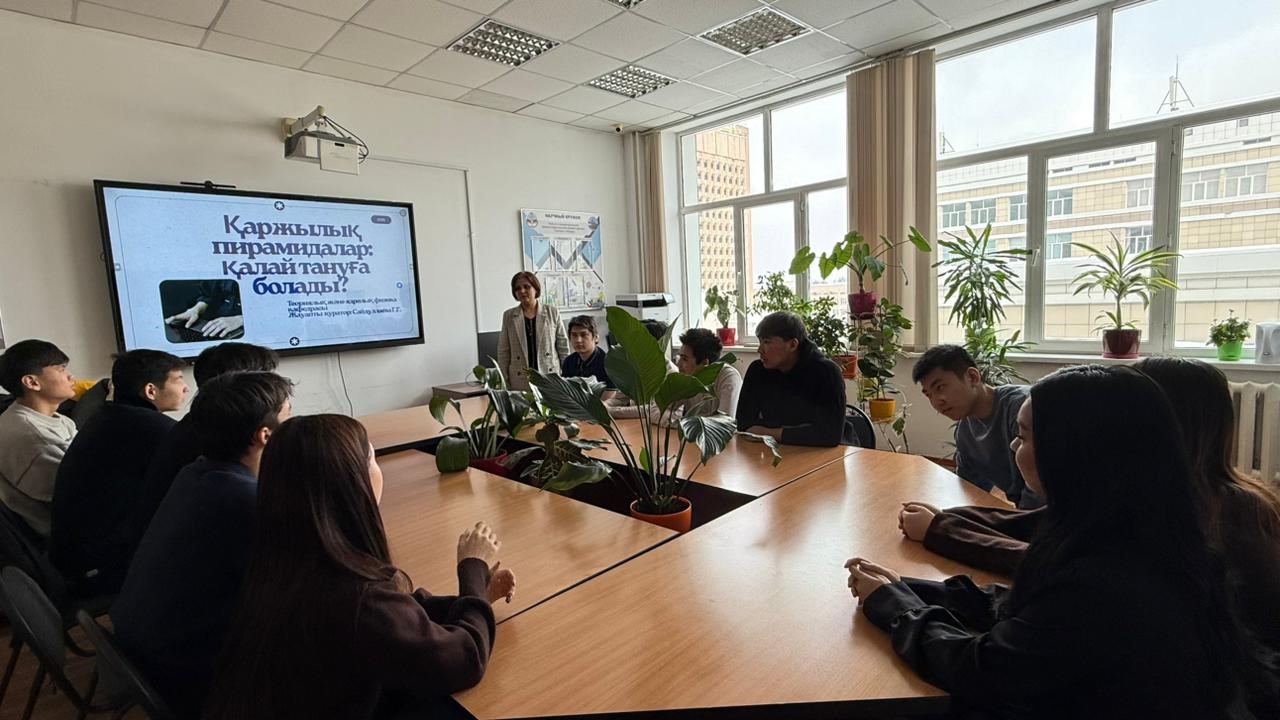
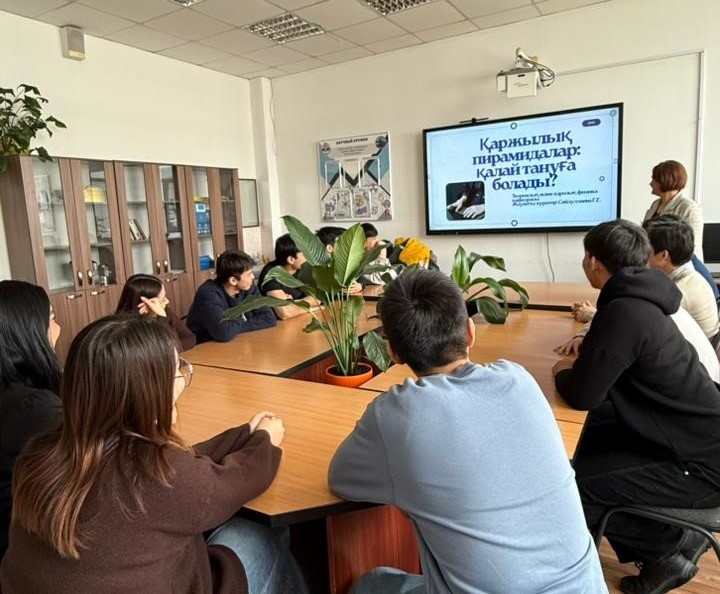
On March 10, 2026, a curatorial session titled “Financial Pyramids: How to Recognize Them?” was held at the Faculty of Physics and Technology of Al-Farabi Kazakh National University. The event took place in Room 304 and was aimed at improving students’ financial literacy and fostering a culture of responsible financial decision-making.
The session was conducted by PhD Gozal Gainidinovna Saidullaeva, Senior Lecturer of the Department of Theoretical and Nuclear Physics. The primary objective of the meeting was to develop students’ understanding of the mechanisms behind financial pyramid schemes and to equip them with the skills necessary to identify and critically evaluate fraudulent financial practices. Particular attention was devoted to raising awareness among young people about the risks associated with participation in questionable investment projects.
In the context of the rapid development of digital technologies, the internet, and social media, financial pyramid schemes have taken on new forms and become increasingly sophisticated. Such structures often rely on aggressive marketing strategies and widely disseminate information through messaging platforms, social networks, and online communities, promising quick and unusually high returns with minimal effort. Young people and university students are often among the most vulnerable groups, as they may not yet possess sufficient financial and economic literacy. Therefore, educational initiatives aimed at raising awareness and preventing financial fraud are of particular importance.
During the session, students were introduced to the economic and mathematical foundations underlying financial pyramid schemes. From a scientific perspective, a financial pyramid is a system that lacks a sustainable economic basis. Payments to participants are made not through genuine economic activity, but rather through funds contributed by new participants. Such schemes are not connected to the production of goods or the provision of services and can exist only as long as new investors continue to join the system.
According to economic theory, these systems cannot operate sustainably over long periods of time. Their stability depends on the continuous exponential growth in the number of new participants. However, the influx of new investors inevitably declines at a certain stage, which leads to the collapse of the entire structure. As a result, the majority of participants incur significant financial losses.
Special attention was given to identifying the key characteristics of financial pyramid schemes. These include promises of extremely high returns within a short period of time, aggressive recruitment strategies, lack of transparency in the company’s operations, and the active involvement of new participants through personal networks such as friends, acquaintances, and relatives. Another important indicator is the absence of proper licensing, official registration, and transparent financial reporting.
It was also emphasized that legitimate financial institutions operate in accordance with legal regulations, undergo mandatory state registration, and maintain transparent financial reporting. The presence of a real product or service is another important indicator of lawful economic activity.
In the practical part of the session, students analyzed real-world examples of financial pyramid schemes and examined the mechanisms through which they operate. Participants discussed common investment attraction strategies and the informational manipulation techniques often used by organizers of such schemes. Particular emphasis was placed on the importance of critical thinking in financial decision-making, verifying the reliability of information sources, and objectively assessing potential risks.
Students actively participated in the discussion, asked questions, and shared their opinions. The curatorial session became an important educational platform for developing students’ financial culture. Such initiatives contribute to enhancing students’ economic security, strengthening their analytical thinking skills, and equipping them with effective tools to protect themselves from financial fraud.