The symbiosis of humans and AI opens up new horizons of knowledge
Al-Farabi Kazakh National University (KazNU) welcomed with a working visit Andrey Rudskoy, Rector of Peter the Great St.Petersburg Polytechnic University and Vice-President of the Russian Academy of Sciences, as well as Askar Akayev, the first President of the Kyrgyz Republic, academician of the Russian Academy of Sciences, and professor. The guests were received by Zhanseit Tuimebayev, Chairman of the Board – Rector of KazNU, who held a meeting in a closed format. During the meeting, both sides agreed to further strengthen cooperation between the two universities, particularly in artificial intelligence (AI) and information technologies, with the aim of implementing joint research and projects.
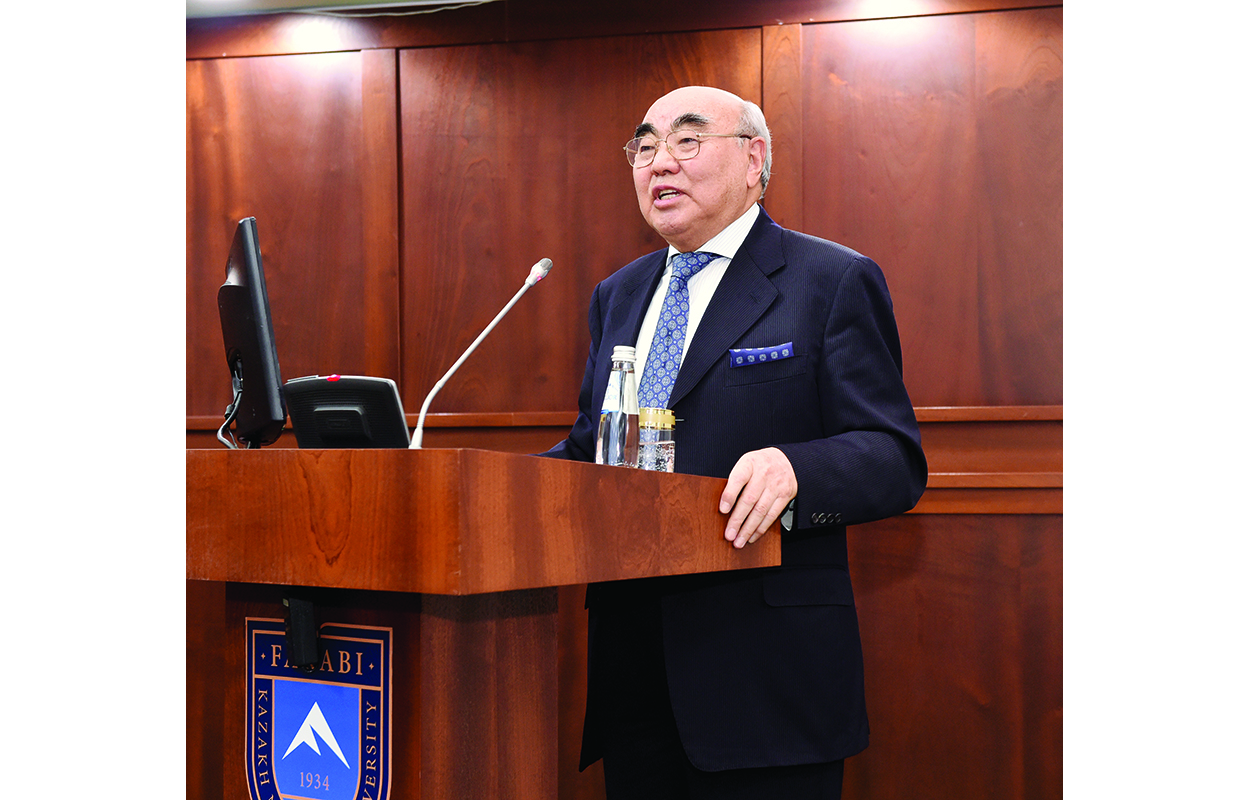
On October 20–21, Professor Akayev delivered a leadership lecture for KazNU staff and students titled: “The World on the Verge of Three Singularities: Technological (AI), Demographic, and Evolutionary, and How They Will Affect the Future of Humanity”.
The honorary professor began his lecture with warm greetings: “Құрметті қазақ туғандарым, саламатсыздар ма?” (“Dear Kazakh compatriots, how are you?”). He emphasized that the world today stands at a pivotal moment in human history, facing three upcoming singularities: technological, demographic, and evolutionary. A singularity refers to a quantity approaching infinity, yet nature and the universe always regulate such extremes.
Technological singularity arises from artificial intelligence, which is difficult to control. Humanity is approaching a point never before experienced in history—a moment comparable to previous revolutionary transitions, such as the Agricultural, Urban, Industrial, and Information Revolutions. Now, we are entering the digital revolution era.
Professor Akayev praised Kazakhstan’s achievements and the ambitious digital development program of President Kassym-Jomart Tokayev. He highlighted the plan to transform Kazakhstan into a fully digital state within a few years, with initiatives such as the creation of a dedicated AI university, unprecedented in Eurasia. He emphasized that KazNU could become a leading institution in AI education and a pioneer in applying AI technologies to economic and government transformation.
Demographic singularity: Knowledge, technology, and innovation drive demographic and economic development. Humanity’s population grew slowly for centuries, then exploded over the past 200 years, bringing both technological advancement and anthropogenic pressures on Earth’s ecosystems, such as soil degradation and climate change. Early predictions by Thomas Malthus and later studies by S.P. Kapitsa suggest that Earth can sustain up to 11.36 billion people, after which population growth will stabilize.
Technological singularity is linked specifically to AI. Scientists envisioned creating artificial human-like intelligence, which could eventually surpass human cognition. This symbiosis of humans and AI can open new horizons for knowledge and innovation. If AI becomes a benevolent assistant, humanity may enter a new era of scientific, cultural, and economic prosperity. If AI becomes a competitor, it could displace humans from intellectual and social roles, potentially leading to societal decline. Experts predict the emergence of human-level AI (Universal Human Intelligence) around 2027–2029.
Akayev stressed that controlling AI now is critical. Failing to do so within the next 20–30 years could result in the emergence of autonomous superintelligent AI beyond human control, potentially causing catastrophic consequences. He warned that the future of civilization depends on fostering a humanistic, noosphere-oriented society, where AI and advanced technologies enhance human potential while ensuring fairness, sustainability, and ecological responsibility.
The key driver of the digital economy is the symbiosis of humans and intelligent machines. While automation may replace 25–50% of routine tasks, humans will focus on higher-order cognitive work, significantly boosting productivity. Preparing for AI’s impact on employment and social structures is crucial, as it will transform not only work but also the trajectory of human evolution.
Kairzhan TUREZHANOV
To be continued