- Main
- News
- Ethnocultural Practice within the Framework of the Sustainable Development Goals: The Sacred Space and Spiritual Heritage of Turkistan
Ethnocultural Practice within the Framework of the Sustainable Development Goals: The Sacred Space and Spiritual Heritage of Turkistan
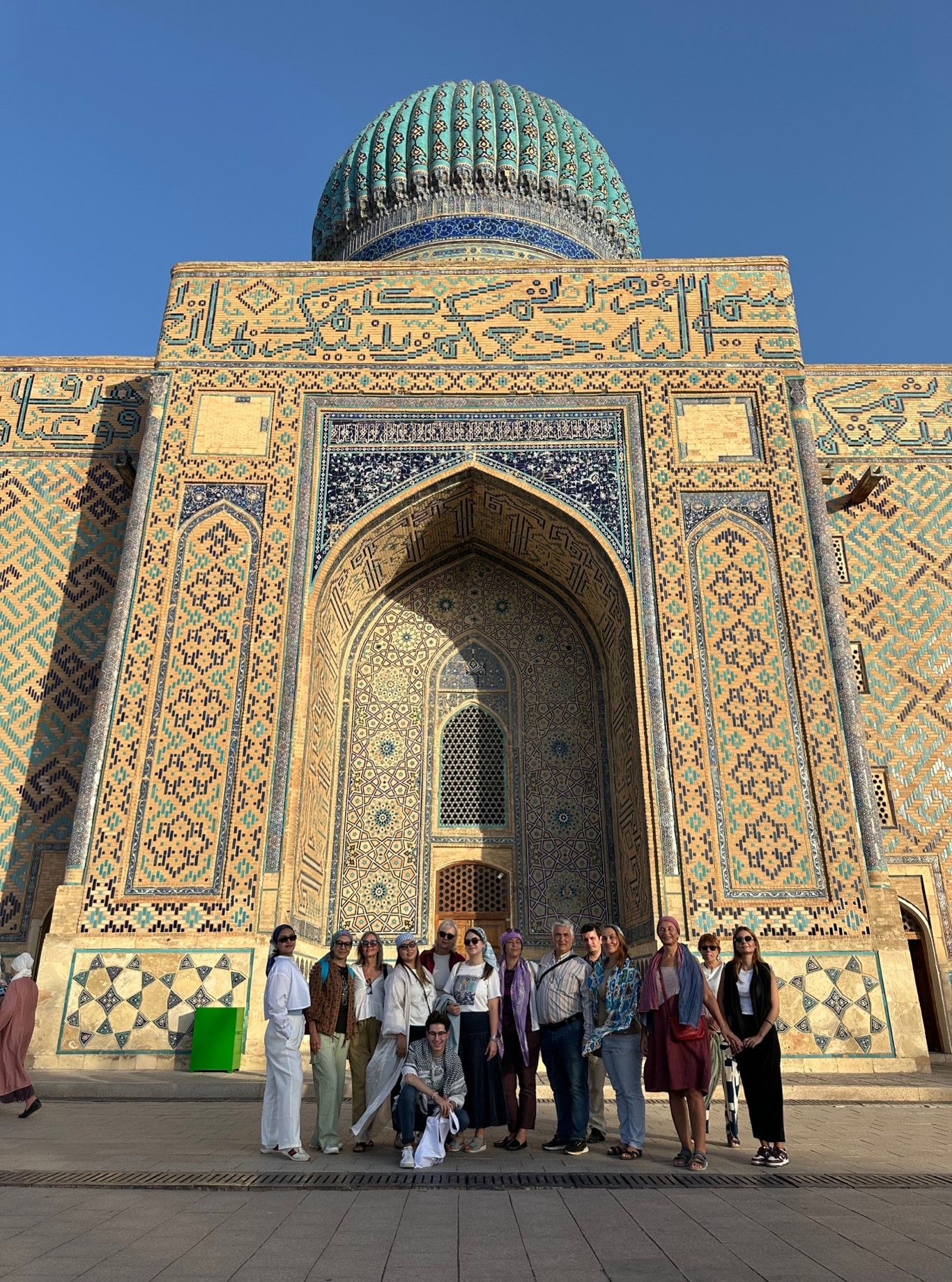
Ethnocultural practice organised by the Faculty of Philosophy and Political Science of Al-Farabi Kazakh National University, with the participation of the Department of Religious Studies and Cultural Studies, as well as the Department of General and Applied Psychology, within the framework of a bilateral cooperation agreement between Al-Farabi Kazakh National University and Sofia University St. Kliment Ohridski (Bulgaria), continued on 5 September 2025.
On this day, the ethnocultural practice was implemented within the framework of SDG 4 — Quality Education, as well as SDG 17 — Partnerships for the Goals, and took place in the Turkestan region, which is one of the key spiritual and sacred centres of Kazakhstan. The day was devoted to understanding the sacred geography of the country, its historical and religious heritage, and the role of spiritual values in shaping national identity and a humanitarian worldview.
Visits to the Arystan Bab mausoleum, the Otyrar settlement and the city of Turkestan contributed to an in-depth study of the history, religious philosophy and cultural continuity of the region. These sites allowed participants to view sacred spaces not only as architectural monuments, but also as carriers of collective memory, spiritual experience and historical self-awareness of the people, which directly corresponds to the objectives of SDG 4 in terms of shaping value-oriented and interdisciplinary education.
Of particular importance in the implementation of SDG 17 was the visit to the International Kazakh-Turkish University named after H.A. Yassawi, where examples of institutional cooperation in the fields of education, science and culture were demonstrated. Familiarisation with the university's activities and a visit to the mausoleum of Ahmed Yassawi, included in the UNESCO World Heritage List, emphasised the importance of international cooperation in preserving and promoting spiritual and cultural heritage at the global level.
This trip was a significant stage in the ethnocultural practice, contributing not only to the expansion of the participants' academic knowledge, but also to the formation of a deep respect for the spiritual origins of Kazakh culture, the strengthening of intercultural dialogue and an awareness of the role of sacred heritage in the context of sustainable development of society.