- Main
- News
- Educational Visit to the “Almaty” Museum: A Dialogue between Cultural Heritage and Contemporary Art for Students
Educational Visit to the “Almaty” Museum: A Dialogue between Cultural Heritage and Contemporary Art for Students
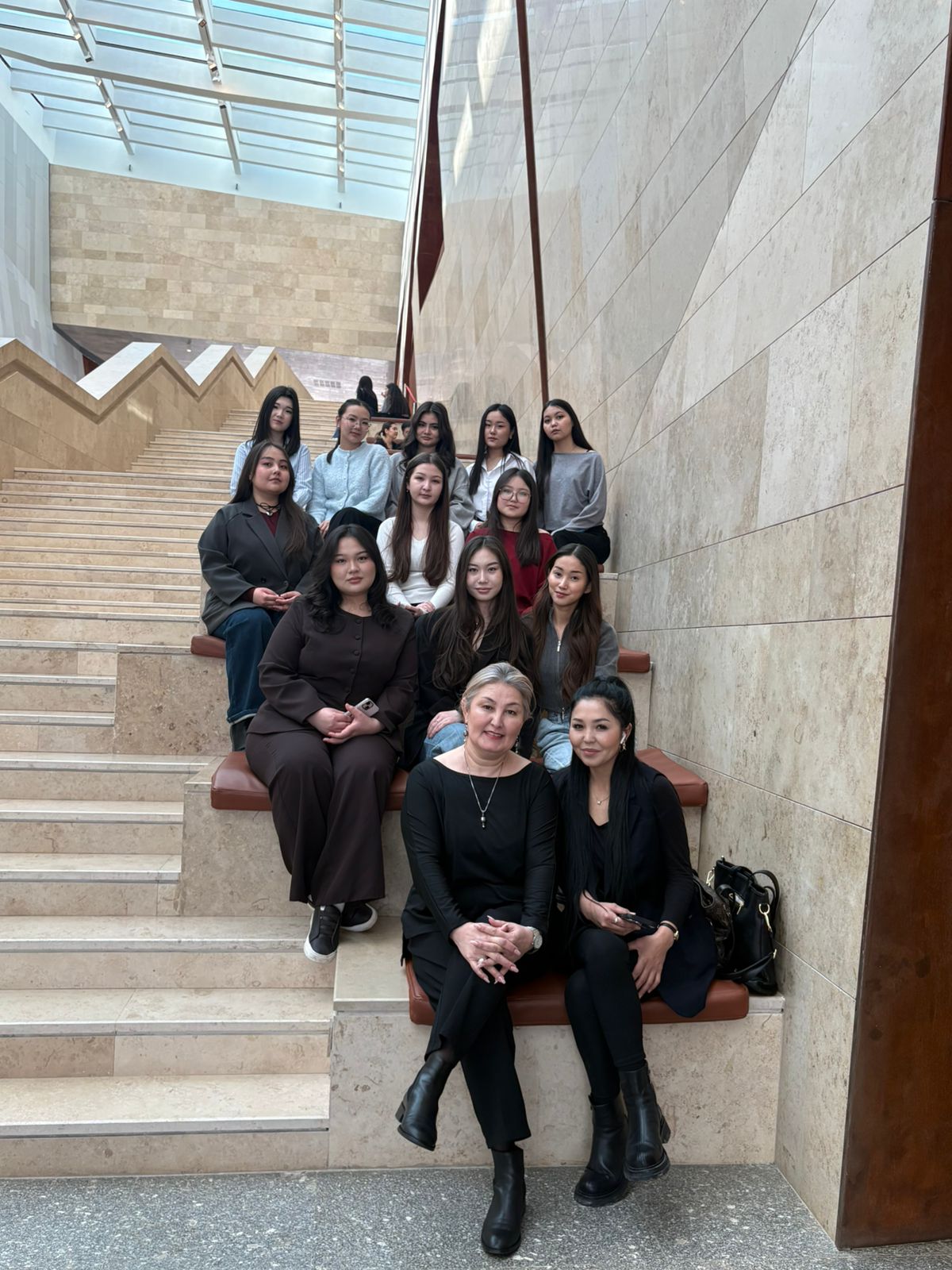
On March 13, 2026, within the framework of one of the Sustainable Development Goals — “Partnerships for Sustainable Development” — an educational visit to the Almaty Museum was organized in order to strengthen professional cooperation with the Association of Museums of Almaty.
During the event, second-year students majoring in Cultural Studies became acquainted with the museum exhibitions and had the opportunity to explore the relationship between contemporary art and cultural heritage. Throughout the экскурсия, the students were introduced to several artistic projects that occupy an important place in both the global and regional art space.
In particular, the work of the German artist Anselm Kiefer entitled “When These Writings Burn, Everything Will Become Clear” encourages viewers to reflect on issues of history, memory, and cultural transformation. The artist’s work connects history and mythology, offering an artistic reinterpretation of the complex relationship between the past and the present.
In addition, the video installation “Women’s Right” by Saodat Ismailova — a prominent contemporary artist and filmmaker from Central Asia — was presented. This work addresses issues related to women’s historical fate, social pressure, and cultural transformation, encouraging viewers to reflect on the complex dimensions of women’s experiences.
The exhibition also included information about the work “Junction” by the American sculptor Richard Serra, which explores the relationship between space and form and introduces the characteristics of minimalism and spatial aesthetics in contemporary art.
The educational visit was organized by the lecturers and doctoral students of the Department of Religious Studies and Cultural Studies: Professor Z.N. Ismagambetova, PhD Dr. S.M. Kaupenbayeva, and first-year doctoral students A.N. Kuderina and M.T. Orynbasar.
Participants:
second-year students majoring in Cultural Studies.
The museum space became an important educational environment that allowed students to learn about contemporary approaches to preserving cultural heritage while also developing artistic thinking and critical analysis skills.
Such cultural and educational activities broaden students’ professional horizons and allow museums to be perceived as spaces for academic and intellectual exploration.
There is an interesting paradox in art museums: sometimes a single painting or installation raises more questions than an entire book. Philosophy begins precisely with those questions.