- Main
- News
- In response to the escalating global water crisis driven by climate change, seven institutions from Europe and Central Asia convened
In response to the escalating global water crisis driven by climate change, seven institutions from Europe and Central Asia convened
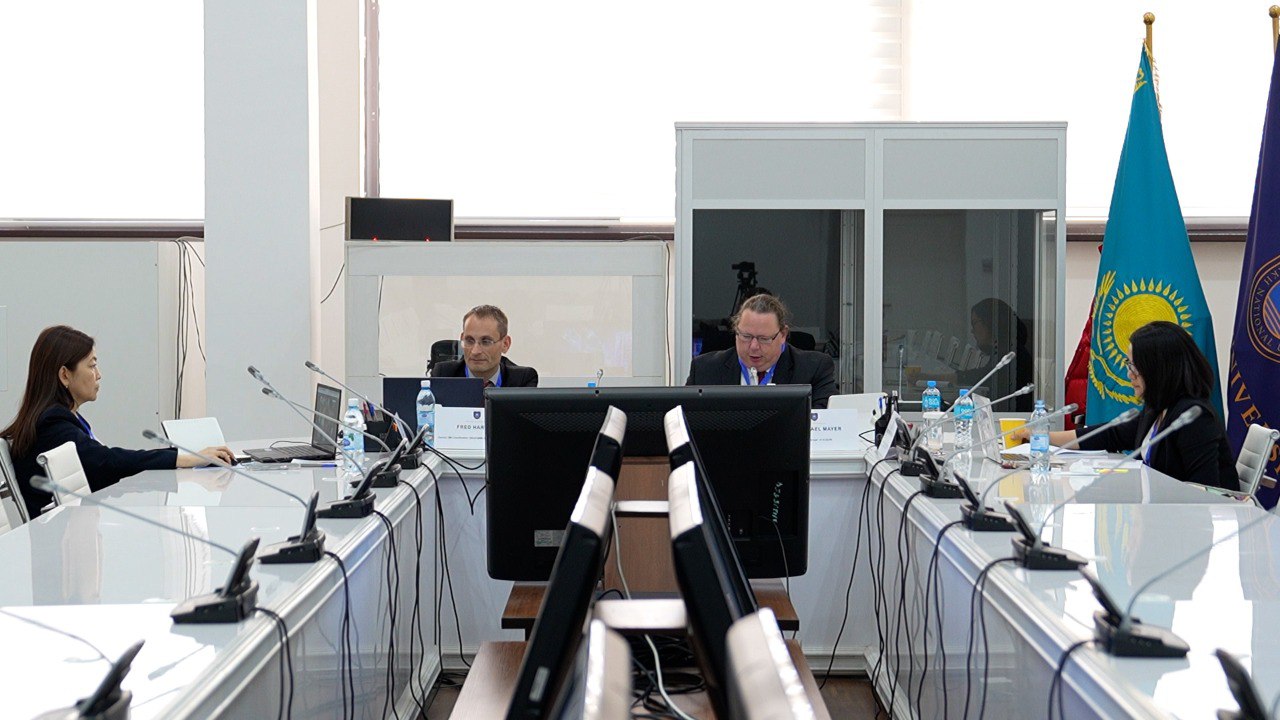
On October 30-31, 2025 in Budapest it was a meeting to launch the Erasmus Mundus Design Measure (EMDM) project titled “Preparing Joint Masters on Water Governance and Water Diplomacy for Shifting the Paradigm for Sustainable Water Action”.
The consortium, led by Eötvös Loránd University (ELTE), includes Al-Farabi Kazakh National University, Karelia University of Applied Sciences (Finland), Kazakh National University of Water Management and Irrigation, Nordic International University (Uzbekistan), TIIAME National Research University (Uzbekistan), and Uppsala University (Sweden). Backed by a € 60,000 EMDM grant, the partnership will spend the next 15 months designing a Joint Masters program aimed at tackling one of the most pressing challenges of our time: sustainable water governance and diplomacy.
The project seeks to blend EU climate resilience strategies with the regional expertise of Central Asian partners creating a globally relevant educational model that fosters collaboration across borders. As climate change is hitting Central Asia particularly hard, successes and lessons learned from the region can be used for the development of innovative curricula that are informed by EU policies on climate change, green development and cooperative approaches to water governance. Thanks to this partnership of cross-fertilization and complementarity, members of the consortium will jointly develop an innovative, highly integrated program on water governance and water diplomacy with a comprehensive curriculum combining engineering, natural sciences, and international water law with social sciences such as institutional economics, political economy of water, public management, and conflict resolution.
At the Budapest-based inaugural meeting, two working groups were formed:
- Academic Working Group—tasked with developing the curriculum of the Joint Masters, working out the guidelines for the development of syllabi, and defining criteria for student admission, monitoring, examination, and quality assurance, as well as
- Legal, Administrative & Financial Working Group—responsible for a joint degree policy, a plan for common services offered to students (e.g., language courses, visa support), an EMJM Partnership Agreement and a draft joint Student Agreement.
At the meeting, the members of the consortium agreed to plan to submit a full proposal to the European Commission by late 2026. If approved, the implementation of the Erasmus Mundus Joint Master project with a budget of € 5 Million and a duration of 6 years could start as early as September 2027.
The consortium delegates emphasized that the Joint Masters program will not duplicate similar programs at partner universities. Its ambition is to facilitate a paradigm shift in water governance and water diplomacy through human capacity building. It endeavors to train a new generation of experts capable of turning water into an instrument of political change, bringing about fundamental improvements in policy making, institutional and regulatory reforms, and strengthened regional and global cooperation. Graduates, thus, will leave equipped not only with technical expertise but also with the diplomatic and policy skills needed to shape sustainable water futures worldwide.
At this meeting, Al-Farabi Kazakh National University was represented by Shamshagul Ibragimovna Mashtayeva, PhD, Senior Lecturer in the Department of Meteorology and Hydrology of the Faculty of Geography and Nature Management and EMDM project coordinator.