- Main
- News
- Topic: “Within the framework of the UN SDGs in Kazakhstan: Protection and Restoration of Terrestrial Ecosystems
Topic: “Within the framework of the UN SDGs in Kazakhstan: Protection and Restoration of Terrestrial Ecosystems
Objective: To familiarize students with global environmental problems related to the destruction of terrestrial ecosystems; to develop an understanding of personal responsibility; to awaken ecological thinking and motivate participation in environmental initiatives.
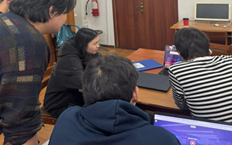
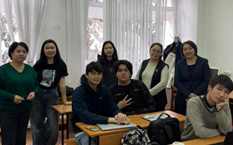
An educational lesson conducted by Alua Gusmaulova, a first-year doctoral student in the educational program “8D05105 – Biotechnology,” as part of pedagogical practice.
Participants: Participants: Cand.Sc. (Biology), Senior Lecturer K.A. Mukhatayeva; Cand.Sc. (Biology), Senior Lecturer G.D. Ultanbekova; PhD, Acting Associate Professor N.S. Mamytova.
Tasks:
1. Educational – to explain the importance of terrestrial ecosystems and the main causes of their degradation; to demonstrate the impact of human activity on the state of nature.
2. Developmental – to broaden ecological thinking, spark interest in biodiversity issues and sustainable development; to develop analytical and project-thinking skills.
3. Educational – to cultivate a responsible attitude toward natural resources and motivate participation in environmental and charitable initiatives.
During the open lesson, an interactive educational model was implemented, aimed at developing students' environmental literacy and systemic thinking. The lesson was centered around UN Sustainable Development Goals 14 and 15, with an emphasis on anthropogenic impact on terrestrial ecosystems. The main methodological focus was on combining playful formats (a quiz with questions on erudition and logic, case analysis, project modeling) with a practical component, where academic points were converted into real charitable donations. The Nemolchi Foundation was chosen by the students. As a result of the lesson, a donation of $50 was sent on behalf of the quiz winner.
During the project activities, students demonstrated varying levels of solution development: from highly scientific but hypothetical (bioremediation of radioactive pollution) to applied and implementable (water-saving agricultural technologies). Reflection showed that such a synthesis of emotional engagement, scientific content, and social responsibility effectively forms not only knowledge but also environmental motivation, highlighting the connection between local actions and global processes.





Relevant questions on the topic:
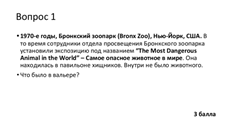
· Anthropogenic causes of species extinction (dodo, Steller's sea cow, Tasmanian tiger).
· The Aral Sea disaster as an example of unsustainable water resource use.
· Cascading ecological consequences of eliminating top predators (example of dingoes in Australia).
· The paradox of fire suppression and the emergence of megafires (examples from U.S. and Australian policies).
· The indirect link between ecosystem destruction and the emergence of zoonotic pandemics (deforestation and COVID-19).
Other news