
- Main
- News
- SDG 12 – Responsible Consumption and Production: Circular Bioeconomy and the Development of Sustainable Technologies at KazNU
SDG 12 – Responsible Consumption and Production: Circular Bioeconomy and the Development of Sustainable Technologies at KazNU
30 december, 2025
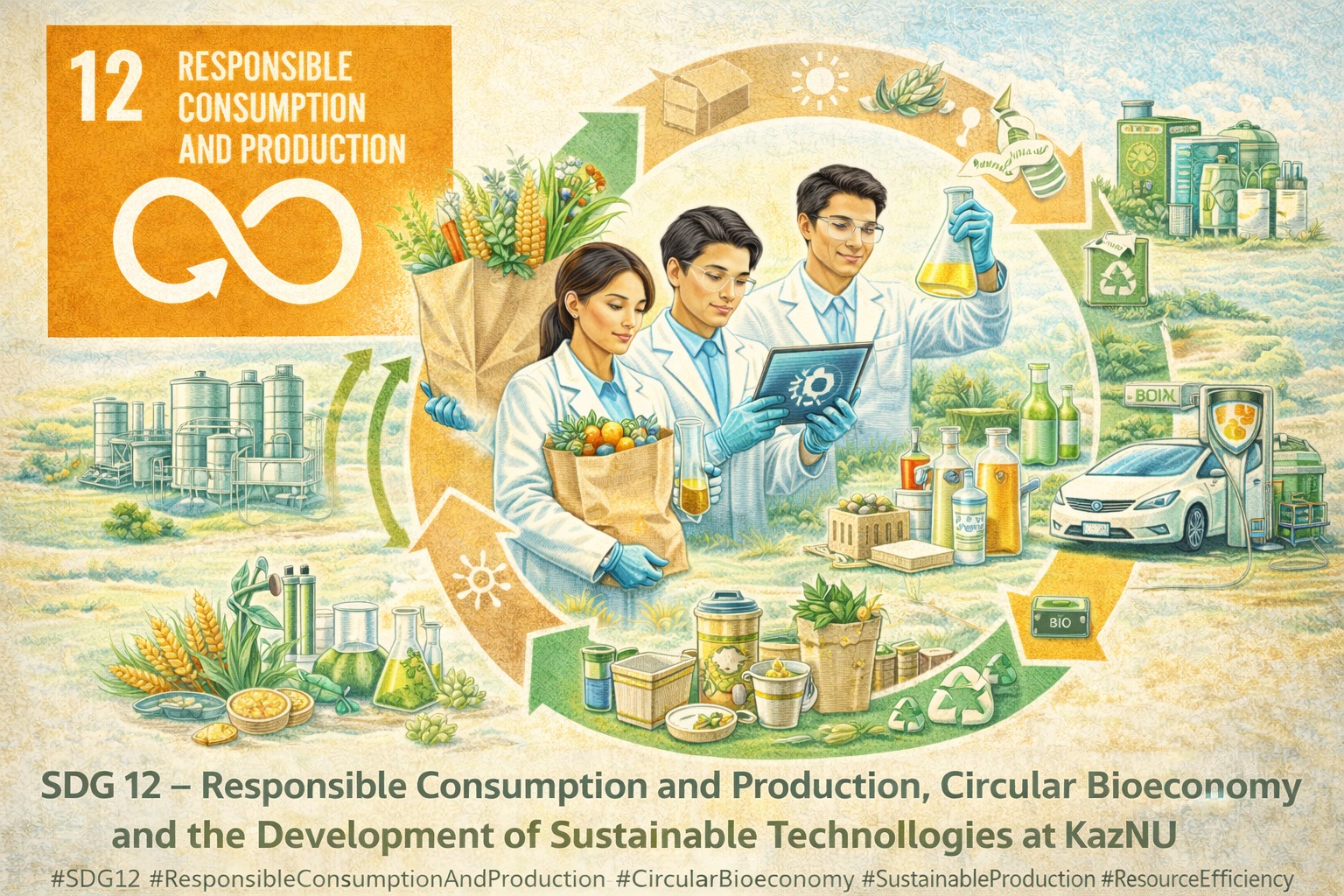
From a linear to a circular economy
The Faculty of Biology and Biotechnology at Al- Farabi KazNU implements cutting-edge research projects aimed at transforming production systems in line with the principles of Sustainable Development Goal 12—ensuring the transition to sustainable consumption and production patterns. Our research covers the entire resource cycle : from waste recycling to the creation of high-value-added products.
A revolution in organic waste disposal
Project AP14869934, "Development of a New Composite Compost Technology Using Cattle Manure and Low-Grade Coal for Sustainable Soil Fertility," led by Professor A.A. Zhubanova , demonstrates how agricultural waste can be transformed into a valuable resource. The technology addresses several issues simultaneously: recycling organic waste, improving soil fertility, and sequestering carbon. This is a prime example of a circular economy, where waste from one process becomes raw material for another.
Project AP14871683, "Biotechnology for Processing Keratin Byproducts Using Immobilized Thermophilic Bacteria," led by A.S. Kistaubaeva, opens up new possibilities for livestock and poultry farming. Feathers, wool, horns, and hooves—waste products that traditionally created environmental problems—can now be efficiently processed into valuable protein products, feed additives, and fertilizers.
Project AP23491702 "Development of decontamination technology The "biochar for sustainable conversion of biomass waste into value-added products" project aims to create closed-loop recycling cycles for organic waste. Biochar , purified from potential contaminants, can be safely used in agriculture, industry, and construction.
Biodegradable materials: an alternative to plastic
Project AP26103429 , "Biotechnological Method for Obtaining Biodegradable Functional Cellulose Film for Innovative Food Packaging" (2025-2027), led by senior lecturer D.Kh. Shokataeva , is a direct response to the global problem of plastic pollution. The biotechnologically developed packaging is completely biodegradable, leaving no toxic residues, while providing the necessary protection for food products.
Project AP26196959, "Biotechnology of Thermophilic Bacteria for the Biodegradation of Plastic Materials" (2025-2027), led by professor S.D. Zhantlesova , is working on a revolutionary solution to the problem of recycling existing plastic materials. This technology could be key to recycling millions of tons of plastic waste accumulated in the environment.
Environmentally friendly technologies
Targeted program project BR18574219, "Development of environmentally friendly technologies for producing innovative products from natural and man-made raw materials in Kazakhstan," combines efforts to create waste-free production and utilize secondary resources. Particular attention is paid to the recycling of man-made waste into valuable products.
Project AP26199543 " Bacterial Exopolysaccharides as the Basis of Biocomposite Materials: Characterization, Fermentation, Modifications, and Possibilities of Their Application in Biotechnology and Ecology" (2025-2027) under the direction of Professor T.D. Mukasheva develops biological materials that can replace synthetic polymers in medicine, the food industry, cosmetology, and other industries, ensuring complete biodegradability.
Functional products with added value
Project AP23487502, "Biotechnology for the Production of Synbiotic Functional Chocolate with Therapeutic and Prophylactic Effects," led by A.S. Kistaubaeva, demonstrates the principles of creating high-added-value products. A traditional product is enriched with beneficial microorganisms and biologically active substances, acquiring therapeutic and prophylactic properties.
Project AP19676645, "Biotechnology for the Production of Biologically Active Peptides from Whey Proteins in Mare's Milk," led by Associate Professor M.Kh. Narmuratova , PhD , demonstrates the potential for fully utilizing dairy raw materials. Dairy industry byproducts are transformed into products with high added value and improved functional properties.
Project AP26199175 "Study of stevia breeding lines for the creation of specialized drinks with improved functional properties" (2025-2027) under the direction of Professor S.Sh. Asrandina develops healthy alternatives to traditional sweeteners, offering consumers functional drinks with improved properties.
Responsible management of water resources
Project AP23488028, "Development of technology for obtaining and testing algal-bacterial biopreparations that ensure sustainability and increased productivity of agroecosystems ," promotes the efficient use of water resources in agriculture by improving the water-holding capacity of soils.
Project AP23485836 "Development of a technology for bioremediation of wastewater contaminated with petroleum products based on an algal-cyanobacterial consortium" develops methods for the purification and reuse of industrial water, reducing the burden on water resources.
Research AP23490113, "Developing a scientific and technical foundation for the design of a consortium of aquatic plants and microalgae effective for water phytoremediation ," is aimed at creating biological water purification systems for its reuse in industry and agriculture.
A systems approach to sustainable production
The scientific activities of the Faculty of Biology and Biotechnology of KazNU in the field of responsible consumption and production are characterized by their comprehensive nature:
- Closed loops : projects AP14869934, AP14871683, AP23491702 turn waste into resources
- Biodegradable alternatives : Projects AP26103429, AP26196959 replace synthetic materials
- Added value : projects AP23487502, AP19676645, AP26199175 create functional products
- Water conservation : projects AP23488028, AP23485836, AP23490113 provide treatment and reuse
- Environmental safety : BR18574219, AP26199543 develop waste-free technologies
Impact on the sustainable development of Kazakhstan
The projects being implemented have high potential for application in key sectors of the Kazakh economy: agriculture, food processing, waste management, and water supply. The developed technologies can be scaled up for implementation at enterprises, facilitating the country's transition to a sustainable, circular economy.
Conclusion: Biotechnology for a Circular Economy
The Faculty of Biology and Biotechnology at Al- Farabi KazNU actively contributes to the achievement of SDG 12 through the development of biotechnological solutions for responsible production and consumption. Our research demonstrates that the transition to a circular economy is not only possible but also economically beneficial, opening up new opportunities for innovation and sustainable growth.
Faculty of Biology and Biotechnology of al-Farabi Kazakh National University
Other news
6 january, 2026
6 january, 2026
5 january, 2026