- Main
- News
- “Natural Heritage as an Educational Resource for Sustainable Development”: The Second Day of the Ethnocultural Practice at KazNU
“Natural Heritage as an Educational Resource for Sustainable Development”: The Second Day of the Ethnocultural Practice at KazNU
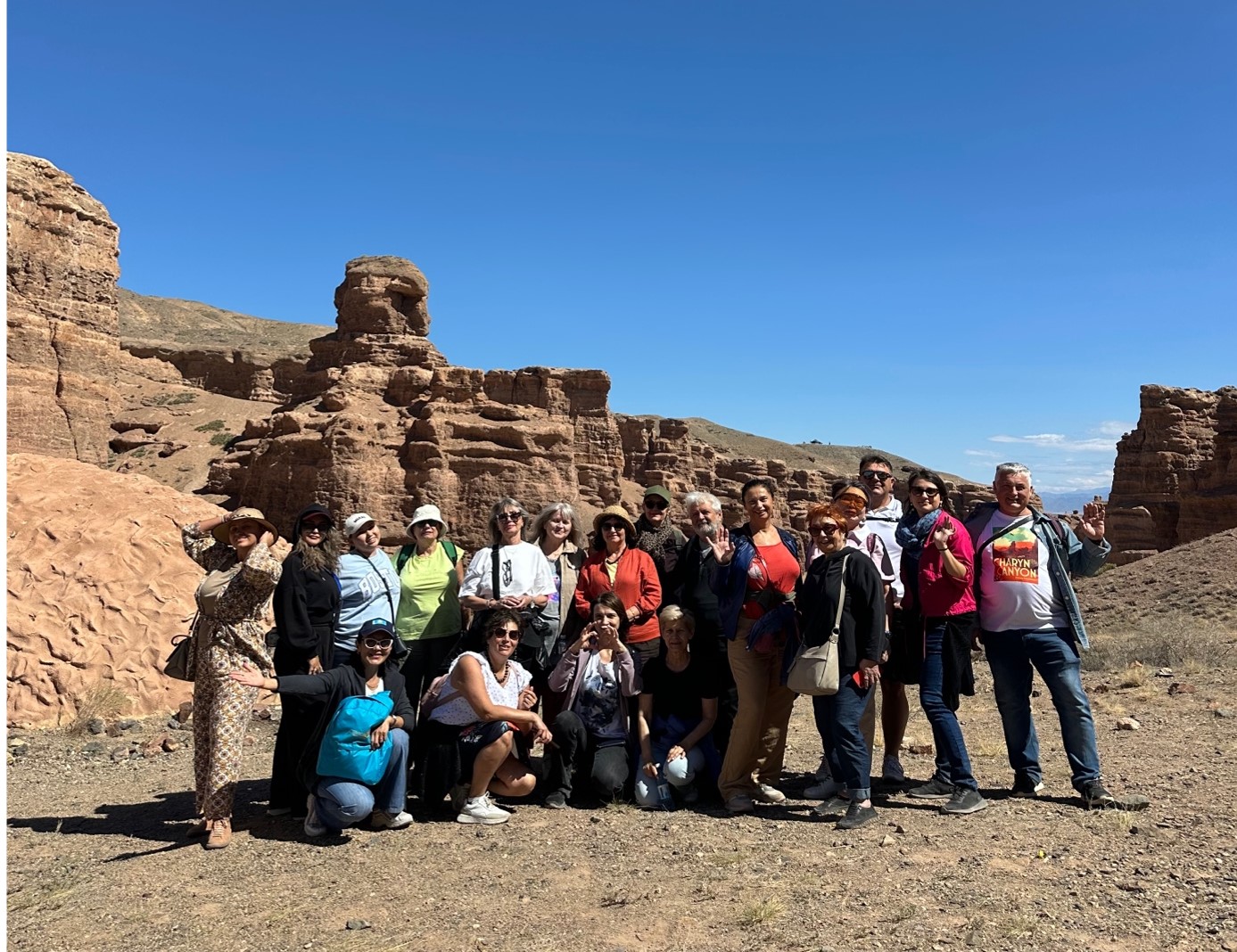
On 3 September 2025, as part of the ethnocultural practice developed by the Department of Religious Studies and Cultural Studies at the Faculty of Philosophy and Political Science, as well as the Department of General and Applied Psychology of Al-Farabi Kazakh National University, the second day of the ethnocultural practice entitled ‘Natural Heritage as an Educational Resource for Sustainable Development’ was held. Thirty guests from Bulgaria took part in the ethnocultural practice, including representatives of the Bulgarian Ministry of Education and Science, management, faculty and students of Sofia University St. Kliment Ohridski, teachers of Plovdiv State University of Psychiatry, representatives of the Academy of the Ministry of Internal Affairs of Bulgaria, as well as the organising committee of the ethnocultural practice of Al-Farabi KazNU: Meirbayev B.B., Zholdubayeva A.K., Kabakova M.P., Khassiyetova Zh.Zh., Alibaeva A.
This day of ethnocultural practice was devoted to the natural heritage of the Almaty region, which plays a crucial role in shaping the worldview of nomadic peoples. For traditional Kazakh culture, nature is not just a habitat, but a carrier of sacred meanings, a source of vitality and spiritual balance.
Visits to the Charyn Canyon, the Valley of Castles and the Charyn River allowed participants to see geological formations that took millions of years to form and to appreciate the depth of historical time. The Moon and Black Canyons demonstrated the diversity of Kazakhstan's natural landscapes, each of which has its own symbolism and energy.
Lake Kolsai was the highlight of the day — this place is traditionally associated with peace, contemplation and inner balance. For the participants, the trip was not only an excursion, but also a philosophical journey, helping them to reflect on the relationship between humans and nature in the context of sustainable development.
The educational programme for the day was structured around SDG 4, implementing sub-items aimed at teaching outside the classroom environment, forming ecological and cultural awareness, and developing critical thinking through direct interaction with the natural and cultural landscape.