- Main
- News
- Ethnocultural Practice within the Framework of the Sustainable Development Goals: Natural–Sacred Sites and the Contemporary Urban Space
Ethnocultural Practice within the Framework of the Sustainable Development Goals: Natural–Sacred Sites and the Contemporary Urban Space
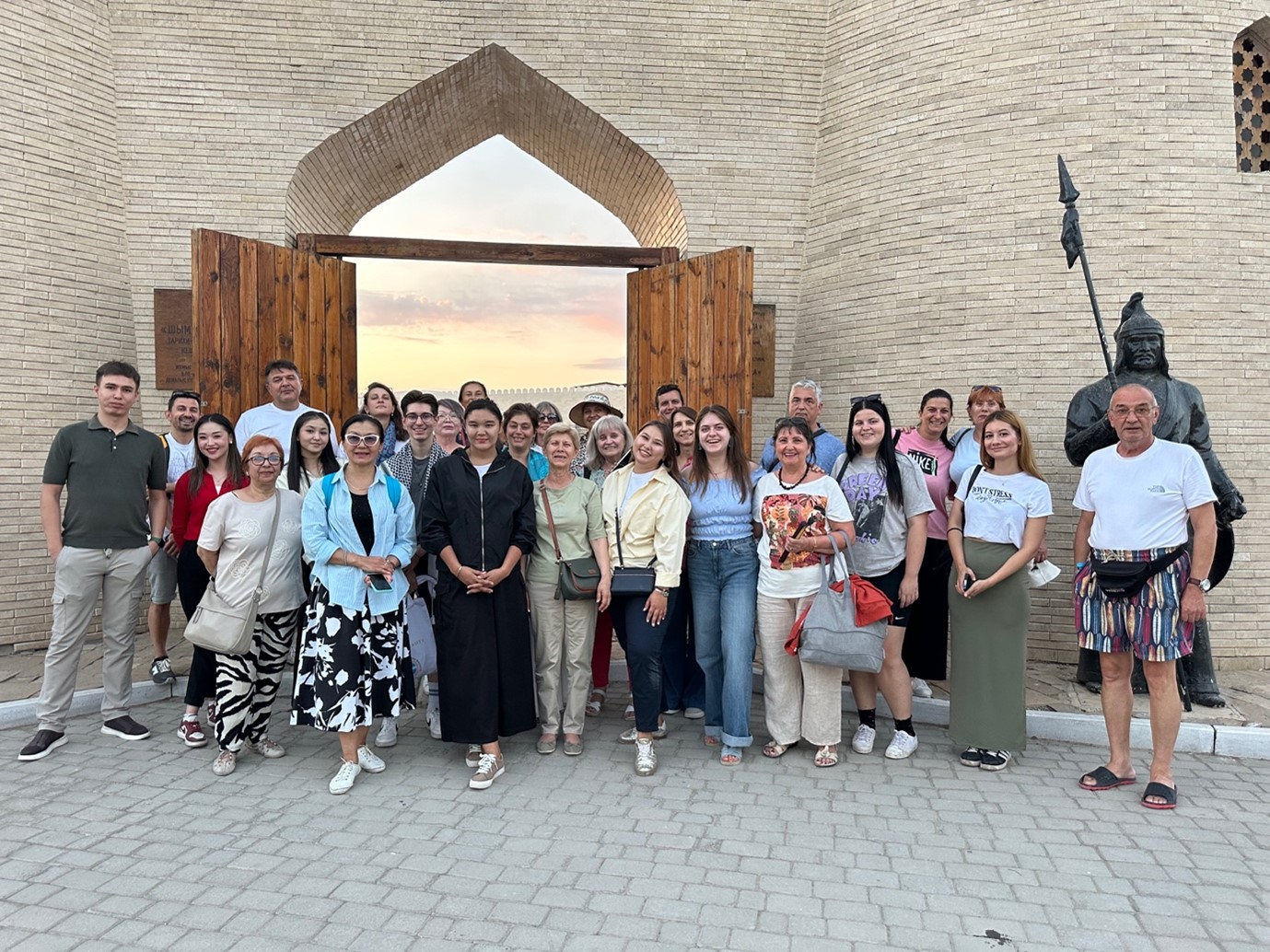
On 6 September 2025, as part of the ethnocultural practice developed by the Department of Religious Studies and Cultural Studies at the Faculty of Philosophy and Political Science, as well as the Department of General and Applied Psychology of Al-Farabi Kazakh National University, the fifth day of the ethnocultural practice entitled ‘Natural-sacred objects and modern urban space’ was held. More than 30 guests from Bulgaria took part in the ethnocultural practice, as well as the organising committee of the ethnocultural practice of Al-Farabi KazNU: Meirbayev B.B., Zholdubaeva A.K., Kabakova M.P., Khasietova Zh.Zh., Alibayeva A.
This day of ethnocultural practice was implemented within the framework of SDG 4 - ‘Quality Education’ and was devoted to studying the relationship between natural-sacred objects and modern urban space. The educational programme for the day combined a visit to the Akmeshit (Ak-Mechet) cave and the city of Shymkent, allowing participants to trace the transformation of traditional spiritual and cultural values in an urbanised society.
The day included excursions to key attractions in Shymkent, including the Ancient Citadel, Dendropark and Independence Park, as well as a bus tour of the city. The Ancient Citadel of Shymkent is one of the oldest historical sites in the region and an important symbol of urban culture in southern Kazakhstan. It reflects the centuries-old history of the settlement, which played a significant role in the Great Silk Road system, and bears witness to the processes of urban civilisation in the Kazakh steppes. For the Kazakh people, the citadel symbolises the continuity of historical memory, the stability of cultural traditions and the connection between nomadic and sedentary lifestyles.
The study of this sacred natural site, combined with an analysis of the city's historical and urban space, helped participants form a holistic view of the interaction between nature, spiritual practices and urban culture. This interdisciplinary approach was fully in line with the objectives of SDG 4, providing in-depth humanities education and developing value-oriented thinking.