Kazakhstan’s scientific ecosystem is confidently advancing to a new level
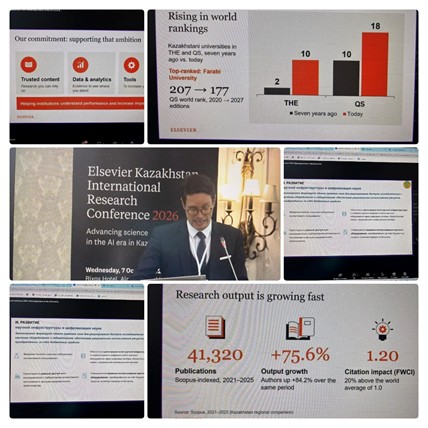
Kazakhstan’s scientific ecosystem is confidently advancing to a new level, where cutting-edge digital technologies are becoming the primary driver of research progress. Today, October 7, 2026 — within the framework of SDG 4 (Quality Education) and SDG 17 (Partnerships for the Goals) Faculty members of the Department of Mathematical Modeling of Mechanics, Faculty of Mechanics and Mathematics the honor of participating in a landmark conference dedicated to a strategic theme—"Advancing Science in the AI Era in Kazakhstan"—organized with the participation of the international scientific publisher Elsevier.
The event brought together key leaders from the country’s academic, scientific, and educational communities. Representatives from the Ministry of Science and Higher Education of the Republic of Kazakhstan and the National Academy of Sciences under the President of the Republic of Kazakhstan delivered welcoming remarks and keynote speeches. Speakers emphasized that integrating artificial intelligence into research processes is not merely a technological trend but a strategic priority for enhancing the competitiveness of domestic science on the global stage.
A session led by Elsevier experts generated particular interest; they demonstrated practical solutions combining big data and generative AI for Scopus and ScienceDirect analytics. Participants discussed in detail how modern machine learning algorithms optimize the process of scientific discovery, accelerate the processing of bibliometric data, and transform approaches to peer review. At the same time, academic integrity, methodological transparency, and the ethical standards governing the use of neural networks in scholarly publications remained central topics of discussion.
Representatives from the Ministry and the Academy of Sciences highlighted the importance of modernizing university research infrastructure and training personnel capable of working at the intersection of fundamental disciplines and data science. Such collaboration opens up immense opportunities for the country’s research universities, ranging from accurate trend forecasting to participation in large-scale international collaborations.
The event clearly demonstrated that the synergy between the state, the academic community, and global technology giants is creating a robust platform for the digital transformation of science in Kazakhstan. We would like to thank the organizers and speakers for a constructive dialogue, deep expertise, and inspiring insights.
Head of the MKM Department
Saule Dzhumakanovna Mausumbekova
Other news