- Main
- News
- Visiting Professor of the Department of the Far East Presented Research on “Chingiz-name” at an International Conference
Visiting Professor of the Department of the Far East Presented Research on “Chingiz-name” at an International Conference
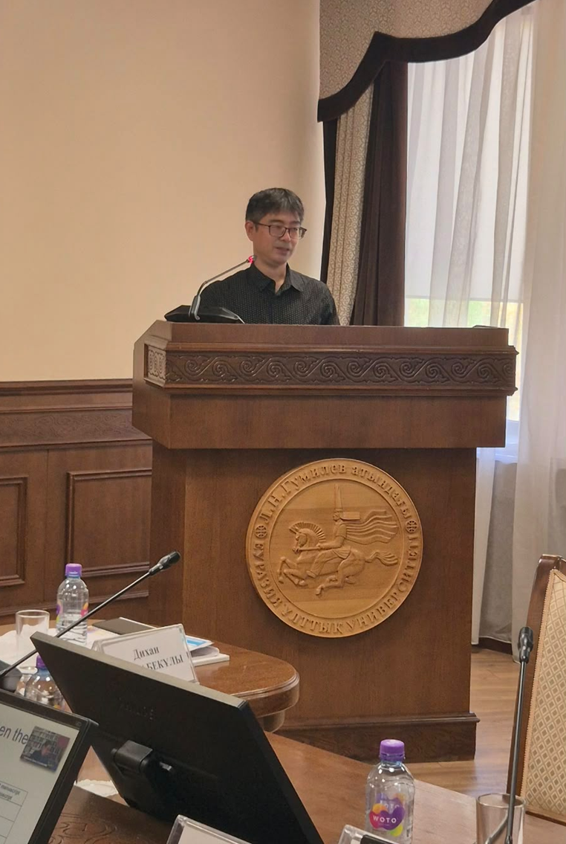
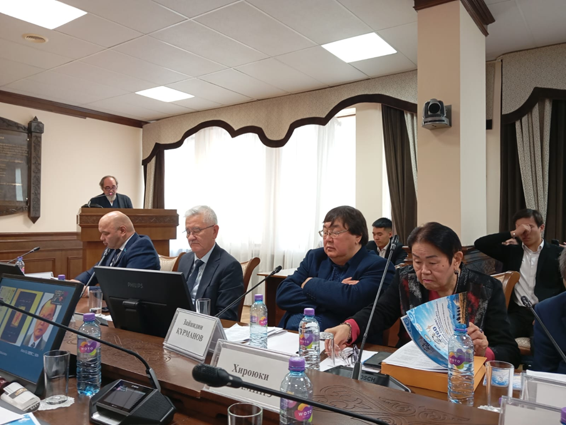
On October 8, 2026, Takashi Ninomiya, a visiting professor affiliated with the Faculty of Oriental Studies at Al-Farabi Kazakh National University (KazNU), participated in the international scientific and practical conference entitled “ALASH ORDA: THE REVIVAL OF THE UNIFIED TURKIC WORLD AND THE EXPERIENCE OF THE JÖCHI ULUS,” held at L. N. Gumilyov Eurasian National University in Astana, Kazakhstan.
The conference brought together researchers from various countries, including Japan, Türkiye, Kyrgyzstan, and Mongolia, to exchange academic perspectives and discuss historical and cultural issues related to Alash Orda, the Jöchi Ulus, and the broader Turkic world. The presentations addressed a range of topics concerning the historical experience, cultural heritage, and scholarly interpretation of these subjects, providing an opportunity for international academic exchange and cooperation.
At the conference, Professor Takashi Ninomiya presented a paper entitled “Morphological and Lexical Features of Chaghatay in the Two Manuscripts of the Chingiz-nama.” His presentation focused on a comparative linguistic analysis of the two known manuscripts of the Chingiz-nama: the Istanbul manuscript and the Tashkent manuscript.
The Chingiz-nama is an important historical text written in Chaghatay Turkic and associated with the historical heritage of the Jöchi Ulus. The existence of two manuscript versions provides valuable material for examining linguistic variation and the transmission of historical texts. By comparing corresponding passages in the Istanbul and Tashkent manuscripts, Ninomiya investigated differences in their morphological forms and lexical choices.
The morphological analysis examined differences in the use of grammatical markers, including plural markers and case markers. The lexical analysis focused on differences in vocabulary between the manuscripts, including correspondences involving Turkic words and Persian-derived vocabulary. Through this comparative approach, the study explored the similarities and differences between the two manuscript versions and considered what these variations reveal about the linguistic characteristics of the text.
The presentation highlighted the importance of examining multiple manuscript witnesses when studying the historical development of Chaghatay Turkic. A systematic comparison of linguistic features can contribute to a more detailed understanding of the language of the Chingiz-nama and provide a basis for further research into the linguistic and textual heritage of the Jöchi Ulus.
Ninomiya’s participation in the conference also contributed to academic exchange between Japanese and Central Asian researchers. The conference provided an opportunity to introduce ongoing research on Chaghatay manuscripts to an international audience and to share perspectives on the historical and linguistic heritage of the Turkic world.
The study represents part of continuing efforts to investigate historical Turkic texts through comparative linguistic analysis and to deepen scholarly understanding of the written heritage associated with the Jöchi Ulus.