Еvent entitled “The Cost of an Error: What Happens When an Accountant Makes a Mistake?”
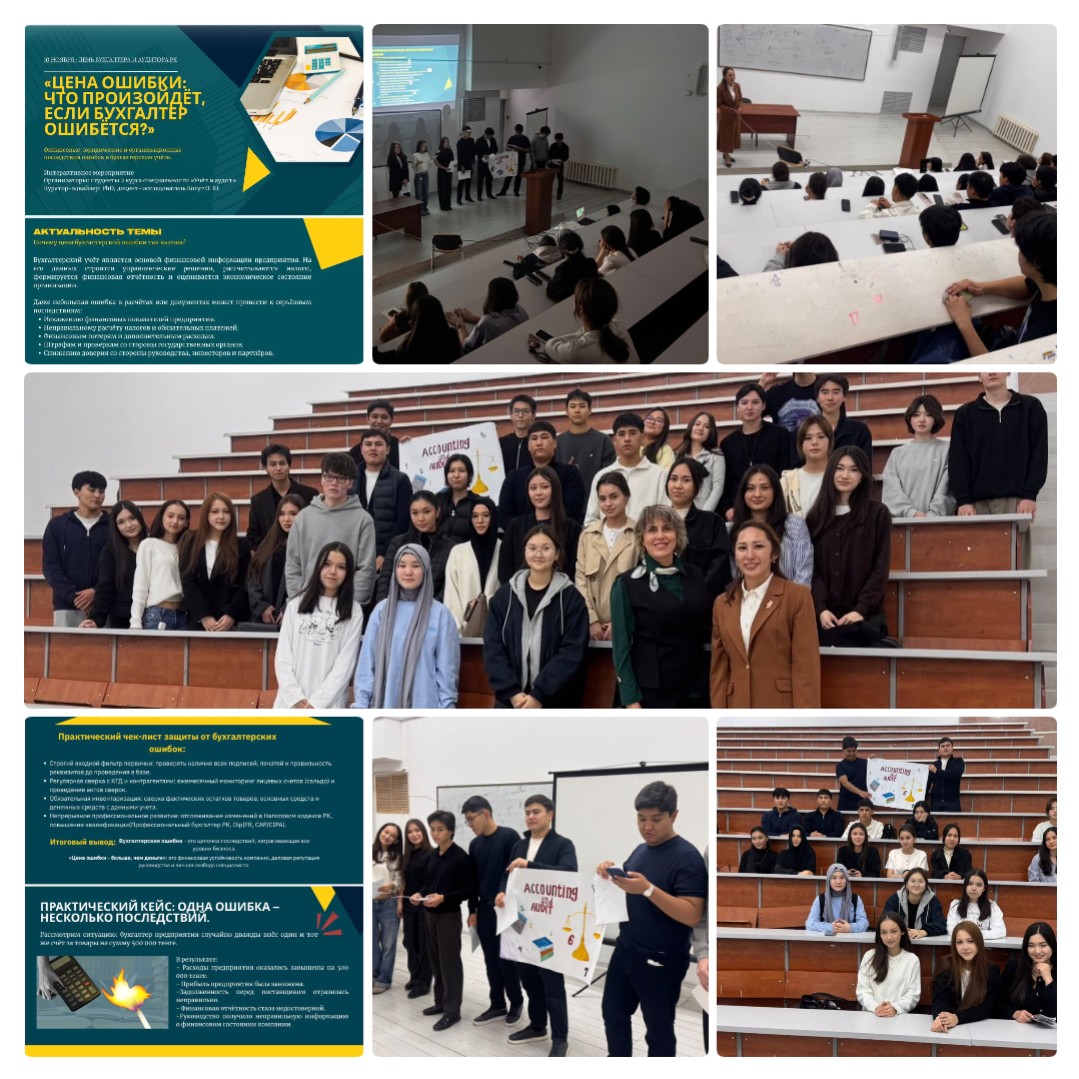
On 10 November 2026, the Day of Accountants and Auditors of the Republic of Kazakhstan, an interactive event entitled “The Cost of an Error: What Happens When an Accountant Makes a Mistake?” was held. The event focused on one of the most relevant issues in professional practice: the financial, legal, and organizational consequences of accounting errors.
The event was organized by second-year students of the Accounting and Audit educational programme under the guidance of their academic adviser and curator, PhD, Associate Professor-Researcher O.Yu. Kogut.
The event was attended by second-year students of the Finance and Economics educational programmes.
The opening remarks were delivered by M.Zh. Daribayeva (PhD, Assistant Professor, Head of the Department of Finance and Accounting) and G.K. Nurgaliyeva (Professor).
The event was organised in support of the United Nations Sustainable Development Goals (SDGs): SDG 4 – Quality Education (the primary goal), SDG 8 – Decent Work and Economic Growth, and SDG 16 – Peace, Justice and Strong Institutions.
The programme included an informative presentation, an interactive Kahoot quiz, a themed crossword puzzle, and the distribution of informational brochures. Participants had the opportunity to test their knowledge, complete subject-related tasks, and discuss the practical significance of accounting and auditing.
The main objective of the event was to demonstrate the importance of accuracy, professional competence, and responsibility in an accountant’s work, as well as to highlight the consequences that even a minor inaccuracy in accounting data can cause.
During the event, students examined the main types and causes of accounting errors, including human factors, insufficient professional knowledge, technical failures, and weaknesses in internal control procedures. Attention was paid to the “domino effect”: a single error in a source document or accounting entry can trigger a chain of consequences, ranging from misstatements in financial statements and incorrect tax calculations to financial losses and damage to an organization’s business reputation.
Using practical examples, participants analyzed errors in payroll calculations, inventory accounting, tax calculations, and the preparation of financial statements. The legal framework governing accounting in Kazakhstan, the types of professional liability and the mechanisms of internal and external control were also discussed.
A practical case study attracted particular interest. It involved an accountant recording the same KZT 500,000 invoice twice. Students traced how a single technical error could result in overstated expenses, understated profit, a misstatement of accounts payable to the supplier, and the provision of inaccurate financial information to management.
The final part of the event focused on modern approaches to error prevention, including the automation of accounting processes, electronic document management, regular reconciliations, inventory checks, and continuous professional development.
The event enabled students to recognize that the accounting profession extends far beyond processing figures and preparing documents. Every business transaction involves an organization’s financial interests, employee well-being, and the trust of its business partners.
The key takeaway from the event was that the cost of an accounting error goes beyond money. It affects an organization’s financial stability, business reputation, and the trust placed in its specialists' professional competence.
Events like this contribute to the development of professional thinking among future accountants and auditors, strengthen their practical skills, and foster an understanding of the broader social significance of their chosen profession.
Other news