«ӘЛ-ФАРАБИ ТРАКТАТЫ: ҒЫЛЫМ, БІЛІМ ЖӘНЕ ФИЛОСОФИЯ» ТАҚЫРЫБЫ БОЙЫНША ОҚЫТУ

Date of the event: November 16, 2026
Time : 14:00
Venue : Audience 402
Group: 456 RET (Russian branch)
Curator: Turlykozhaeva D.A.
The purpose of the event
To introduce students to the scientific and philosophical legacy of the great thinker Abu Nasr al-Farabi, to examine the main ideas of his treatises, and to demonstrate their significance for modern education, science, and personal development.
Progress of the event
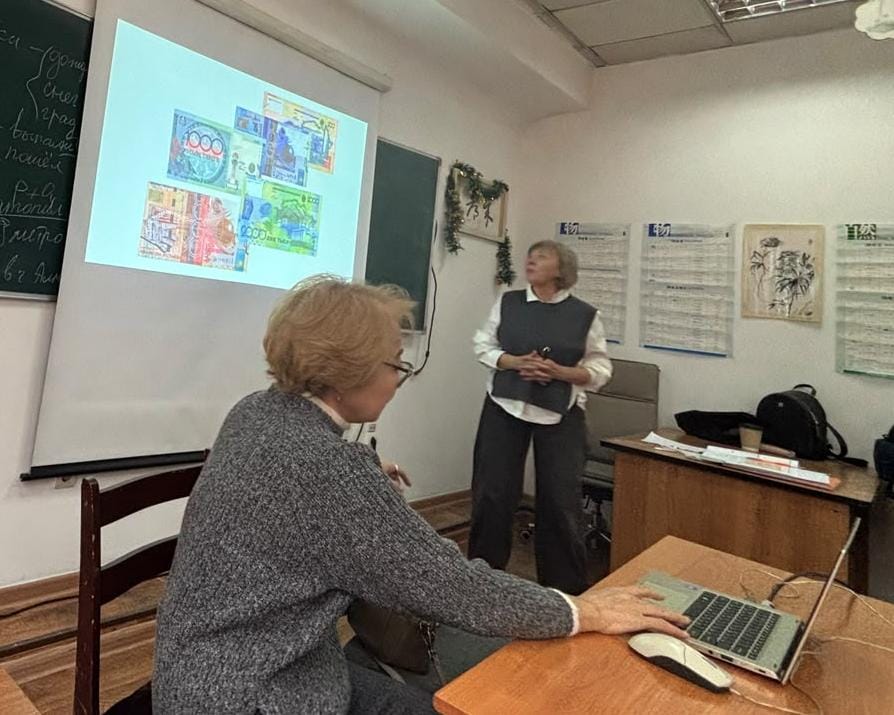
As part of the curatorial hour, a thematic training session was held dedicated to the life, scientific work, and philosophical legacy of Abu Nasr al-Farabi.
During the event, students learned about the thinker's main areas of scientific research, his contributions to the development of philosophy, logic, mathematics, music, and the natural sciences.
Particular attention was paid to the following works:
"A Treatise on the Views of the Inhabitants of a Virtuous City" examines Al-Farabi's ideas about an ideal society, justice, morality, and the role of knowledge in governing the state.
"Classification of Sciences" discusses the scientist's approaches to systematizing scientific knowledge and the interrelationships between various fields of science.
"The Great Book of Music" examines Al-Farabi's contribution to the development of musical theory and the study of sound patterns.
"On Achieving Happiness" - ideas about the role of education, upbringing, morality and intellectual development of a person are discussed.
During the interactive portion of the training, students discussed the relevance of Al-Farabi's ideas in the modern world, analyzed the importance of science and education in society, expressed their own opinions, and shared their thoughts on what constitutes an educated and morally developed person.
Key findings and results
Following the training, the students came to the following conclusions:
Knowledge and education are the most important conditions for the development of the individual and society.
Scientific disciplines are interconnected, and the development of science requires a comprehensive and systematic approach.
Morality, responsibility and the pursuit of knowledge must be combined in the formation of a modern specialist.
Al-Farabi's ideas about an ideal society, justice and enlightenment remain relevant today.
The scientific legacy of the great thinker is an important part of world intellectual culture.
Conclusion
The training helped expand students' horizons, increase their interest in the history of science and philosophy, and foster a respectful attitude toward national and global scientific heritage.
The students noted that Al-Farabi's ideas are not limited to the historical period of his life, but can serve as a guide for the modern generation in matters of education, scientific research, moral development, and professional development.
Other news