In the context of rapid digital transformation, education ceases to be exclusively the transfer of knowledge — it becomes a space for developing 21st-century skills. One of the key factors of this transition is artificial intelligence (AI), which today plays an important role in teaching foreign languages, particularly English.
The use of AI tools in teaching English is no longer an experiment, but an objective necessity dictated by the demands of the time. Educational programs oriented toward practice-based and personalized learning increasingly include AI as a mandatory component of the educational process.
AI allows to:
• personalize learning taking into account the level, pace, and goals of each student;
• develop all types of speech activity (speaking, listening, reading, writing);
• simulate real communicative situations;
• provide instant feedback and progress analytics;
• increase learners’ motivation through interactivity and engagement.
Thus, AI becomes an intellectual assistant to the teacher, enhancing rather than replacing their professional role.
In language education, AI tools open fundamentally new opportunities:
• Development of communicative competence: chatbots and dialogue simulators allow students to practice live speech in a safe environment without fear of mistakes.
• Academic writing: AI helps analyze text structure, vocabulary, and style, forming skills of argumentation and critical thinking.
• Pronunciation and listening: intelligent speech recognition systems provide targeted feedback on phonetics.
• Learner autonomy: students learn to independently plan their learning, analyze mistakes, and adjust strategies.
It is important to emphasize that effective use of AI requires methodologically грамотная integration into the curriculum, rather than the spontaneous use of individual digital tools.
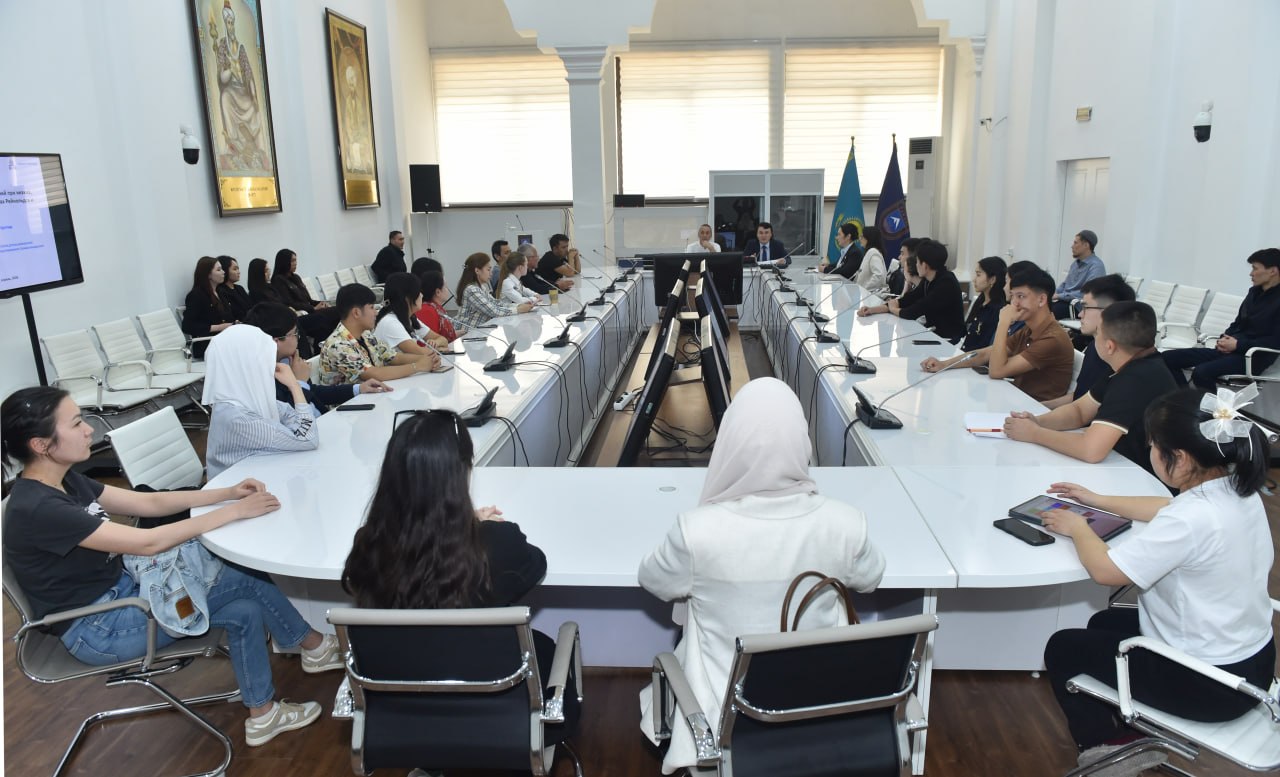
Recognizing the relevance of digital transformations, teachers of the Department of Foreign Languages under SRO and SROP purposefully integrate elements of artificial intelligence into the content of academic disciplines. Within the framework of classes, students not only use AI tools to develop language skills, but also reflect on their role in education and future professional activity.
The educational process includes relevant and socially significant topics such as:
• “How can AI help students in learning?”;
• “Application of AI in my professional field”;
• the role of AI in the development of academic and professional communication;
• ethical aspects of the use of artificial intelligence in education.
Work on such topics contributes to the development of critical thinking, digital literacy, and the ability to express one’s position in a reasoned manner in English. Artificial intelligence in teaching English is an important resource for improving the quality of education and training competitive specialists. The experience of teachers of the Department of Foreign Languages of Al-Farabi Kazakh National University under SRO and SROP demonstrates that the systematic and conscious implementation of AI in the educational process meets the demands of the time and the strategic goals of the university.
The актуализация of the topic of artificial intelligence in educational programs contributes to the formation of a generation of graduates ready for professional activity in the conditions of the digital economy and the global academic space.