KazNU Faculty of Physics and Technology Showcases Research at Qazaqstan AI for Science
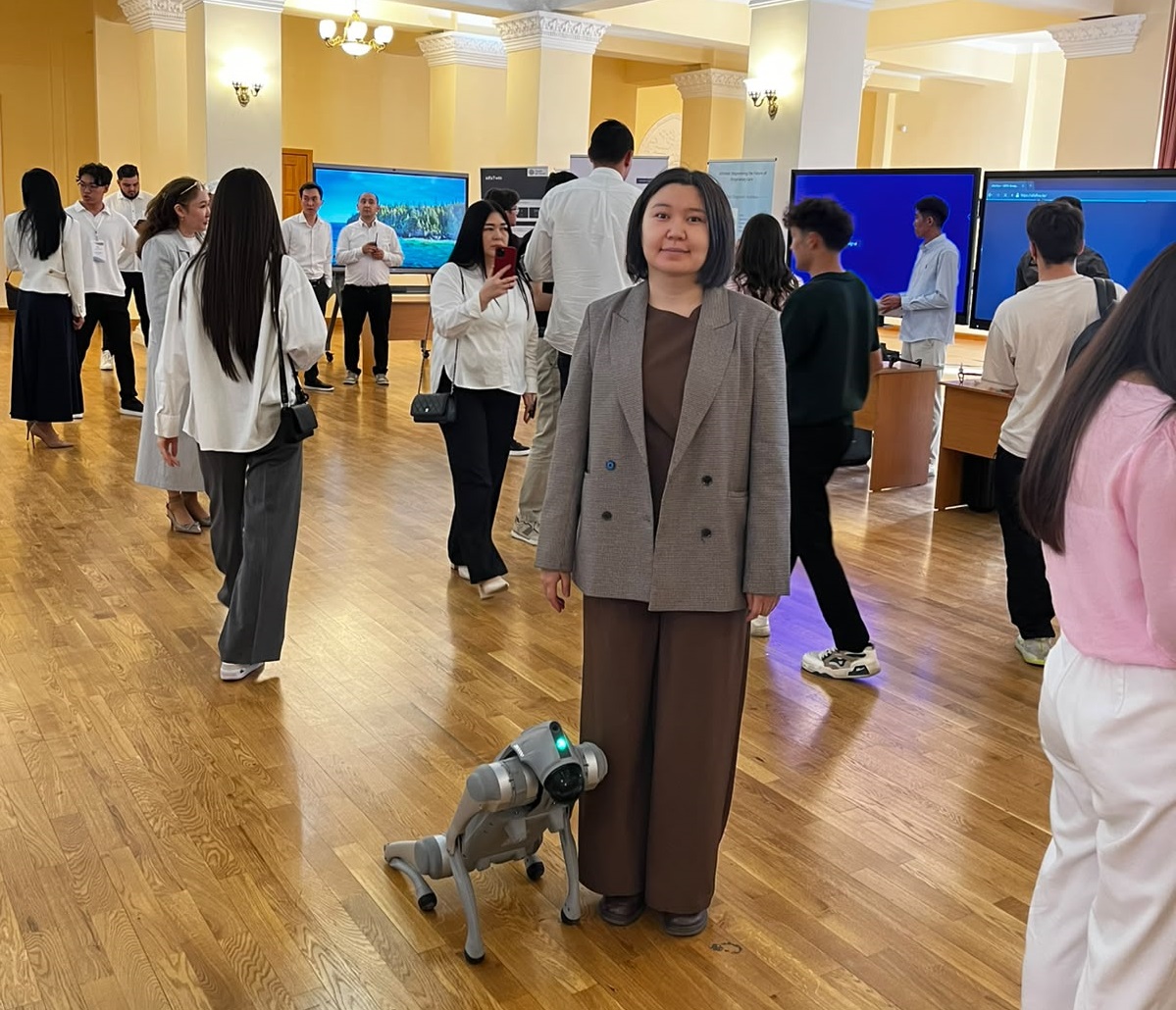
On 17 September 2026, the National Academy of Sciences of the Republic of Kazakhstan under the President of the Republic of Kazakhstan hosted the first open strategic session of Qazaqstan AI for Science, dedicated to advancing and integrating artificial intelligence technologies into scientific research. As part of the event, an exhibition of Kazakhstan’s scientific developments and innovative technologies was held at the Gylym Ordasy scientific and cultural centre in Almaty.
Representatives of the Faculty of Physics and Technology at Al-Farabi Kazakh National University (KazNU) participated in the exhibition, showcasing advanced engineering solutions in unmanned technologies, electronics, and artificial intelligence.
Among the developments presented was the research of Dana Turlykozhaeva, PhD, a researcher at the Faculty of Physics and Technology, KazNU. Her work focuses on developing intelligent systems for infrastructure monitoring using unmanned aerial vehicles (UAVs), FPGA/SoC hardware platforms, and deep and convolutional neural networks.
The proposed approach combines unmanned systems, high-performance data processing, and artificial intelligence methods to automate the monitoring and assessment of infrastructure assets. The use of these technologies can improve the speed and efficiency of surveillance and large-scale data processing while enabling the automated identification of potentially problematic areas.
The Qazaqstan AI for Science exhibition featured robots, unmanned aerial vehicles, digital applications, technology projects, and other innovations developed by researchers from across Kazakhstan. The exhibition demonstrated a broad range of contemporary solutions at the intersection of science, electronics, programming, automation, robotics, and artificial intelligence.
Particular attention was given to the potential of artificial intelligence as a tool for scientific research. The Qazaqstan AI for Science initiative aims to foster a modern science and technology ecosystem and promote the use of AI tools throughout the research cycle — from scientific data analysis and hypothesis generation to experimentation, interpretation of results, and their subsequent practical application.
For the Faculty of Physics and Technology at KazNU, advancing interdisciplinary research at the intersection of physics, electronics, telecommunications, unmanned technologies, and artificial intelligence represents a promising area of research and innovation. Participation in events of this kind provides an opportunity to showcase the Faculty’s research achievements to a broader professional audience, strengthen collaboration with research institutions and technology partners, and create new opportunities for joint interdisciplinary projects.
The presentation of the Faculty of Physics and Technology’s research at Qazaqstan AI for Science also contributes to the United Nations Sustainable Development Goals (SDGs). In particular, research in intelligent systems, artificial intelligence, and advanced engineering technologies supports SDG 9 – Industry, Innovation and Infrastructure, which promotes resilient infrastructure, scientific research, and technological innovation. Strengthening cooperation among universities, research institutions, and the technology sector also contributes to SDG 17 – Partnerships for the Goals.
The participation of researchers from the KazNU Faculty of Physics and Technology in Qazaqstan AI for Science contributes to the advancement of Kazakhstan’s scientific and technological developments, strengthens links between science and technology, and demonstrates the potential of university research to address current real-world challenges.
Other news