- Main
- News
- Dean of the KazNU Faculty of Physics and Technology Delivers a Talk in the International Advanced General Relativity Series
Dean of the KazNU Faculty of Physics and Technology Delivers a Talk in the International Advanced General Relativity Series
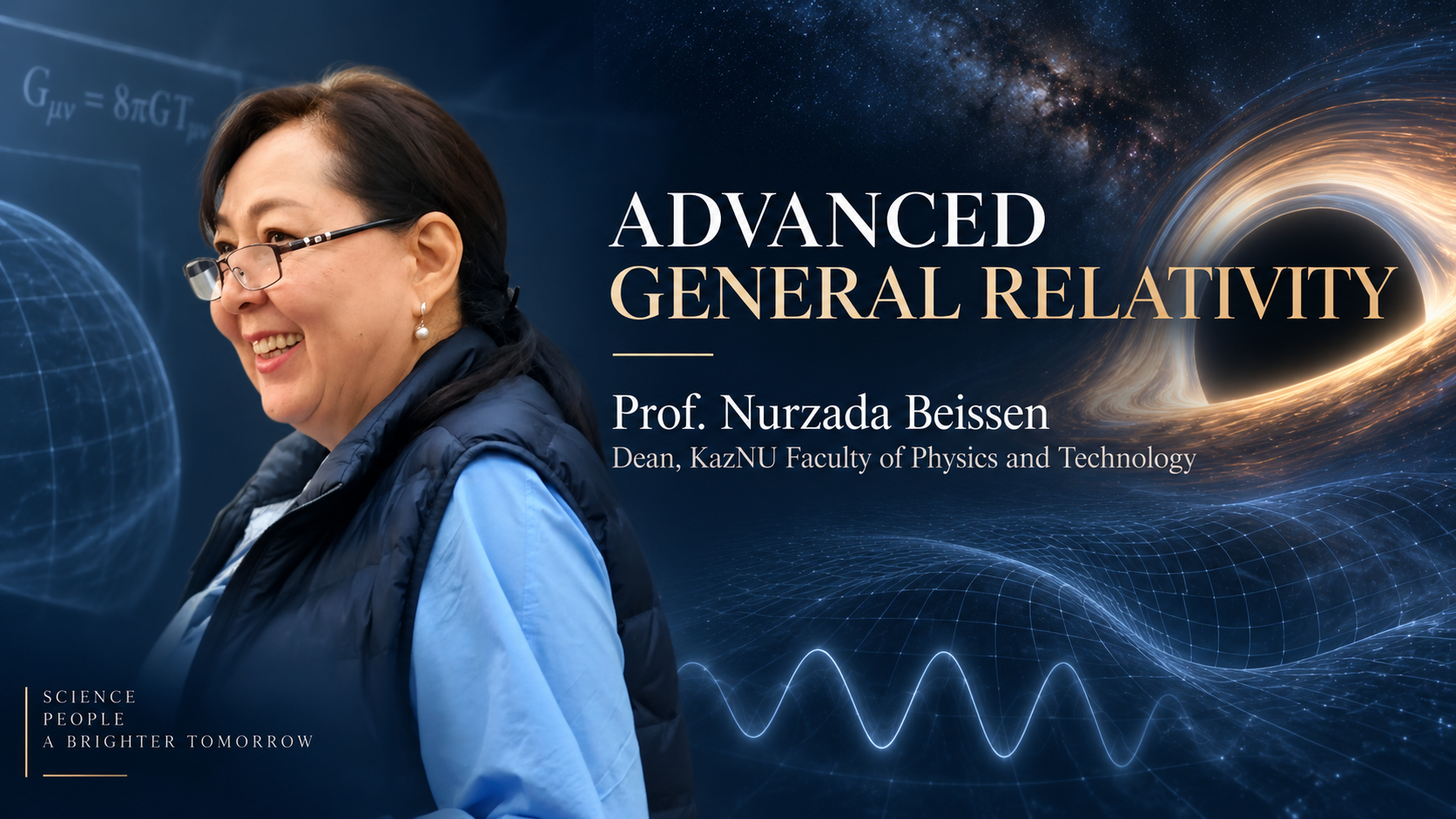
On 17 September 2026, Professor Nurzada Beissen, Dean of the Faculty of Physics and Technology at Al-Farabi Kazakh National University (KazNU), delivered an invited talk as part of the international Advanced General Relativity scientific series, which brings together researchers and experts in general relativity, gravitation, and astrophysics.
The international series is organised with the participation of the South African National Institute for Theoretical and Computational Sciences (NITheCS) and focuses on contemporary research into the geometry of spacetime and fundamental problems in gravitation. According to the programme, Professor Beissen's talk took place on 17 September, where she was introduced as Dean of the Faculty of Physics and Technology at Al-Farabi KazNU.
The lecture series has a broad international reach, bringing together representatives of universities and research institutions from South Africa, Kazakhstan, China, and Sweden. Confirmed speakers include researchers from the University of KwaZulu-Natal, Rhodes University, Stellenbosch University, Yangzhou University, and Luleå University of Technology.
Professor Beissen's participation in the international scientific series is closely aligned with her long-standing research in general relativity and relativistic astrophysics. Her research interests include the stability of motion in general relativistic mechanics, relativistic planetary cosmogony, the generation of magnetic fields in relativistic compact objects, analytical methods in relativistic celestial mechanics, relativistic N-body modelling, and investigations into the internal structure and dynamics of relativistic compact objects.
The international nature of the series provides an important platform for academic exchange among researchers representing different scientific schools and traditions. The programme features specialists in mathematical and theoretical physics, general relativity, gravitation, and astrophysics. Among the participating scholars is Professor Sudan Hansraj of the University of KwaZulu-Natal, whose research focuses on extensions and modifications of general relativity, particularly in relation to stellar structure. He also serves as President of the South African Gravity Society.
The participation of the Dean of the KazNU Faculty of Physics and Technology in this international scientific series contributes to strengthening the University's academic ties with international research institutions, expanding professional collaboration in fundamental physics, and creating new opportunities for joint research, scientific publications, and the training and mentorship of early-career researchers.
The event also contributes to the United Nations Sustainable Development Goals (SDGs). International scientific exchange and the advancement of fundamental research support SDG 4 – Quality Education by facilitating the integration of cutting-edge scientific knowledge into the academic environment and contributing to the development of the next generation of researchers. Strengthening research capacity and international scientific collaboration is also aligned with SDG 9 – Industry, Innovation and Infrastructure, particularly its emphasis on supporting scientific research and fostering innovation.
The international composition of the series is particularly relevant to SDG 17 – Partnerships for the Goals. KazNU's engagement with researchers and scientific institutions from different countries helps expand international research networks, facilitate the exchange of expertise, and strengthen long-term academic partnerships.
Professor Nurzada Beissen's contribution to the Advanced General Relativity series highlights the active engagement of researchers from the KazNU Faculty of Physics and Technology in the international scientific community and supports the further advancement and international visibility of the University's research in fundamental and theoretical physics.
Other news