- Main
- News
- A Step Toward a Clean Future: KazNU Faculty of Physics and Technology Hosts Meeting with "Recycle Birge" Activists
A Step Toward a Clean Future: KazNU Faculty of Physics and Technology Hosts Meeting with "Recycle Birge" Activists
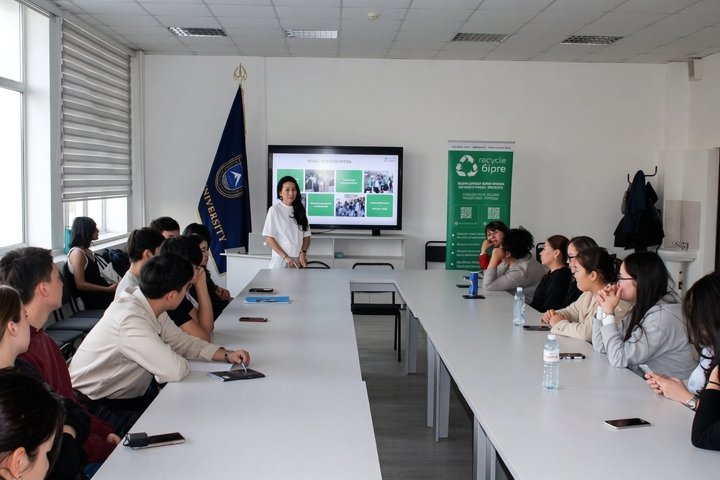
Today, the Faculty of Physics and Technology at Al-Farabi Kazakh National University hosted a meaningful, deep, and inspiring meeting with representatives of the well-known public movement "Recycle Birge," which makes a substantial practical contribution to building ecological awareness, environmental stewardship, and sustainable consumption in our country. Faculty leadership, academic staff, young researchers, and students attended this vibrant event, warmly welcoming the founder of the movement, Banu-Akkumis Kuspanova, and core activist Kamila Akimbekova.
This important event organically aligns with the large-scale national environmental initiative "Taza Kazakhstan," which calls on every conscious citizen to actively care for the cleanliness of their homeland, preserve natural resources, and develop a high culture of order at all levels of modern society. Speaking to an engaged student audience, the guests openly and engagingly shared the origins of their public movement, the challenges they faced in the beginning, and how a modest volunteer idea eventually evolved into a powerful eco-community changing the daily habits of thousands of Kazakhstanis.
Special attention during the fruitful discussion was paid to the practical implementation of the United Nations Sustainable Development Goals in everyday life and the academic environment. It was discussed how the movement's activities directly relate to SDG 12 ("Responsible Consumption and Production"), aimed at actively introducing principles of the circular economy, reusing resources, and significantly reducing waste volumes. Furthermore, issues related to SDG 13 ("Climate Action") and SDG 15 ("Life on Land") were raised. It was emphasized that modern students, future engineers, physicists, and researchers must possess not only fundamental professional and technical knowledge but also a deep understanding of the global environmental agenda to successfully tackle contemporary technological and climatic challenges.
Students of the faculty showed a genuine and high interest in proper waste sorting, the introduction of eco-standards, and real participation in university volunteer projects. The meeting was held in an open and interactive dialogue format, allowing young researchers to ask various questions about effective recycling methods and ways to reduce their personal carbon footprint. Faculty leadership expressed absolute confidence that such educational initiatives play a key role in fostering a new generation of high-level professionals capable of combining deep engineering competencies with high civil and environmental responsibility. At the end of the event, the sides thanked each other for the productive communication and agreed on further close cooperation in implementing joint environmental projects and educational actions at the university.
Other news